Lime, Mortar, Cement, and Concrete
Difficulty: hard. Kiln operation, caustic lime, dust, material qualification, curing, and structural use each need specialist controls. Prerequisites: fire and heat (a kiln that holds ~900–1000°C for many hours), basic chemicals (quicklime), characterized raw materials, protected mixing/grinding, and competent material and structural design for anything load-bearing.
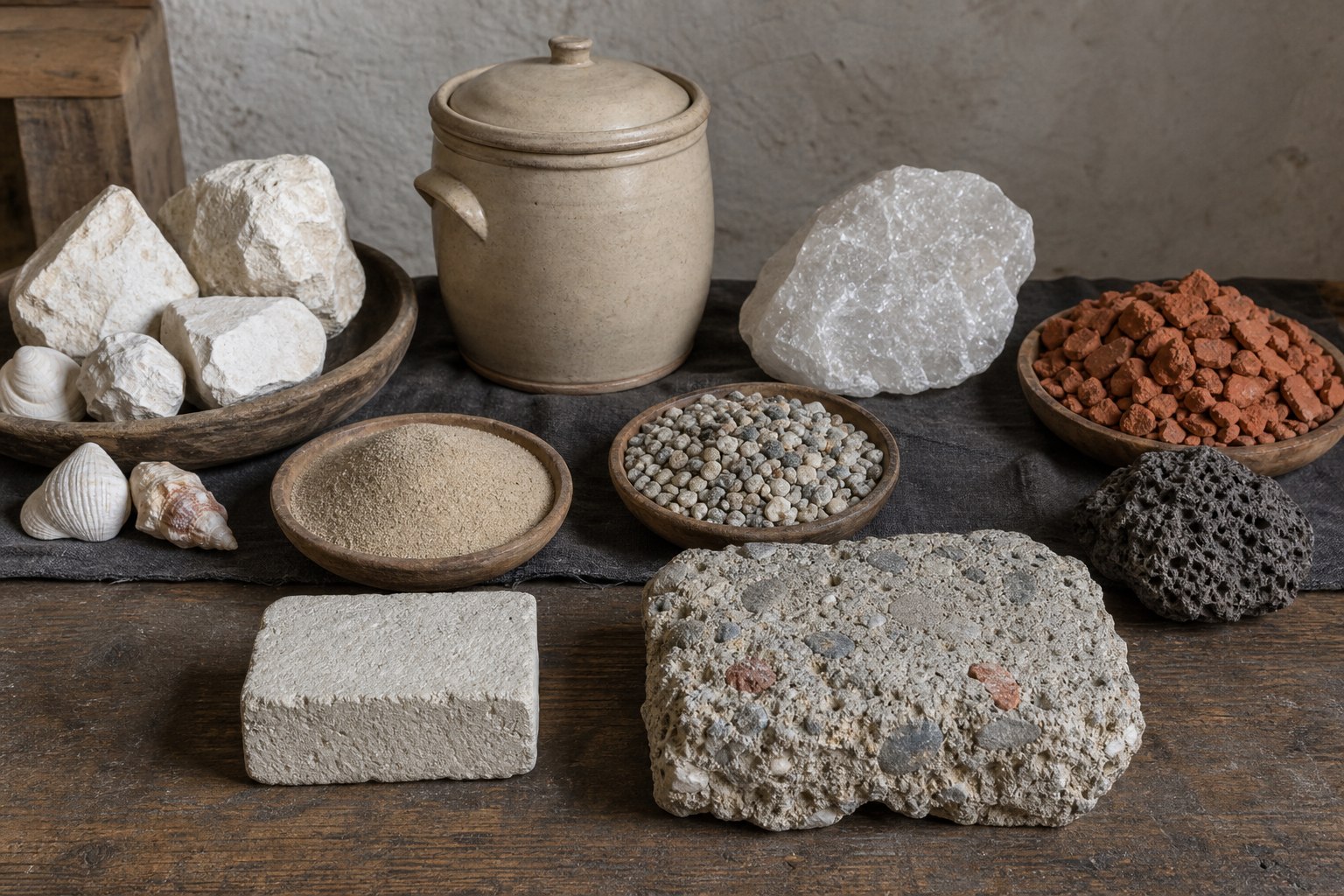
AI-generated visual reference: binder and aggregate candidates → contained lime putty → cured mortar and pozzolanic concrete samples. It is not a historical photograph, material-identification test, mix design, or structural standard.
Why it matters
Binders are how you build things bigger than a person can lift. Mortar turns a pile of stones into a wall, an arch, an aqueduct, a harbor. Concrete lets you cast structures in any shape without skilled stonemasons. Plaster gives you weatherproof, washable, bright interiors — a genuine public-health improvement over mud and thatch.
Lime is also needed for glass, sugar, paper, tanning, soap, and treating maize. If you make it for building, you get all of those for free.
Four binders, easiest to hardest
| Binder | Fire needed | Sets by | Water resistant? |
|---|---|---|---|
| Gypsum plaster | ~150°C | Rehydration, minutes | No |
| Lime mortar | ~900°C | Absorbing CO₂ from air, months | No (until pozzolan added) |
| Pozzolanic / hydraulic | ~900°C + tested additive | Hydraulic reactions | Some tested formulations can set in wet or underwater exposure |
| Portland cement | ~1450°C | Hydration, days | Yes |
Portland cement needs about 1450°C and tightly controlled raw materials and grinding — genuinely industrial. For a small pre-industrial operation, lime and tested lime-pozzolan binders are more realistic. They are not simply weaker Portland cement: strength, curing, permeability, and durability differ by formulation and exposure. Some surviving Roman marine mixes are exceptionally durable, but they do not establish a universal comparison with modern concrete.
Gypsum plaster — the quick win
If you find a soft white/grey rock that may be gypsum, confirm more than fingernail hardness: look for gypsum's characteristic cleavage and density, exclude look-alikes such as talc, then calcine a small clean sample and check whether its powder sets again with water. Assay contaminants before scaling up.
- Heat crushed gypsum to only 120–180°C — a low fire, a bread oven, even a hot pan. It gives off part of its water.
- Grind the result to powder. This is plaster of Paris.
- Mix with water and it sets hard in minutes as it takes the water back.
Uses: interior plaster, moulds for pottery and metal casting, and decorative work. Plaster casts can immobilize broken bones, but clinical application belongs to trained care: setting heat, swelling, pressure, and poor fit can burn tissue or cause limb-threatening compression. Gypsum plaster dissolves slowly in water, so it is an interior material unless a validated protected assembly says otherwise.
Lime — the workhorse
Burning
Full detail is in basic chemicals; the short version:
- Candidate raw material: limestone, chalk, marble, coral, or seashells. Acid fizz is only a carbonate screening observation; it does not identify mineralogy, purity, salts, metals, organics, or fitness for a kiln/product.
- Break to uniform fist-size or smaller.
- Burn at 900–1000°C for 8–24 hours in a shaft kiln, loaded in alternating layers of fuel and stone (a "mixed feed" kiln) or with a separate firebox.
- The soak time, not the peak temperature, is what's hard. Underburnt cores are the standard failure.
Evaluate burn completion from representative cooled samples using a controlled material test. Slaking even a small sample can spit caustic material and release intense heat, so use a shielded compatible vessel, remote addition, splash/eye/ skin protection, and the selected test method rather than holding or leaning over a lump.
Slaking
Slaking is a violent, exothermic caustic process. The safe charging order and water ratio depend on whether the designed process makes putty, slurry, or dry hydrate; uncontrolled addition in either direction can boil, spit, dust, or form dangerous hot pockets. Use a purpose-designed vessel, small controlled feed, agitation/temperature control, shielding, and a validated procedure.
Two products:
- Lime putty — slake with excess water into a thick cream, then store it under a layer of water in a pit. It improves with age; Roman law reportedly required three years' maturation before use, and month-old putty is noticeably better than fresh. Start a lime pit early and keep feeding it.
- Hydrated lime powder — a controlled hydration process can make a dry powder. Its fitness is formulation- and application-specific, not inherently inferior or interchangeable with putty.
Quicklime burns skin and eyes severely, and the burns worsen over hours because the reaction continues in the moisture of your tissue. Cover up, keep your face away, and never store quicklime where rain can reach it — the heat of accidental slaking starts fires.
Mixing mortar
An initial trial proportion is often 1 part lime putty to 2.5–3 parts clean, well-graded sand by volume, but the suitable ratio depends on putty water content and aggregate grading. Angular grains can improve interlock, yet rounded river sand is not automatically weak; clay, salts, organic matter, poor grading, and excess mixing water are more dependable warning signs. Wash and grade a representative sample, then make and cure trial panels.
Mix thoroughly so the binder coats the aggregate and the batch is uniform. Traditional mortar was often worked with a hoe or rammer, but no universal strength multiplier follows from beating: compare trial batches and avoid adding water merely to make mixing easier.
How lime mortar actually sets — and why it matters
Lime mortar does not dry hard. It carbonates: calcium hydroxide slowly reabsorbs CO₂ from the air and turns back into calcium carbonate — literally back into limestone.
Ca(OH)₂ + CO₂ → CaCO₃ + H₂O
Consequences you have to plan around:
- It takes months to years to fully cure, and it cures from the outside in. A thick pour may have soft lime in the middle for a decade.
- Do not let it dry out too fast. Keep new work moist and shaded initially while still allowing air exchange; waterlogging can impede carbonation. The curing schedule depends on section thickness, weather, and binder.
- Do not build in freezing weather. Frost destroys uncured lime mortar.
- Many lime mortars are relatively vapor-permeable, and limited autogenous crack sealing can occur under suitable moisture/carbonation conditions. Neither is a guarantee of durability. Incompatible hard, dense repointing can redirect moisture and salt damage into softer historic masonry, so diagnose the wall and select a compatible repair mortar rather than choosing by binder name alone.
Hydraulic and pozzolanic mortar — the Roman achievement
Ordinary lime mortar can't set underwater or in permanently damp conditions, because it needs air. Fix it by adding a pozzolan — a reactive silica-rich material that combines with lime in the presence of water to form calcium silicate hydrate, the same compound that makes modern concrete work.
Pozzolans, best first:
| Material | Source | Notes |
|---|---|---|
| Volcanic ash | Near volcanoes — Pozzuoli near Naples is the namesake | The real thing. Highly reactive |
| Crushed fired brick or pottery (cocciopesto) | Clean kiln waste | Potentially useful when finely ground and tested; reactivity varies with clay and firing |
| Rice husk ash | Controlled combustion of clean rice husks | Can supply reactive amorphous silica when burn conditions are controlled; overheated/crystalline or contaminated ash may perform poorly |
| Burnt clay / calcined shale | Characterized clay calcined under a tested schedule | Reactivity varies with mineralogy and firing |
| Diatomaceous earth | Pale, chalky, very light lake deposits | Naturally reactive |
Typical mix: 1 part lime : 1 part pozzolan : 2–3 parts sand/aggregate.
Fineness matters, but chemistry matters too. Screen candidate material with small strength and durability trials before structural use. Fired brick, ash, clay, sand, and concrete can release respirable crystalline silica and caustic dust when crushed or mixed. Prefer wet processing or enclosed local extraction, control access, and use exposure-assessed respiratory and eye protection; never dry-grind an unknown material in occupied air.
Some specific Roman marine lime-volcanic-ash formulations used seawater and developed durable mineral assemblages over long exposure. Do not generalize that observation into a recipe: seawater, sulfates, and chlorides can damage many binders, and chloride ingress can corrode embedded iron or steel. Marine work requires characterized materials, exposure testing, drainage/detailing, and competent structural design.
Natural hydraulic lime — the shortcut
Some clay-bearing limestones can yield natural hydraulic lime, but color and a nominal clay percentage do not predict the phases, burn window, soundness, or strength. Characterize the stone and use controlled trial burns, slaking, chemical/physical tests, and exposure-matched trial mixes. Do not scale from a grey appearance or a single underwater set observation.
Concrete
Roman concrete (opus caementicium) is not poured like modern concrete. It's built in layers: a bed of mortar, then a layer of caementa (fist-sized stone rubble, broken brick, or volcanic tuff) tamped into it, then more mortar, repeatedly, usually between brick or stone facing walls that serve as permanent formwork.
Practical points:
- Use light aggregate high up. The Pantheon dome uses heavy basalt at the base and lightweight pumice near the top. This is why it's still standing.
- Keep the verified load path compression-dominant. Unreinforced lime or concrete is weak in tension. Arches, vaults, and domes are important examples, but not the only forms; every foundation, wall, opening, lateral load, thrust, and construction stage still needs competent design and inspection. The Pantheon is evidence of a sophisticated system, not a safe span rule.
- Do not improvise iron reinforcement. Reinforced and unreinforced structures solve different load cases; both require competent design, material control, cover, drainage, curing, and inspection. Surviving Roman examples do not prove that an arbitrary unreinforced mix or shape is durable or safe.
- Cure slowly and keep it damp. Weeks, not days.
Lime's other uses — set up the kiln once, get all of these
- Limewash: thinned lime putty painted on walls. Cheap, bright, breathable, and mildly antiseptic — it was standard sanitation in stables and dairies. Add pigment for color.
- Tanning: lime liquor loosens hair from hides.
- Agriculture: liming can improve a genuinely acidic soil, but first measure soil pH and buffering capacity and use a locally validated rate. Overliming can cause nutrient deficiencies, while sulfate-bearing or otherwise unsuitable soils can react badly in stabilization work.
- Nixtamalization: an established food-grade alkaline process improves niacin bioavailability and other properties of maize. It helps prevent pellagra, whose risk is greatest when untreated maize dominates a low-diversity, low-protein diet; it is not an automatic outcome of eating maize.
- Sanitation: lime is not a substitute for latrine design, waste containment, treatment, and safe siting. Uncontrolled addition can inhibit biological treatment, and neither odor reduction nor burial proves pathogen control.
- Water treatment: controlled lime treatment can soften and assist clarification, but it does not by itself disinfect water or certify it potable.
Failure modes
| Symptom | Cause | Fix |
|---|---|---|
| Lime lumps don't react with water | Underburnt — core still limestone | Smaller stones, longer soak, hotter kiln |
| Quicklime is fused and glassy | Overburnt ("dead burnt") | Lower temperature, shorter hold |
| Mortar powders instead of setting | Dried too fast, or too little lime | Keep damp and shaded for weeks; check the mix |
| Mortar never hardens in a thick wall | No CO₂ reaching the core | Build in lifts; use hydraulic lime or pozzolan |
| Mortar destroyed by first frost | Built too late in the season | Don't build within weeks of frost |
| Weak mortar despite good lime | Dirty/poorly graded aggregate, excess water, bad proportion, or inadequate mixing/curing | Characterize and wash aggregate; make cured trial mixes; control water and mixing |
| Concrete crumbles in wet conditions | Binder/aggregate chemistry, proportion, water, curing, exposure, erosion, salts, or structural distress | Remove the load/exposure if unsafe and obtain material/structural diagnosis; do not add an untested pozzolan to an existing recipe |
| Pozzolanic mix sets slowly or not at all | Reactivity, mineralogy, firing, fineness, proportion, water, temperature, or curing may be wrong | Stop scaling; characterize materials and compare safely processed trial mixes. Finer dry grinding alone can add silica exposure without fixing chemistry |
| Old wall decays after repointing | Replacement mortar incompatible with masonry and moisture/salt movement | Diagnose the wall, then choose a compatible strength, permeability, aggregate, and joint detail; do not copy or substitute blindly |
Era notes
Lime plaster predates pottery — there are plastered floors at Çatalhöyük and lime-plastered skulls at Jericho from ~7000 BCE. Gypsum plaster is older still. Roman hydraulic concrete reached remarkable scale in the 1st–2nd century CE. After the western Roman building economy changed, its recipes and scale changed regionally rather than disappearing everywhere; hydraulic lime and pozzolanic traditions persisted in several places.
Potential knowledge advantages include testing locally available pozzolans, controlling aggregate/water/curing, matching repair mortar to masonry, designing verified compression-dominant unreinforced load paths, measured liming of acidic soil, and established food-grade nixtamalization.
Sources and limits
- NIOSH explains the health risk and control hierarchy for respirable crystalline silica.
- FHWA summarizes how chlorides and seawater affect concrete, especially when reinforcement is present.
- Research on surviving Roman marine material documents a specific lime-volcanic-ash system, not a general license to mix structural concrete with seawater.
- Structural, marine, soil-stabilization, and heritage-masonry work requires site-specific material testing and competent design; this chapter supplies historical orientation, not a validated construction specification.