Whiskey and Distilled Spirits
Difficulty: moderate. The distilling is easy; doing it safely and making it taste good are the hard parts. Prerequisites: basic chemicals (distillation), copper for the still, woodworking for barrels, grain.
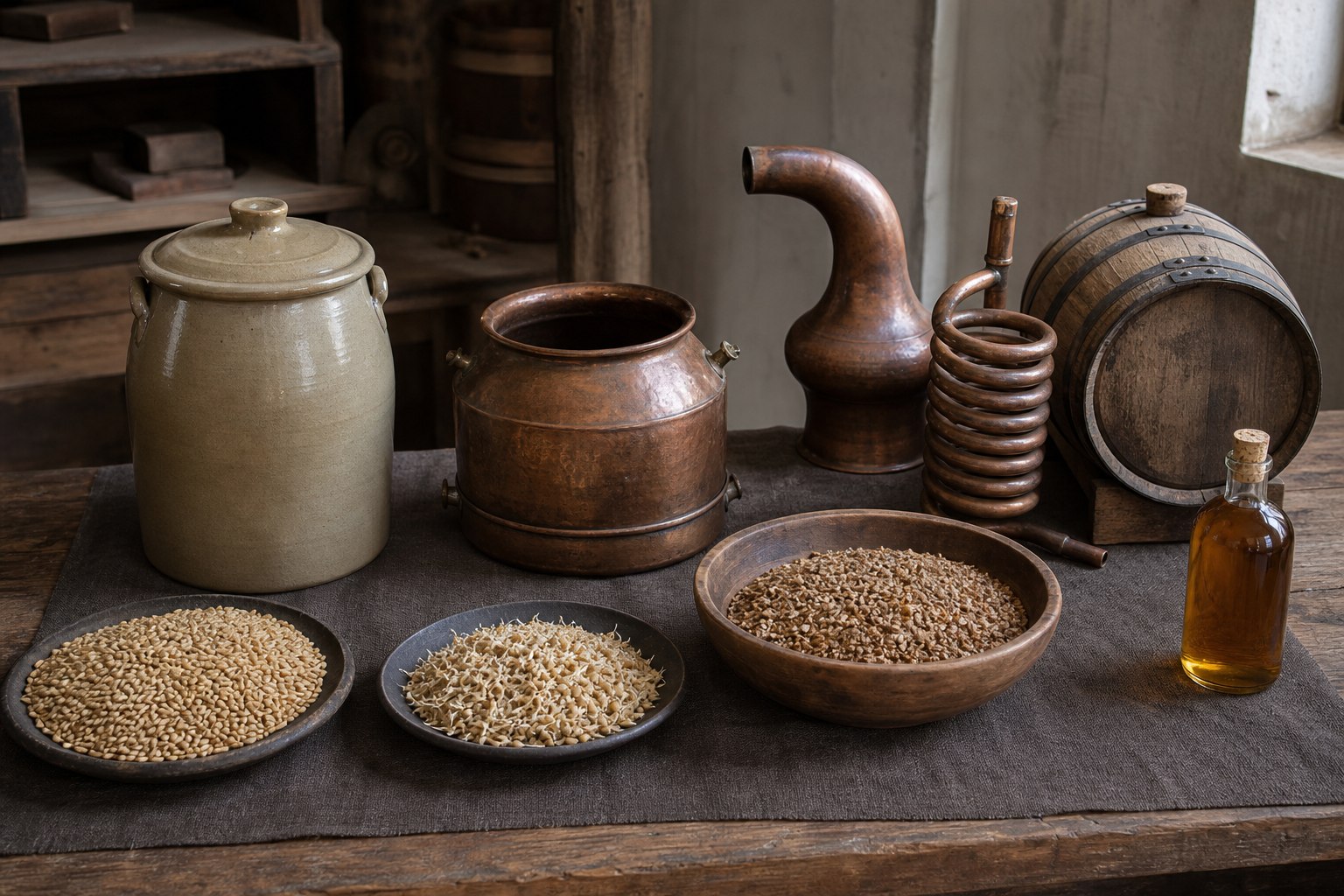
AI-generated visual reference: grain and malt → closed wash → inactive still components, cask, and bottled spirit. It is not an equipment design, legal guidance, purity test, methanol test, or safe-distillation demonstration.
Why it matters
Distilled spirits solve a real logistics problem: alcohol concentrated is alcohol that travels. A barrel of beer is mostly water, spoils, and is barely worth carrying overland. The same grain distilled is a quarter the volume, keeps indefinitely, and is worth many times more per unit weight. American frontier farmers distilled their corn for exactly this reason — grain wouldn't pay to transport, whiskey would.
Properly formulated alcohol can also be a surface or hand antiseptic in some settings (not something to pour into wounds; see medicine), as well as a solvent for extracting medicines and perfumes, your lamp and stove fuel, your preservative for specimens, and — with a lot of purification — the feedstock for ether anesthesia.
Read the safety section before the process section. Distilling has four genuinely serious hazards — fire, pressure, toxic contamination, and methanol — and all have killed people. Sensory cuts do not certify methanol safety. Also note that unlicensed distilling is a criminal offense in most modern jurisdictions; this page is about how it was done historically.
The core principle
Ethanol boils at 78.4°C, water at 100°C. Heat a fermented liquid and the vapor coming off is enriched in alcohol. Condense that vapor and you have a stronger liquid. Repeat and it gets stronger still.
Two limits worth knowing up front:
- You cannot distill past 95.6% ethanol. At that concentration ethanol and water form an azeotrope — the vapor has the same composition as the liquid, so no amount of further distillation separates them. To go beyond, dry the spirit over quicklime or another desiccant.
- Distillation concentrates everything volatile, not just ethanol. That includes the compounds you don't want, which is the whole reason for making cuts (below).
Step 1: Make a fermented wash
You cannot distill what you haven't fermented. The still concentrates alcohol — it doesn't create it.
From fruit → brandy
Easiest by far. Ferment fruit as in wine, then distill. Grape brandy, apple applejack, plum slivovitz, cherry kirsch. No starch conversion needed because fruit already contains sugar.
From sugar or molasses → rum
Also easy. Dissolve molasses (the byproduct from sugar making) in water, pitch yeast, ferment. Molasses was a waste product of the sugar trade until someone distilled it, at which point it became the more profitable half.
From grain → whiskey
Harder, because grain is starch, and yeast cannot eat starch. It must be converted to sugar first. Two routes:
Malting (the Western route).
- Steep barley in water for 2–3 days until the grain is fully hydrated.
- Germinate — spread it on a floor 100 mm deep, keep it damp and cool, and turn it regularly to prevent matting and overheating. Over 4–6 days the grain sprouts and produces amylase enzymes to break down its own starch reserves.
- Stop it at the right moment — when the shoot (acrospire) has grown to about three-quarters the length of the grain. Too early and there's not enough enzyme; too late and the sprout has eaten the starch you wanted.
- Kiln it — dry with warm air (below ~60°C if you want to preserve the enzymes; hotter for darker, more roasted malt with less enzyme power). Peat smoke in the kiln is what gives Islay whisky its character.
Koji (the East Asian route). Use Aspergillus oryzae to convert the starch, exactly as in sake. This is how shochu, soju, and baijiu are made, and it works on rice, barley, sweet potato, and sorghum.
Then mash and ferment:
- Mill the malt coarsely — cracked, not floured.
- Mash: mix with hot water and hold at 63–68°C for about an hour. This is the critical temperature window: the amylase enzymes are most active here and convert starch to fermentable sugar. Above ~75°C you destroy the enzymes and nothing converts. Below ~60°C conversion is slow and incomplete.
- Test: the mash should taste distinctly sweet, and go from cloudy-starchy to noticeably thinner. (The traditional check is an iodine drop, which turns blue -black on starch — if you have iodine.)
- Cool to about 20–25°C, pitch yeast, and ferment 3–5 days to roughly 7–9% alcohol. This is essentially beer without hops (distiller's beer or wash).
Malted barley can convert other grains too. Roughly 10–20% malted barley in a mash of unmalted corn, rye, or wheat supplies enough enzyme to convert the whole lot. That's how bourbon and rye whiskey are made, and it's a useful economy.
Step 2: The still
Pot still (start here)
A closed vessel, a swan-neck head, a downward-sloping arm (the lyne arm), and a condenser.
Build it from copper. This is not aesthetic preference:
- Copper removes sulfur compounds from the vapor, which otherwise make the spirit smell of rotten eggs and cabbage. A glass or steel still produces noticeably worse spirit.
- It conducts heat evenly and is easy to work and repair.
- Historically stills were among the most valuable copper objects a community owned.
Never use lead anywhere in a still — not in solder, not in the condenser, not in a lead-glazed pot. Lead dissolves into the acidic distillate and poisons the drinker. American "moonshine palsy" and various historic mass poisonings came from car radiators and lead-soldered joints used as condensers. Use pure copper, silver solder, or fire-welded joints. This is a real and recurring cause of death, not a theoretical concern.
Seal joints with rye-flour paste or clay (luting). Fire gently and evenly — a direct flame under a pot still scorches the solids on the bottom and gives a burnt taste, so use a water bath, a steam jacket, or a rake stirring the base.
Condenser
- Worm tub — a coiled copper tube immersed in a barrel of cold running water. Traditional, effective, and gives a heavier spirit.
- Shell-and-tube — a bundle of tubes with water flowing around them. More efficient, more copper contact.
- Whatever you build, run the cooling water counter-current (entering at the far end from the vapor and flowing back toward it). It's a free efficiency gain.
Column still (the upgrade)
A tall column packed with plates or packing material, where vapor rises and condensed liquid falls back down. Each plate acts as another distillation stage, so a single pass produces very high-proof spirit continuously rather than in batches.
Coffey's continuous still (1830) is a large industrial jump — it's what makes neutral grain spirit and vodka practical. Pot stills give more character; column stills give more purity and throughput. Build a pot still first.
Step 3: Distilling, and making the cuts
Traditional practice is two passes:
- Stripping run — distill the whole wash fast and take everything. You get a cloudy, rough spirit of around 25–30% (low wines). Don't try to make cuts here.
- Spirit run — redistill the low wines slowly and carefully, and make cuts.
The cuts — the most important skill
The distillate changes composition throughout the run. You separate it into three fractions as it comes off:
Foreshots and heads (segregate as hazardous process waste). Early fractions often contain more acetaldehyde, ethyl acetate, and other volatile congeners and can smell solvent-like. Removing them is important for product quality, but it does not remove or certify the methanol content. Do not use an unknown heads fraction as skin or wound antiseptic, and do not taste it.
Hearts (candidate product). Collect the middle fraction in small, numbered, closed jars. Sensory evaluation is for quality only, after the feedstock and process are validated and chemical analysis has cleared the lot; taste and smell cannot establish methanol or contaminant safety. Until then, every fraction is quarantined process material, not a drink.
Tails (redistill). As the run continues, heavier compounds come over — fusel oils, which smell oily, cardboardy, and vegetal, and taste harsh. Cut when the character turns. Save the tails and add them to the next stripping run; nothing is wasted.
The methanol question, accurately. Methanol causes blindness and death. Fermentation of pectin-rich fruit material can produce more than grain or sugar washes, and deliberate adulteration with industrial methanol has caused many mass poisonings. Distillation does not create methanol, but a simple pot still does not neatly sort a water–ethanol–methanol mixture by the pure compounds' boiling points either. Methanol co-distils across heads, hearts, and tails, and research on fruit spirits finds that ordinary sensory cuts cannot reliably control the final concentration.
Therefore discarding a fixed foreshot volume is not a methanol safety test. Smell, taste, flame behavior, and thermometer readings cannot certify it. Feedstock control, a validated fermentation and distillation process, and chemical analysis are the safeguards. Without those, especially for fruit or pomace spirits, do not represent the product as safe to drink.
Measuring strength without a hydrometer
- The gunpowder proof test — the origin of the word "proof." Spirit was poured over gunpowder and lit; if the powder still ignited afterward, the spirit was "proved" (roughly 57% ABV). Effective, and obviously not something to do casually.
- The bead test — shake the spirit in a clear bottle and watch the bubbles. Large bubbles that vanish instantly mean high proof; small bubbles that linger mean lower. Experienced distillers read this remarkably accurately.
- A hydrometer is simply a weighted float that sits deeper in less dense liquid. Make one from a sealed glass tube with shot in the bottom, and calibrate it against water and against a known spirit. Well worth building — see glass.
Step 4: Maturation
New spirit is harsh and colorless. Barrels are what make whiskey.
What the barrel does (see woodworking for coopering):
- Adds vanillin, tannins, lactones, and sugars from the oak — vanilla, spice, coconut, and color.
- Subtracts harsh sulfur compounds and immature notes, absorbed into the char layer, which acts as an activated-charcoal filter.
- Transforms through slow oxidation via the wood's pores over years.
Charring the inside — burning the staves to a deep alligator-skin char before filling — is the key step. It creates the filtering carbon layer and caramelizes wood sugars just beneath it. Toasting (heating without flame) gives gentler spice notes instead.
Practical points:
- Smaller barrels mature faster (more surface area per volume) but plateau and can become over-oaked. A 200-litre barrel is a reasonable compromise.
- Expect to lose 2–5% per year to evaporation — the "angels' share." In a humid cellar you lose more alcohol than water; in a dry one, more water than alcohol, so the proof rises.
- Reusing barrels gives progressively gentler influence. First-fill is aggressive; a third-fill barrel is nearly neutral and useful for long aging.
- Time: 3 years minimum for anything worth calling whiskey, 8–12 for good. This is a long-term investment — lay down barrels now and sell them in a decade.
Unaged spirits are perfectly legitimate: vodka, gin, grappa, moonshine, and most shochu. Gin is simply neutral spirit redistilled with juniper and other botanicals, and it's a fast route to a saleable product while your whiskey ages.
Safety — four major dangers
- Fire. Alcohol vapor is heavier than air, invisible, and ignites easily. A still leak near an open flame is how distilleries burn down. Distill in a well-ventilated space, keep the heat source separated from the still where possible (steam or water bath), and never open a hot still.
- Pressure. A blocked condenser or vapor path turns a still into a bomb. Never seal a still completely — the vapor path to the condenser must always be clear. Use a properly sized and rated pressure/vacuum relief system designed for the equipment and process, discharged to a safe location; an improvised “weak point” can eject hot liquid or flammable vapor unpredictably. Have a qualified process engineer review the system and check for blockages before every run.
- Toxic contamination. Lead solder, lead-glazed vessels, galvanized (zinc) parts, and automotive components have all poisoned people. Copper, glass, stainless steel, and food-safe materials only.
- Methanol and other composition hazards. Cuts, odor, taste, flame tests, and boiling temperature do not certify a batch. Control feedstock and process, then use an appropriate chemical assay before release—especially for fruit or pomace spirits.
Plus the obvious: distilled spirits are far stronger than fermented drinks and alcohol harm scales accordingly. Introducing high-proof spirits to a population with no prior exposure has repeatedly been socially catastrophic — the historical record on this is grim and consistent, and it's worth thinking about before you scale up production.
Failure modes
| Symptom | Cause | Fix |
|---|---|---|
| Mash tastes starchy, ferments weakly | Mash temperature wrong | Hold 63–68°C; check the malt has live enzyme |
| Malt has no converting power | Kilned too hot | Dry below 60°C for enzyme malt |
| Spirit smells of rotten eggs or cabbage | Insufficient copper contact | Copper still and condenser; add copper packing |
| Spirit smells like solvent or nail polish | Volatile congeners remain | Segregate the batch; sensory cuts affect quality but do not certify chemical safety |
| Spirit is harsh or oily | Later congeners included, contamination, or another process fault | Segregate and analyze; do not use symptoms or taste as a safety assay |
| Distillate tastes burnt | Scorched solids on the still bottom | Water bath or steam heat; filter the wash first |
| Very low yield | Poor fermentation, or vapor leaking at the joints | Check the wash strength; lute the joints properly |
| Distillate comes over cloudy | Wash boiling over into the head (puking) | Lower the heat; don't overfill; leave headspace |
| Whiskey stays harsh after years | Barrel exhausted or too large | First-fill charred barrel; smaller cask |
| Whiskey is bitter and over-oaked | Barrel too small or too long in wood | Blend with younger spirit; larger casks |
Sources and limits
A peer-reviewed review of methanol mitigation in fruit spirits and experimental work on fruit-spirit distillation reproducibility show that methanol is distributed through pot-still fractions and is not made safe by a simple heads cut. The UK Health Security Agency methanol overview summarizes toxicity and adulteration risk. This chapter is historical process context, not authorization to distill or a substitute for legal, food-safety, fire-code, and analytical controls.
Era notes
Distillation apparatus is ancient — Mesopotamian, Greek, and Egyptian alchemists had alembics — but they distilled perfumes, medicines, and mercury, not alcohol. The distillation of wine into spirit appears in the medieval Islamic world and in the Salerno medical school around the 12th century, spreading through Europe as aqua vitae, initially as a medicine. Irish and Scottish whiskey are recorded from the 15th century; barrel aging as a deliberate practice is much later, arguably discovered by accident during long sea transport.
Your knowledge advantages: copper's role in removing sulfur, the mash temperature window and why it matters, that heads/hearts/tails is about separating pre-existing compounds rather than avoiding creating them, why the azeotrope caps you at 95.6%, counter-current condensing, charring versus toasting barrels, and above all never using lead anywhere in the apparatus — which would have saved a great many lives.