Salt
Difficulty: crude evaporation is easy to demonstrate; food-grade salt needs source characterization, contamination control, process measurements, and quality testing as well as logistics. Prerequisites: fire (for the boiling method), and shallow pans of fired clay, iron, or copper. Never lead — see the pan note under Route 2.
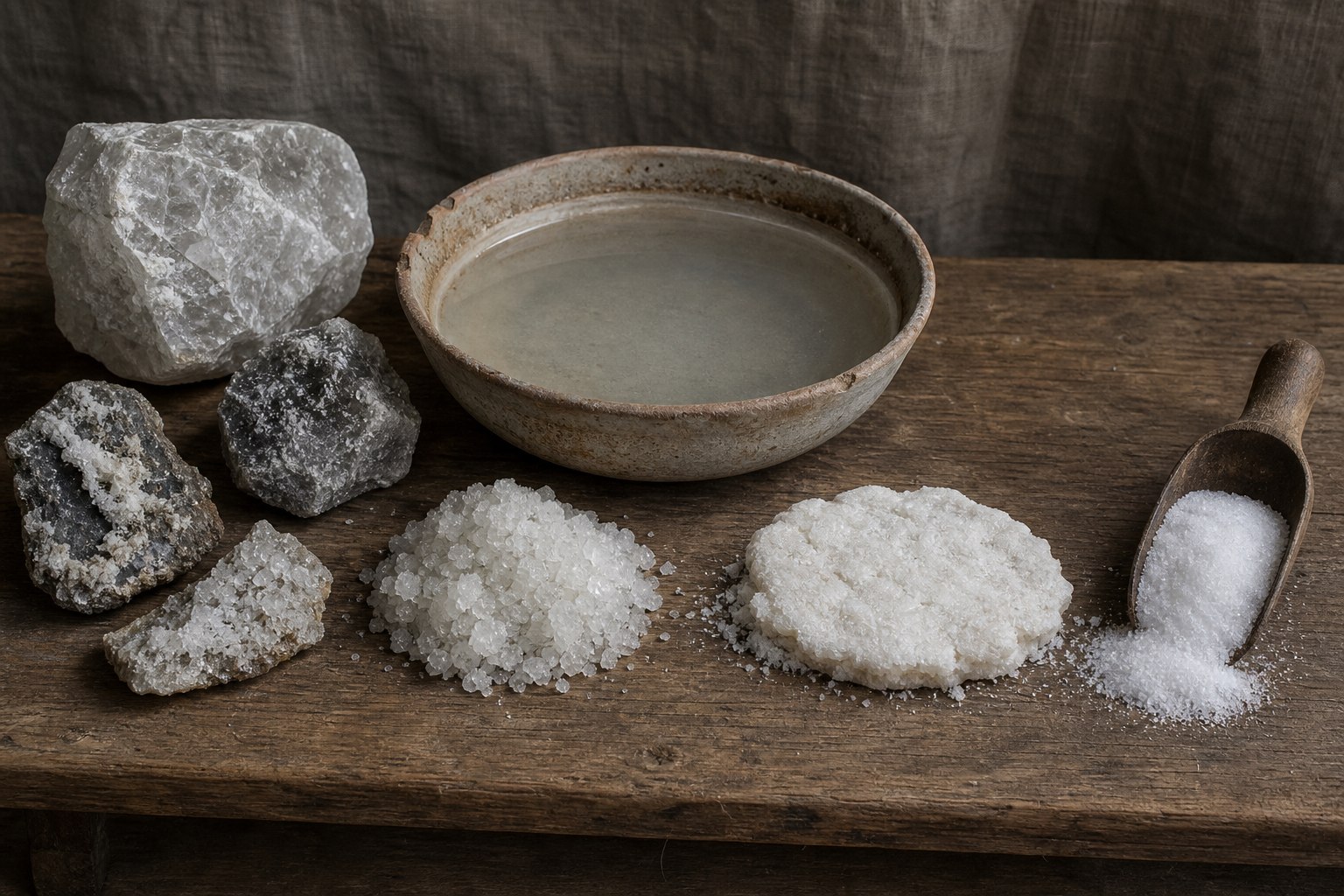
AI-generated visual reference: halite or brine → coarse crystals and salt cake → screened salt. It is not a historical photograph, purity test, or food-safety standard.
Why it matters
Salt is the single most important preservative in a world without refrigeration, an essential nutrient, and historically a currency. The salt roads of the Sahara, the Venetian salt monopoly, the Chinese state monopoly, and the French gabelle salt tax all point the same way — controlling salt has repeatedly meant controlling a region. (The old story that Roman soldiers were paid in salt, giving us "salary," is an etymological myth; salarium was money, whatever its origin. The trade was genuinely that valuable without the legend.) If you arrive somewhere inland with no salt supply, making it is possibly the fastest route to wealth in this entire repo.
You also need salt for: food preservation of every kind, soy sauce, curing hides for tanning, salt-glazing pottery, salting out soap, parting silver, and as a flux in metalworking. Route 3 below is a mining problem; Route 2 is a fuel problem.
Route 1: Solar evaporation (best, if you have coast + climate)
Requires a hot, dry, windy climate with a long rainless season — Mediterranean, subtropical coasts, or arid inland salt lakes. In a wet temperate climate this does not work and you must boil.
- Build a series of shallow terraced ponds on a flat coastal area with impermeable clay floors, arranged so brine flows by gravity from one to the next. Compact the clay hard; leaks are the main failure.
- Admit seawater at high tide into the first, largest pond.
- Let it evaporate and move it downstream as it concentrates. Seawater is ~3.5% salt; you are aiming to concentrate it roughly ten-fold before crystals form.
- Watch what precipitates and when — this is the quality control step.
As brine concentrates, minerals drop out in order:
- First: calcium carbonate and calcium sulfate (gypsum) — chalky, bitter. Leave these behind in the earlier ponds; do not carry that sludge forward.
- Then: sodium chloride — this is your harvest, and it crystallizes over a wide range of concentration.
- Last: magnesium salts — bitter, deliquescent (they suck water from the air and make your salt clump and go damp). Stop harvesting and discard the remaining mother liquor before these come out. Greedily evaporating to dryness is what makes bad, bitter, sticky salt.
- Rake the salt from the crystallizing pans, drain, and dry it in the sun.
The residual bitter liquor (bittern) is a variable mixture rich in magnesium and other salts, not pure magnesium chloride. Food use such as nigari requires a characterized, food-grade product; unknown concentrated mother liquor can also concentrate harmful contaminants.
Route 2: Boiling brine (works anywhere, costs fuel)
This is how salt was made across northern Europe, inland China, and anywhere without a drying climate.
Sources of brine, best to worst:
- Natural brine springs — salty water emerging from underground deposits. Far more concentrated than seawater, sometimes 25%. Look for salt licks where animals gather, salt-tolerant plants inland, or ask locals where the "salty spring" is; they usually know. Animal use or salty taste does not establish food safety: assay for arsenic, lead and other metals, objectionable ions, pathogens where relevant, and local industrial or geological contaminants.
- Seawater — 3.5% salt, meaning you must evaporate ~28 kg of water for 1 kg of salt. Brutally fuel-expensive if boiled directly.
- Salt-rich ash — burn seaweed, salt-marsh plants, or driftwood soaked in seawater, then leach the ash with water. Crude but real, and used across Iron Age northern Europe.
Concentrate before you boil. Never boil seawater from full strength. Use:
- Graduation towers: trickle brine over stacked brushwood/thorn bundles in the wind. Huge surface area, wind does the evaporation for free, and the gypsum deposits on the twigs instead of in your pan. This one technique cuts fuel use by most of the total.
- Sand washing: on tidal flats, let sun-dried salty sand accumulate, then wash it with a small amount of seawater to leach concentrated brine.
- Freeze concentration: in a cold climate, leave brine out overnight. Pure water freezes first — remove the ice, keep the liquid. Repeat. Free energy in winter.
Then boil: in wide, shallow pans over a long fire trench. Skim the scum (gypsum and impurities) as it forms. As the brine nears saturation, salt crystals appear at the surface; lower the heat to a simmer for larger, cleaner crystals, and rake them out continuously. Stop before the pan goes dry, and discard the last bitter liquor.
Pan material must be heat-safe, corrosion-resistant in hot concentrated brine, cleanable, and verified for food contact. Never use lead. Iron can corrode and copper can contaminate acidic or otherwise aggressive brines; neither is automatically acceptable without material/process testing. Intact compatible fired ceramic or a validated metal system may be suitable.
Route 3: Rock salt mining
If there's a salt dome or evaporite bed nearby (look for salt springs, salt lakes, or place-names with a salt root — Hallstatt, Salzburg, Nantwich), you can mine it directly. This is by far the least labor per kilogram.
Rock salt is often dirty grey with clay and anhydrite. Purify by recrystallization: dissolve it in the minimum hot water, let insoluble grit settle, decant the clear brine, and evaporate that. This is the same dissolve → filter → evaporate loop used everywhere in this repo.
Purification and finishing
To upgrade any crude salt:
- Dissolve in hot water until saturated.
- Let it stand; sand and grit settle out. Decant or filter through tight cloth.
- A controlled lime/carbonate treatment can remove some calcium and magnesium, but dosing needs measured composition, pH and a precipitation endpoint, followed by complete settling/filtration and final food-quality tests. It does not remove every dissolved contaminant or make unknown brine "genuinely pure."
- Evaporate gently. Slow evaporation gives large flake crystals (premium product); fast boiling gives fine grains.
To reduce caking, keep finished salt dry in a clean, sealed food container. Do not add unknown clay or flour: they can introduce metals, pathogens, allergens, moisture, or spoilage. Use only an identified food-grade anticaking agent under a controlled formulation.
Iodine is the major nutritional detail
Salt supplies sodium and chloride but does not naturally guarantee adequate iodine. Iodine deficiency can cause goitre and, during pregnancy and early childhood, irreversible harm to brain development. Where population iodine status is inadequate, universal salt iodization is a public-health program, not a pinch-by-eye recipe: use food-grade potassium iodate or iodide, calibrated mixing/dosing equipment, uniformity and retention tests, labeled lots, protected storage, and monitoring of salt iodine and population status. Both too little and too much are harmful, and the target must account for salt intake and losses. Do not encourage extra salt consumption to obtain iodine.
Failure modes
| Symptom | Cause | Fix |
|---|---|---|
| Salt has an abnormal bitter character in a controlled sensory check | Magnesium salts or another contaminant carried over | Quarantine the lot; test composition and process separation. Never taste an unknown source as an identification test |
| Salt is chalky, gritty | Gypsum not separated | Skim scum; use graduation towers |
| Salt goes damp and clumps | Magnesium chloride contamination | As above, plus dry storage |
| Enormous fuel consumption | Boiling unconcentrated seawater | Concentrate first — always |
| Ponds won't hold water | Porous floor | Puddle the clay: wet it and tread it hard |
Sources and limits
- WHO recommends iodization of food-grade salt while emphasizing monitoring so population needs are met but not exceeded: iodization of salt for prevention of iodine deficiency.
- Evaporation and boiling remove water and therefore concentrate many nonvolatile contaminants. Crystal appearance and taste do not certify chemical or microbiological food safety; see the repository-wide source policy.
Era notes
Salt production is ancient—Neolithic sites in Europe and China show large-scale briquetage (salt boiled in disposable clay vessels)—but feasibility and food safety still depend on a viable source, climate or fuel, containers, labor, and contamination control. Your knowledge advantage is not the concept but the efficiency: graduation towers, staged evaporation ponds, and knowing to discard the bittern will let you undercut every existing producer on fuel cost and beat them on quality.