Clay and Earth Building
Difficulty: easy to test and shape; difficult and potentially life-critical when used as a load-bearing building material. Prerequisites: hand tests need simple tools and water. Habitable structural work also needs a proven local system, competent design and supervision, site and soil tests, foundations and drainage, safe scaffolding, and load/seismic/wind details appropriate to the location.
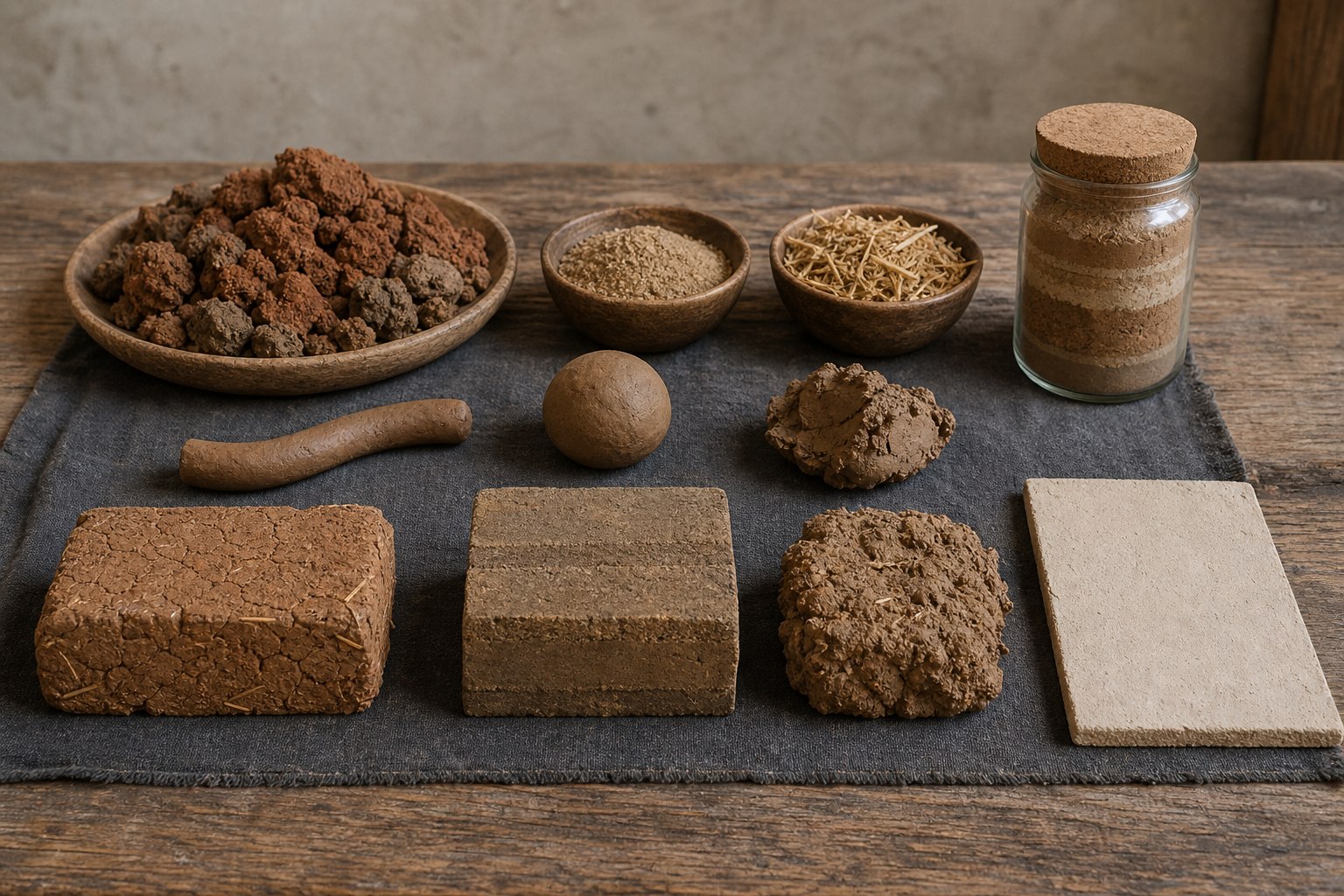
AI-generated visual reference: clay-rich earth and additives → field-test samples → adobe, rammed earth, cob, and plaster. It is not a historical photograph, soil classification, mix design, or structural demonstration.

Interactive figure, Fig 3 · Jar Test Stand: load one of three sample soils, shake the jar and move through settling time to watch sand, silt and clay settle in turn, with the clay share compared against the guide's cob and rammed-earth ranges. A code-drawn explanatory model built from this guide's numbers, for orientation only; it is not an equipment drawing or a procedure.
Why it matters
Clay is the most abundant useful material on Earth, it's free, and it's under your feet almost everywhere. It's the raw material for pottery, crucibles, and furnace linings — but this page is about clay itself: how to find it, test it, process it, and build with it unfired.
Roughly a third of the world's population still lives in earthen buildings, some of them centuries old. Unfired earth needs no fuel at all, which matters enormously when charcoal is your bottleneck for everything else. If you need shelter, a kiln, a furnace, a granary, or a water channel this month, earth is how you get it.
For firing clay into ceramics, see pottery and ceramics.
Structural life-safety gate. A successful sample block does not establish a safe building. Walls, openings, roofs, floors, foundations, connections, bond beams, lateral loads, moisture, erosion, settlement, and construction sequence interact. Scale a locally proven design and obtain competent engineering for occupied or load-bearing work—especially for multiple stories, domes, vaults, large openings, weak soils, floods, high winds, or earthquakes. Unskilled labor is appropriate only under that design and supervision.
What clay actually is
Clay minerals are microscopic plate-shaped crystals formed by the chemical weathering of feldspar in rocks. The plates slide over each other when wet — which is what plasticity is — and lock together when dry. Particle size is under 2 microns, which is why clay feels smooth and why it holds water.
Everything about clay's behavior follows from those plates: it's plastic when wet, hard when dry, shrinks as it loses water, and swells when it takes it back.
Finding clay
Where to look:
- Riverbanks and stream cuts — the classic. Look for a smooth grey, brown, red, or blue-grey layer in the exposed bank.
- Road cuts, erosion gullies, and construction pits — anywhere the subsoil is exposed.
- Under the topsoil. Dig through the dark organic layer and the layer beneath is often clay-rich. This is the most common source and requires no landform at all.
- Lake and pond bottoms, and the base of hillsides where fines wash down.
- Below coal seams — often high-alumina fireclay, the best refractory material you can find. Worth prospecting for specifically.
Colors and what they suggest: red and orange mean iron (fine for building and terracotta, bad for glass and refractories); grey and blue-grey mean iron in reduced form and often good plasticity; white or pale cream means kaolin — low iron, high alumina, the material of porcelain and firebrick, and by far the most valuable clay to find.
Field tests
Run these in order. They take minutes and save weeks.
- Ribbon test. Wet a lump, roll a coil the thickness of a pencil, and bend it around your finger. Good clay bends into a full ring without cracking. Cracks on the outside of the bend mean too silty or too sandy.
- Shine test. Rub the wet surface with your thumb. Clay burnishes to a sheen; silt stays dull.
- Jar test — the most informative. Put a handful in a jar of water, shake hard, let it stand a day. It separates into visible bands: gravel and sand at the bottom (settles in seconds), silt above (minutes), clay above that (hours to days), organic matter floating. Measure the band thicknesses — this gives you the actual proportions, which tells you exactly what to add.
- Drop test (for building soil). Squeeze damp soil into a ball and drop it from waist height onto hard ground. It shatters completely → too sandy. It flattens without breaking → too much clay. It cracks into a few large pieces → about right for rammed earth.
- Organic-content screen. With gloves, inspect color, roots, and odor; a dark topsoil-like sample with roots or a peaty odor is unsuitable for structural or refractory work until tested. Never taste soil: it may contain pathogens, parasites, metals, sewage, or other contamination.
Processing clay
For building — usually none needed
Dig it, break up the lumps, remove stones and roots, and use it. Overprocessing building earth is wasted labor.
For pottery, crucibles, and fine work — levigation
- Dry it hard, then crush it to powder. Dry clay slakes far faster than wet lumps.
- Slake in plenty of water and let it stand until fully saturated — hours to days. Stir to a thin slurry.
- Settle briefly. Sand and grit drop out in under a minute. Pour the clay-rich water off into a second vessel, leaving the grit behind.
- Settle fully, a day or more. Pour off the clear water on top.
- Dry the sediment to working consistency on a plaster slab, a bed of dry ash, or cloth stretched over sand. Plaster is best — it wicks water evenly. See cement and concrete for gypsum plaster.
- Wedge it — knead like bread dough, cutting and slamming, to drive out air bubbles and even the moisture. Air pockets explode in a kiln.
Aging
Store wet clay covered, in a dark pit, for weeks or months. Bacteria break down organics and produce acids that make the clay noticeably more plastic. Chinese potters aged clay for years and passed prepared clay down a generation. This costs nothing but a hole and patience, and it's a real improvement.
Adjusting clay to fit the job
Almost no natural clay is ideal as dug. You adjust it:
| Problem | Symptom | Fix |
|---|---|---|
| Too plastic ("fat") | Sticky, shrinks and cracks badly on drying | Add sand, grog, or a leaner clay |
| Too lean | Crumbles, won't hold shape | Add a more plastic clay, or age it |
| Too much shrinkage | Cracks in drying and firing | Add grog (crushed fired clay) — it has already shrunk |
| Melts or slumps when fired | Iron/lime/alkali flux content | Different clay; look for pale high-alumina material |
| Won't hold up in fire | Not refractory | Kaolin/fireclay plus heavy grog |
Grog is the universal fix, and it's free: crush your broken pottery and failed bricks and add 20–40%. It stabilizes shrinkage, adds strength while drying, and improves thermal shock resistance.
Building with unfired earth
These traditional and modern methods behave differently. Choose from locally proven assemblies after checking climate, hazards, soil, loads, available skill, and maintenance—not merely labor and material availability.
Cob
Clay soil mixed with straw and water, trodden into a stiff mass, and built up in courses by hand — no forms, no bricks. Walls are thick (450–700 mm), sculpted, and monolithic.
- Best for: cold, wet climates. English cob houses 500 years old are still lived in.
- Mix: roughly 15–25% clay, the rest sand and aggregate, plus straw for tensile strength.
- Build in lifts of 300–600 mm, letting each dry for a few days before adding the next, and trim the sides as you go. Rushing this is how walls bulge and collapse.
Adobe / mudbrick
The same mix, but moulded into bricks and sun-dried before laying, with mud mortar. Because the bricks dry individually, this is far faster overall than cob and needs no waiting between courses.
- Best for: hot, dry climates. The oldest continuously used building method there is — Jericho, Mesopotamia, the American Southwest, all of North Africa.
- Add straw or dung to the mix to reduce cracking.
- Dry bricks on edge, out of direct fierce sun for the first day (fast drying cracks them), then stack them to finish curing for a couple of weeks.
Rammed earth (pisé)
Damp, low-clay soil compacted in layers inside engineered formwork. It still needs moisture control, protection, drying or curing (especially when stabilized), and strength verification before being loaded.
- Best for: dry climates, and where you have labor for tamping.
- Mix: much leaner than cob — around 5–15% clay, mostly well-graded sand and gravel.
- Establish layer thickness, target moisture, compactive effort, density, and compressive strength with trial specimens. Sound can help an experienced crew notice changes, but it is not a structural acceptance test.
- Sections of the Great Wall are rammed earth, as are large parts of Moroccan and Chinese vernacular architecture.
Wattle and daub
A woven lattice of split wood (wattle) plastered with clay, dung, and straw (daub). Thin, light, fast, and needs very little material — the structure comes from the timber frame. This is the classic infill for half-timbered buildings everywhere from Rome to medieval Europe to Africa.
Earthbag / rammed sacks
Filled-sack systems are modern assemblies whose bag material, fill, reinforcement, connections, ultraviolet protection, moisture control, and code acceptance all matter. Domes and vaults develop thrust and can collapse during construction; they require engineered geometry, temporary support, tested materials, and supervised placement.
Compressed earth blocks
Adobe made with a lever press rather than by hand. Much denser and stronger, uniform, and needs less clay. A wooden or iron press is a small machine with a large return — see mechanical power.
Moisture protection—and the rest of the load path
Water is a dominant durability hazard, so the traditional "hat and boots" rules are valuable, but earth buildings also fail through earthquake or wind loads, poor soil bearing, missing ties, bad openings, roof thrust, weak mixes, erosion, fire at embedded timber, and construction mistakes:
- "A good hat" — a wide overhanging roof, so rain never runs down the walls. Overhangs of 500 mm or more.
- "A good pair of boots" — a stone or fired-brick foundation raising the earth wall at least 300 mm above ground, so splashback and rising damp never reach it.
These details reduce rain and rising-damp exposure; they do not by themselves prove the structure safe or durable.
Additional protection:
- Lime render over the earth — breathable, sheds rain, and repairable. See cement and concrete. Never use hard impermeable cement render on earth; it traps moisture behind it and destroys the wall.
- Limewash annually — cheap, bright, mildly antiseptic.
- Stabilization: lime or cement may improve a compatible soil, but dosage, mixing, curing, durability, and strength must be established by test; some clays respond poorly and excess binder can cause brittleness or incompatibility.
- Traditional additives such as fibers, dung, casein, plant mucilage, oils, or cactus preparations have been used in specific mixes. Historical use is not a universal waterproofing specification: test adhesion, erosion, vapor behavior, pests, decay, hygiene, and compatibility before adoption.
Why earth buildings are comfortable
Thick earth walls have enormous thermal mass. They absorb heat during the day and release it at night, so interior temperature swings are a fraction of outdoor swings. In a hot dry climate this is the difference between a livable house and an oven, and it costs nothing but wall thickness. Earth walls are also breathable — they buffer humidity — and non-flammable.
The trade-off is poor insulation: mass isn't the same as insulation, so in a continuously cold climate you want earth walls plus an insulating layer (straw, reed, or a cavity), not earth alone.
Clay's other uses
- Refractory linings for every furnace and kiln in this repo.
- Waterproofing — puddled clay (clay trodden with water until dense and homogeneous) is genuinely watertight. It lines canals, mill ponds, reservoirs, and salt-evaporation pans. This is how canals held water for two centuries before concrete.
- Clay pipe and drainage tile — fired, but the shaping is pure clay work. Field drainage tiles transformed agricultural yields on heavy soils.
- Sealing — luting joints on retorts and stills with clay paste; sealing fermentation and storage jars.
- Moulds for metal casting.
- Fuller's earth — a specific absorbent clay used to degrease wool. See textiles.
- Kaolin as medicine — clay binds toxins and is a traditional treatment for diarrhea; geophagy (deliberate clay eating) appears in many cultures and does have a real pharmacological basis. Note that oral rehydration is the intervention that actually saves lives there.
- Clarifying — clay fines wine and other liquids by binding suspended particles and settling out.
- Slip and paint — clay slurries as coatings and pigment binders.
Failure modes
| Symptom | Cause | Fix |
|---|---|---|
| Cob wall bulges or slumps | Built too fast, lifts too tall, mix too wet | 300–600 mm lifts, dry between, stiffer mix |
| Deep cracks in a drying wall | Too much clay, dried too fast | More sand and straw; shade the wall while drying |
| Adobe bricks crack while drying | Fierce sun, too much clay | Dry in shade the first day; add sand and straw |
| Wall erodes at the base | No plinth, splashback | Stone foundation 300 mm above grade |
| Wall erodes at the top or streaks down | No roof overhang | Extend the eaves |
| Render falls off in sheets | Cement render on earth, trapping moisture | Strip it; use lime render only |
| Wall gets damp and crumbly at the bottom | Rising damp | Damp-proof course of slate, stone, or bitumen |
| Rammed earth stays soft and dusty | Poor grading, moisture, compaction, curing, or incompatible stabilizer | Stop loading; test density/strength and redesign the trial mix and process |
| Diagonal cracks spread from openings, walls separate, or a wall leans | Settlement, lateral load, roof thrust, missing ties/bond beam, or inadequate design | Evacuate and shore only under competent direction; assess the whole load path before repair |
| Clay won't become plastic no matter what | It's silt, not clay | Jar test to confirm; find a different source |
| Fired lining melts and slumps | Clay too fluxy (iron/lime) | Find pale high-alumina fireclay; add grog |
Sources and limits
- Modern earthen construction standards treat structural design, moisture, materials, connections, and seismic provisions as an integrated system; see the International Code Council's earthen-building provisions.
- Damaged earthen buildings can collapse without warning. FEMA's guidance on cordoning earthquake-damaged buildings illustrates why inspection and exclusion matter.
- Mix percentages and dimensions in this chapter are historical starting points, not stamped designs. See the repository-wide source policy.
Era notes
Earth building is older than agriculture and older than fired pottery. Çatalhöyük (7500 BCE) was mudbrick. The oldest standing buildings in the world are earthen. There is nothing here to introduce to anyone.
Your knowledge advantages are diagnostic and protective: the jar test to measure your soil instead of guessing, the drop test for rammed earth moisture, lime stabilization of clay soils, why lime render works on earth and cement render destroys it, and the two rules — a good hat and a good pair of boots — stated as principles rather than inherited habit.