Oils, Fats, and Pressing
Difficulty: moderate for identified food/industrial oils; hard for hot-oil polymerization, toxic seeds, feed release, or powered pressing. Prerequisites: woodworking for the press, pottery for settling jars, heat.
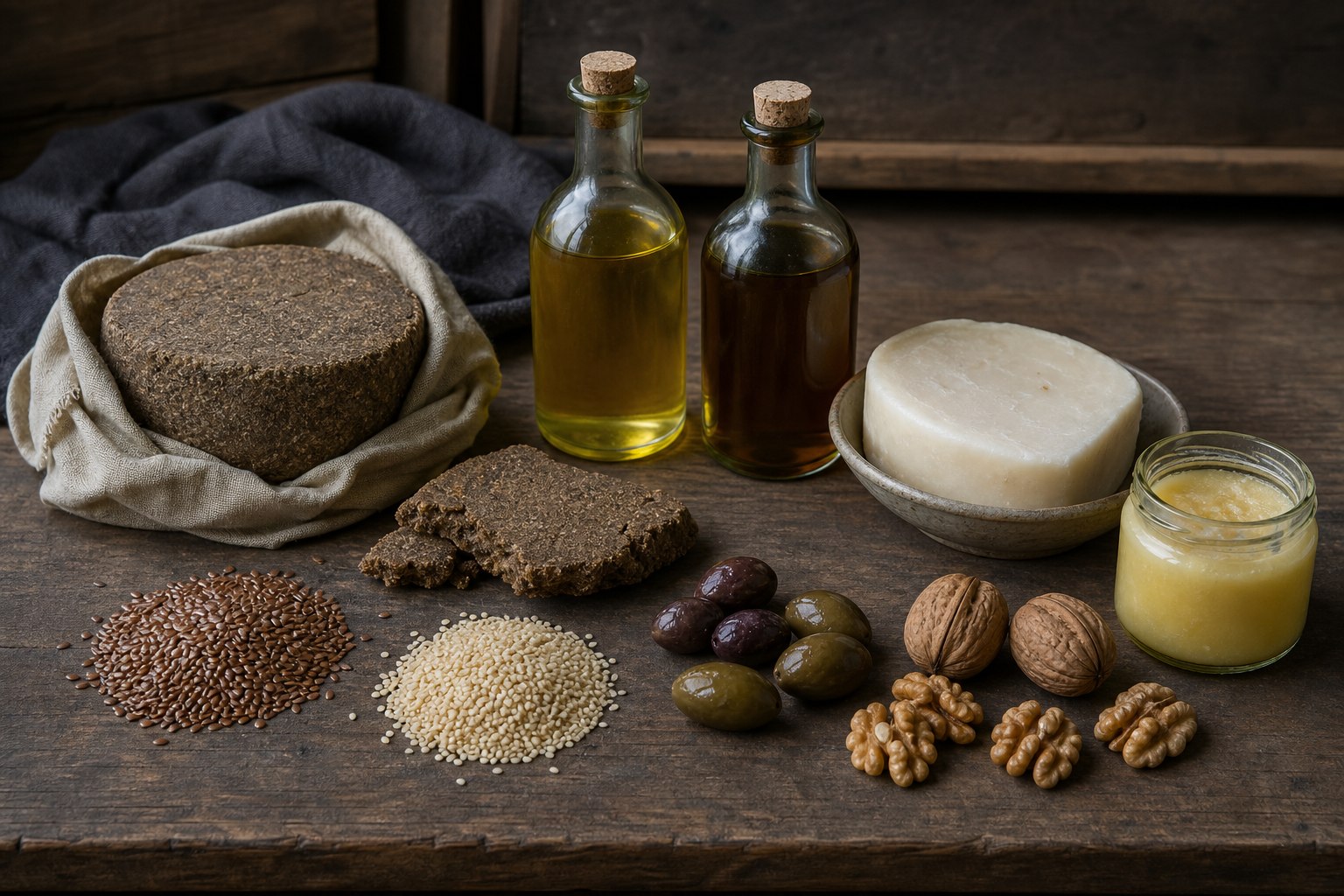
AI-generated visual reference: plant and animal feedstocks → press cake → settled oils, rendered fat, and grease. It is not a historical photograph, species-identification guide, food-safety test, or processing endpoint.
Why it matters
Half a dozen guides here call for fat or oil and none of them tell you where to get it in quantity.
- Soap depends principally on fat and measured alkali, plus controlled water/process conditions.
- Printing ink and oil paint both need boiled linseed oil — without it, movable type does not work.
- Leather must be curried with oil or it dries to cardboard.
- Bearings and gears need grease, or they burn out.
- Lamps need oil; without light your working day ends at dusk.
- Some wood finishes use suitable oil, but durability depends on species, design, preparation, formulation, exposure, and maintenance.
- And people need fat to eat — it is the densest calorie source there is, at 9 kcal/g against 4 for grain.
The soap page states the constraint plainly: "fat is food, and in a subsistence economy spending it on soap is a real cost." Oilseed can expand the supply and provide valuable co-products, but it still competes for edible seed, land, water, labor, and soil fertility. Plan food, feed, lamp, soap, and industrial allocation explicitly rather than treating pressed oil as cost-free surplus.
Where fat comes from
Animal fat — rendering
Free if you're already slaughtering. See animal husbandry.
| Fat | Source | Character | Best for |
|---|---|---|---|
| Tallow | Beef and sheep suet (kidney fat) | Hard, white, high melting point | Hard soap, candles, currying |
| Lard | Pork back and belly fat | Soft, mild | Soft soap, cooking, pastry |
| Neatsfoot oil | Simmered cattle feet and shin bones | Stays liquid when cold | Leather dressing — the best there is |
| Fish oil | Oily fish, cod livers | Liquid, smells appalling | Lamps, leather, tanning; cod-liver oil is a concentrated vitamin source whose medical use and dose need qualified control because vitamins A and D can be toxic |
| Butter / ghee | Milk | — | Food. Clarify to ghee and it keeps for months unrefrigerated |
| Wool grease | Recovered from fleece-scouring liquor | Waxy, water-repellent | Industrial feedstock only until separated, refined, and tested for pesticides, dirt, microbes, detergents, and other contaminants; crude grease is not skin-grade lanolin |
To render: chop the raw fat small (or mince it), simmer gently with a splash of water to stop it catching, and hold it until the fat runs clear and the connective tissue browns into crisp scraps. Strain through cloth, let it cool, and lift the clean cake off the water beneath. Render twice for anything going into soap or leather — once gives you fat that still carries meat residue and will go rancid within weeks.
Yield is roughly 75–85% of the raw fat weight.
Plant oil — pressing
This is the scalable route, but food and industrial demand still compete for the same crops and resources.
| Seed | Oil content | Notes |
|---|---|---|
| Olive | 15–25% of fruit | The Mediterranean staple. Food, lamps, soap, skin |
| Flax (linseed) | 35–45% | The industrial oil. Dries to a hard film — paint, ink, wood finish. Fiber crop too, see textiles |
| Rapeseed / mustard | 35–45% | Temperate and hardy; lamp/industrial uses are broad, but food use requires an authenticated edible cultivar and processing that controls erucic acid, glucosinolates, and other constituents |
| Hemp | 30–35% | Oil plus the best cordage fiber |
| Sesame | 45–55% | Highest-yielding traditional oilseed. Very stable, resists rancidity |
| Walnut / hazelnut | 50–60% | Fine drying oil for paint |
| Poppy | 40–50% | Painter's oil |
| Castor | 45–55% | Lamps and lubricant; seed, hull, meal, and dust require a closed ricin-exposure control system, and cake is not animal feed |
| Sunflower, safflower | 30–45% | Where available |
| Coconut / palm | 60%+ | Tropical, enormous yields, superb soap |
Note the drying/non-drying distinction — it matters. Drying oils (linseed, walnut, poppy, hemp) polymerize on exposure to air into a tough solid film, which is exactly what you want for paint, ink, and wood finish and exactly what you don't want in a lamp. Non-drying oils (olive, rapeseed, sesame) stay liquid, which suits food, lamps, and lubrication.
Pressing, step by step
1. Prepare the seed
- Clean — winnow out chaff, stones, and dirt.
- Dehull where the hull is thick (sunflower, hemp). Hulls absorb oil and give it back grudgingly, so removing them raises your yield.
- Grind or crush to a coarse meal. The classic tool is an edge runner mill — a heavy stone wheel rolling on its edge around a circular stone trough, turned by animal or water power. Olives were traditionally crushed whole, stones included.
- Warm it to around 50–70°C, or moisten and steam it briefly. Warm oil is less viscous and flows out far more readily, and gentle heat ruptures the remaining cell walls. Do not overheat — above about 80°C you darken the oil and drive off the flavor.
Cold vs hot pressing: pressing cold gives less oil but a better, more stable product; warming gives noticeably more oil but a darker, stronger-tasting one that keeps less well. The traditional compromise is a cold first pressing for food and a second, warm, harder pressing of the same cake for lamp oil and soap.
2. Press it
Wrap the meal in coarse cloth, or stack it in flat woven mats, and squeeze.
- Wedge press — the oldest: the mat stack sits in a stout timber frame and wedges are driven in with a maul. Crude, effective, and needs no metal.
- Lever (beam) press — a long beam pivoted at one end, weighted or windlassed at the other, bearing on the stack. Huge force, simple carpentry. This is the Roman olive and wine press.
- Screw press — a large wooden screw driven by a lever bar. Compact, controllable, and reusable for paper, printing, cider, and sugar cane. If you build one press, build this one.
Press slowly and in stages. Apply pressure, wait for the flow to stop, then increase it. Oil takes time to migrate out of the meal, and squeezing hard immediately just seals the outside of the cake and traps the oil inside — the same case-hardening logic as tanning.
Expect to recover 60–80% of the seed's oil with a good press and two pressings. The rest stays in the cake.
3. Clarify
Fresh-pressed oil is cloudy with water and fine solids ("foots").
- Settle in a tall narrow jar for days to weeks in a cool, dark place. Water and solids sink; draw the clear oil off the top.
- Filter through felt, wool, or tightly woven cloth if you want it bright.
- Store full to the top, sealed, cool and dark. Air, light, heat, and metal are the four things that turn oil rancid.
4. Evaluate the cake
Some pressed residues (oil cake or press cake) are protein-rich and were historically valuable livestock feeds, fertilizers, or fuels. None is automatically feed: authenticate the seed and any chemical treatment, test for toxins, antinutrients, spoilage, pesticides, and process contaminants, then set a species- and life-stage-appropriate ration with veterinary/feed expertise.
Castor cake is ricin-bearing hazardous material, not feed. Enclose seed and meal handling, suppress and capture dust, prohibit food use, control contaminated clothing and cleanup, and use an approved hazardous-material or validated industrial treatment route. Do not infer detoxification from pressing or heat.
Boiled linseed oil — the one to get right
Raw linseed oil can take days to weeks to cure depending on formulation, film, substrate, oxygen, temperature, and humidity. Historical “boiled oil,” bodied oil, and modern drier-containing products are not interchangeable; a characterized printing varnish or coating vehicle is what matters.
Traditional “boiled oil” involved heated oil and sometimes toxic metal driers; modern products may instead be raw oil blended with characterized catalysts. Use a verified non-lead formulation or a specialist supplier. Do not infer a safe temperature or endpoint from tackiness, and do not add an unidentified metal compound to a coating that people may touch.
Heating drying oil is specialist fire/process work. An open vessel outdoors can still flash, foam, boil over, emit harmful decomposition products, and spread burning oil. Polymerization requires a purpose-designed, temperature-controlled, indirectly heated and ventilated system with rated containment, fire protection, emergency shutdown, and competent supervision. If that system is unavailable, use a characterized product and do not heat it.
Rags soaked in linseed oil spontaneously combust. The polymerization reaction generates heat, and a crumpled oily rag can insulate that heat until it ignites without a flame or spark. Put used wipes promptly into an approved self-closing metal oily-waste container and follow the coating maker's and local fire/waste authority's disposal instructions. Water immersion in a closed compatible container may be a temporary control where the authority permits; never leave piles or burn waste by guess.
Lighting, since you now have oil
Light is what extends the working day, and no other page covers it.
- Rushlight — the cheapest light there is. Peel a rush leaving one strip of skin for backbone, soak the pith in hot tallow, dry it, and clamp it at an angle in a split holder. Burns 15–30 minutes for essentially nothing.
- Dipped candles — dip a wick repeatedly in molten tallow, cooling between dips, building up in layers. Tallow smokes and smells; beeswax (see animal husbandry) is far better and far dearer.
- Moulded candles — pour into tapered moulds with the wick strung through. Faster than dipping once you have moulds.
- Oil lamp — a reservoir, a wick, and a bit of the wick standing proud. A flat wick burns brighter than a round one; a glass chimney over it (see glass) creates a draft that roughly doubles the light and stops the flicker.
- The plaited wick — a genuinely valuable, free improvement. A twisted wick needs constant snuffing because the burnt end sits in the flame. A tightly plaited wick curls outward as it burns, so the tip moves to the edge of the flame and is consumed completely. Self-trimming. This was only worked out in the 1820s and it costs nothing to introduce.
Burning fat and oil indoors without ventilation produces soot and carbon monoxide. Lamp-black lung was real. Ventilate, and collect the soot — it's your ink and pigment.
Put every flame on a stable noncombustible surface with clearance from cloth, oil stock, children, and traffic; use a guard or chimney suited to the lamp, keep extinguishing means available, and never leave it burning unattended or while people sleep.
Failure modes
| Symptom | Cause | Fix |
|---|---|---|
| Poor oil yield | Seed not ground fine, or pressed cold and fast | Grind to meal, warm to 50–70°C, press slowly in stages |
| Oil comes out dark and harsh | Overheated during warming or pressing | Keep below ~80°C; cold-press the first run |
| Oil goes rancid in weeks | Water and solids left in; stored warm, light, or airy | Settle and filter; store full, sealed, cool, dark |
| Rendered fat smells meaty and spoils | Rendered once, residue left in | Render twice, strain, wash the fat |
| Cake still heavy with oil | Pressure applied too fast, cake sealed | Slower staged pressing; second warm pressing |
| Linseed coating does not cure | Wrong oil/formulation, incompatible substrate, excessive film thickness, cold/humid conditions, contamination, or degraded material | Quarantine the work and review the characterized product, substrate preparation, film thickness, and cure conditions; do not add drier or heat by guess |
| Paint or ink stays tacky | Formulation, proportion, pigment, substrate, oxygen, temperature, humidity, or contamination problem | Stop applying it; diagnose with small controlled samples and a verified formula rather than reheating the bulk oil |
| Workshop fire or self-heating waste | Heated oil, vapor ignition, spill/boil-over, or piled drying-oil waste | Evacuate and call fire services; do not carry or open a hot container. Prevent recurrence with a designed process and approved covered oily-waste containers |
| Lamp smokes and needs constant trimming | Round twisted wick, no chimney | Plaited flat wick; glass chimney |
| Animals sicken on the press cake | Toxic seed, processing residue, spoilage, contaminant, or unsuitable ration | Stop feeding it and obtain veterinary/feed analysis; only use an authenticated feed material with a species-appropriate ration and contaminant controls |
Sources and limits
- OSHA requires solvent- or coating-soaked waste to be kept in a covered metal container in the cited workplace setting; applicable local fire and hazardous-waste rules determine the exact approved container and disposal route.
- The National Fire Protection Association's oily-rag safety guidance documents spontaneous-heating risk and emphasizes cool, closed storage and local disposal direction.
- CDC's ricin fact sheet and NIOSH's ricin emergency card describe inhalation, ingestion, and contact hazards relevant to castor seed, meal, dust, and contaminated cleanup.
- Oil identity, flash behavior, catalyst toxicity, food/feed suitability, and coating cure cannot be established from appearance or a generic historical recipe. Follow the product data and a process-specific fire and exposure review.
Era notes
Olive presses are Bronze Age and the beam press is well documented in the classical Mediterranean; the screw press appears in the Roman period and is what Gutenberg later adapted. Sesame oil is attested in Mesopotamia; linseed and its drying properties were known to Roman and medieval painters, and boiled linseed oil is what makes 15th-century oil painting and printing possible at the same moment.
Your knowledge advantages: the drying/non-drying distinction and why (polymerization), staged slow pressing, warming the meal before pressing, evaluating usable press-cake co-products without assuming feed safety, the spontaneous-combustion hazard of oily rags, and the plaited self-consuming wick.