Copper, Bronze, and Brass
Difficulty: moderate — the easiest metallurgy, and the right place to start. Prerequisites: fire and heat (charcoal + bellows, ~1100–1200°C), pottery (crucibles, moulds).
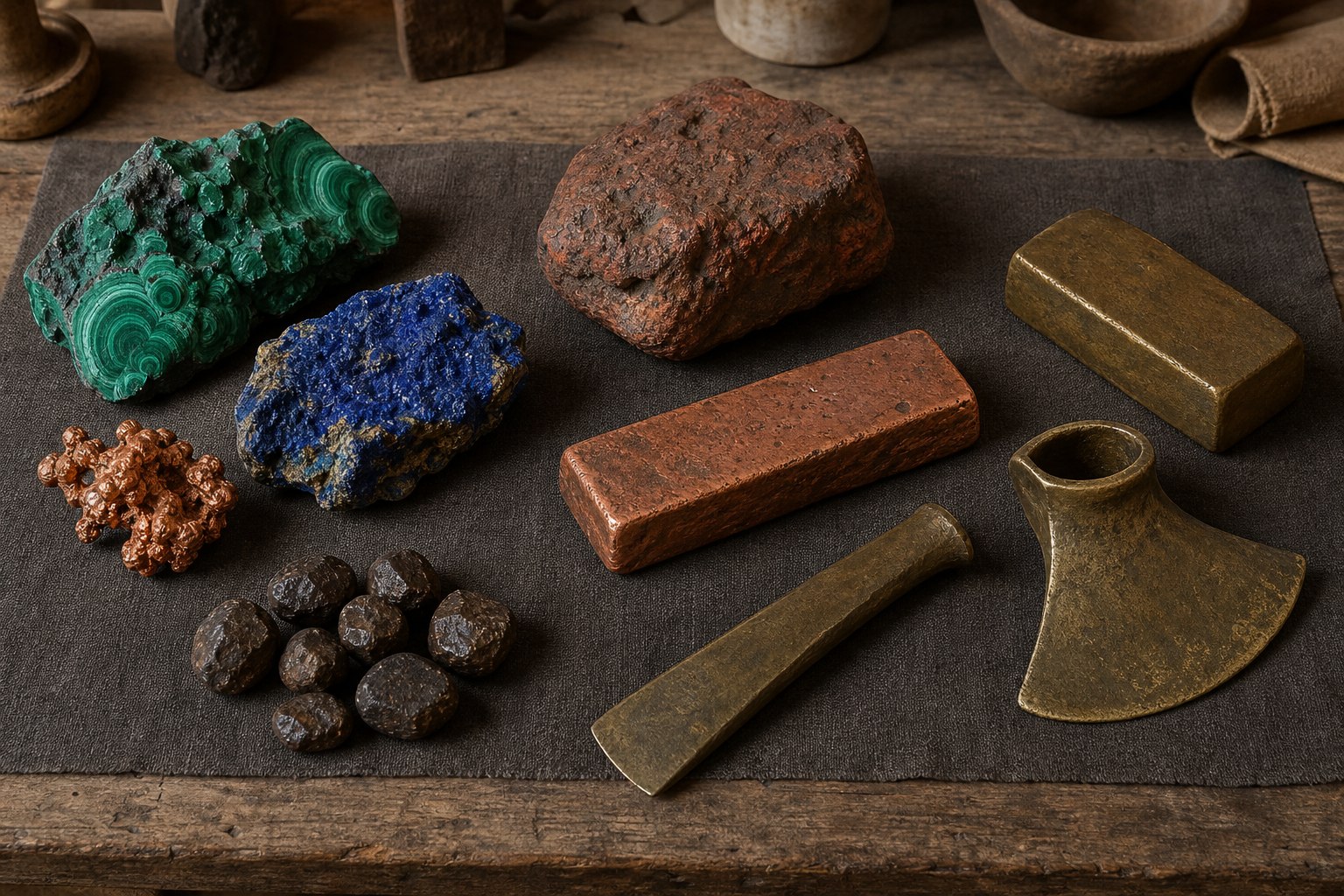
AI-generated visual reference: copper and tin ores → copper and bronze bars → cast tools. It is not a historical photograph, ore-identification test, alloy composition standard, or safe casting demonstration.
Why it matters
Copper alloys are your training metal. They melt low enough to pour, they cast into finished shapes rather than needing forging, and the failure modes are forgiving. Learn crucibles, moulds, fluxes, and furnace atmosphere here, then apply the same skills to silver, glass, and eventually iron.
Practical uses copper beats iron at: cooking vessels (doesn't rust, conducts heat evenly — but see the tinning warning below), stills and condensers, pipes and plumbing, wire, ship sheathing, bells, coins, and anything needing corrosion resistance. Bronze bearings and gears outlast iron ones. And copper is the only route to electricity if you ever get that far — wire is copper.
Finding ore
General prospecting technique — reading the landscape for where ore concentrates, gossans, streak and density tests, panning upstream to a source, and assaying a deposit before you commit a season to it — is in mining and prospecting. This section covers what copper specifically looks like.
Copper ores are usually brightly colored, which makes prospecting easy.
| Ore | Appearance | Notes |
|---|---|---|
| Native copper | Reddish metal nuggets, malleable | Rare but real; needs no smelting at all. Lake Superior, Cyprus |
| Malachite | Vivid green, banded, often botryoidal (grape-like) | The beginner's ore. Carbonate — smelts easily, no roasting needed |
| Azurite | Deep blue, often with malachite | Same, equally easy |
| Cuprite | Ruby red, heavy | Oxide, smelts easily |
| Chalcopyrite | Brassy gold, iridescent tarnish | The most abundant ore, but sulfide — needs roasting and matte smelting. Harder |
| Chalcocite / bornite | Dark grey / "peacock ore" iridescent | Sulfides, richer than chalcopyrite |
Where to look: green and blue stains on rock faces are unmissable — the weathered "gossan" cap above a copper deposit. Look in arid regions where weathering exposes color, along quartz veins, and in contact zones around igneous intrusions.
Start with malachite. Green carbonate ore reduces directly with charcoal at a temperature you can reach with a simple bowl furnace. This is how copper smelting was discovered — almost certainly by accident, from malachite used as a pigment falling into a pottery kiln.
Smelting oxide/carbonate ore (the easy route)
- Crush the ore and hand-sort out the obviously barren rock.
- Mix with crushed charcoal, and add a flux — iron oxide if your gangue is silica-rich, or silica sand if your gangue is iron-rich. Flux exists to make the waste melt into a fluid slag that separates cleanly.
- Charge into a clay bowl furnace or short shaft furnace with a tuyère at the base.
- Blow hard. Target 1150–1250°C and a strongly reducing atmosphere — plenty of charcoal, air entering low so it burns to CO before reaching the charge.
- Copper (mp 1085°C) collects as a puddle at the bottom under a layer of slag.
- Let it cool and break out the copper "bun," or tap it into a mould.
The chemistry is simply CuO + CO → Cu + CO₂, with the carbonate decomposing
to oxide on the way up.
Smelting sulfide ore (chalcopyrite — the harder, more common route)
Sulfide ores need an extra loop, but they're what most deposits actually contain.
- Roast the crushed ore in an open hearth with plenty of air, stirring, for hours. This historical method burns off part of the sulfur as SO₂. Do not use an open hearth: sulfide roasting and converting require contained equipment, effective local capture and treatment of emissions, exclusion of bystanders, exposure monitoring, and controlled waste. Being outdoors or downwind is not a control; see the warnings in sulfur.
- Matte smelt. Melt the roasted ore with silica flux. Iron combines with the silica and floats off as slag; copper and remaining sulfur sink as a dark, dense liquid called matte.
- Roast and smelt again, repeatedly. Each cycle removes more sulfur and iron and enriches the matte.
- Convert. Blow air through the molten matte. The last sulfur burns out as SO₂ and you're left with blister copper — so named for the gas bubbles that pit its surface.
- Poling / refining (historical). Green-wood poling was used to deoxidize molten copper, but introducing wet material to a melt creates a severe steam- explosion and splash hazard. Do not reproduce it as an open-workshop test; controlled refining uses a characterized deoxidation process, dry tools, barriers, ventilation, and analytical endpoints.
Alloying — the real skill
Pure copper is soft and gummy. It work-hardens as you hammer it, and you restore it by annealing: heat to a dull red and let it cool. Unlike steel, the cooling rate doesn't matter — quenching and air-cooling both soften copper equally, and smiths usually quench simply because it's faster and knocks the scale off. Note this is the opposite of steel, where quenching hardens.
But pure copper makes poor tools.
Bronze (copper + tin)
| Tin % | Properties | Use |
|---|---|---|
| 5–8% | Tough, forgeable, golden | Sheet, vessels, armour |
| 10–12% | Hard, strong, castable | The general-purpose alloy — tools, weapons, statuary |
| 20–22% | Hard, brittle, very sonorous, silvery | Bells and cymbals |
| 30%+ | White, brittle, takes a mirror polish | Speculum metal — mirrors and telescope reflectors |
Add tin after the copper is fully molten, stir with a charcoal rod, and pour promptly — tin oxidizes and burns off if you hold the melt. Cover the melt with charcoal to keep air off.
The tin problem: cassiterite (tin oxide — heavy, black-brown, found as water-worn pebbles in stream gravels) is geologically rare and concentrated in very few places: Cornwall, Iberia, Erzgebirge, Malaysia, Nigeria, Bolivia. The entire Bronze Age ran on long-distance tin trade, and its collapse is a leading theory for the Bronze Age collapse. If there's no tin where you land, use one of these instead:
- Arsenical bronze — the historical predecessor of tin bronze, made by smelting copper with arsenic-bearing ores. It works well. Do not do this. Arsenic fume during smelting is acutely and chronically poisonous, and the historical association between smiths and lameness may well be arsenical neuropathy. Not worth it when alternatives exist.
- Brass — see below. Zinc is far more common than tin.
- Leaded bronze — a few percent lead improves castability and machinability enormously. Fine for statues, bearings, and gears; never for anything holding food or drink.
Brass (copper + zinc)
Brass is harder, more corrosion-resistant, gold-colored, and — crucially — zinc ore is widespread where tin is not.
The problem: zinc boils at 907°C, below copper's melting point of 1085°C. Add zinc metal to molten copper and it flashes off as burning white vapor. Metallic zinc was therefore not available in the West until the 18th century.
The solution — cementation brass, known since Roman times:
- Pack finely crushed calamine (zinc carbonate/silicate ore — pale, earthy, often white or yellow-brown) together with charcoal and small pieces of copper in a sealed clay crucible.
- Heat to around 900–1000°C — below copper's melting point — and hold for hours.
- The ore reduces to zinc vapor, which is absorbed directly into the solid copper without ever existing as liquid metal.
- Then raise the heat to melt and pour.
This tops out around 28% zinc. To go higher you need distilled zinc metal — made by reducing calamine with charcoal in a sealed retort with a downward-pointing condenser tube, so the vapor condenses out of contact with air. India was doing this at Zawar by the 12th century, centuries before Europe.
Antimony — smelt it here, use it in printing
Antimony is not a copper alloy, but historical type-metal formulations often used it to improve hardness and casting detail. Printing can begin with woodblocks or other materials; antimony is useful for durable movable metal type, not a prerequisite for printing itself.
Stibnite (Sb₂S₃) commonly appears as soft lead-grey metallic needles, often in radiating sprays or bundles, in hydrothermal quartz veins, frequently alongside cinnabar and realgar. It's soft enough to mark paper but appearance does not establish identity or purity. Do not heat an unknown mineral in a candle flame: it can release toxic antimony, arsenic, mercury, and sulfur compounds. Use mineralogical and chemical analysis.
Historical process outline—not a workshop procedure:
- Liquation (the simple one). Stibnite melts at only 550°C. Heat the crushed ore in a perforated pot set over a collecting vessel and the sulfide simply runs out, leaving the rock behind. You now have clean stibnite, not yet metal.
- Then reduce it. Roast the liquated stibnite in air to drive off sulfur as SO₂ and convert it to the oxide, then smelt that oxide with charcoal and a little soda or potash flux at around 800–900°C. Antimony metal (mp 631°C) runs out as a brittle, silvery, coarsely crystalline button.
- The one-step alternative: heat stibnite directly with scrap iron. The iron
takes the sulfur and antimony metal separates out —
Sb₂S₃ + 3 Fe → 2 Sb + 3 FeS. Wasteful of iron, but it skips the roast.
Antimony compounds and process fume are toxic, and roasting stibnite releases SO₂. These steps need closed handling, engineered local exhaust and emission treatment, exposure monitoring, hygiene, and contained hazardous waste. If those controls and authenticated ore are unavailable, do not attempt them.
Casting
This is where copper alloys shine.
- Open mould — carve a shape into stone or fired clay and pour. Flat objects only. Simplest possible start.
- Two-part mould — stone or clay halves, with pour channel (sprue) and air vents. Reusable. Good for axes, tools, ingots.
- Green-sand casting — pack a controlled-moisture, permeable sand/clay system around a wooden pattern in a two-part box, remove the pattern, pour. This is the workhorse method and it's how most metal was cast until modern times. Cheap, fast, and the mould material can be reclaimed for many cycles if screened, reconditioned, and kept free of metal, moisture, and contaminant buildup.
- Lost wax — model the object in beeswax, coat it in fine clay slurry, build up thicker clay, dry, then fire so the wax melts and runs out. Pour metal into the cavity, break the mould to release. Handles arbitrary complexity and undercuts. This is how every ancient bronze statue was made.
Casting rules that matter:
- Match moisture control to the mould system. Ceramic, stone, and investment moulds must be fully dried and commonly preheated. Green sand intentionally contains controlled moisture and must have validated composition, permeability, venting, and handling; arbitrary wet sand can explode or spit.
- Vent the mould. Trapped air stops the metal filling. Cut fine vent channels at the high points.
- Include a riser/feeder — an extra reservoir of metal above the casting. Metal shrinks as it solidifies, and without a feeder it draws that shrinkage from inside your casting, leaving voids.
- Pour hot, fast, and in one continuous stream. Hesitation gives cold shuts where two fronts of metal meet but don't fuse.
- Skim the dross off the melt before pouring, and keep charcoal on the surface.
Working and finishing
- Annealing: copper alloys work-harden; heat to dull red and cool (quench or air, either works) to soften. Alternate hammering and annealing to raise vessels from sheet.
- Tin the inside of any copper cooking vessel. This page tells you elsewhere to make verdigris deliberately by exposing copper to vinegar — that same reaction happens in a pot of anything acidic, and copper salts cause vomiting and diarrhea, with chronic exposure doing worse. Wipe the cleaned interior with flux (rosin or sal ammoniac), melt tin into it, and spread it thin with a pad of tow. Re-tin whenever the copper starts showing through. Every historical copper kitchen did this, and it is the single most important safety habit on this page after the fume warnings.
- Patina: exposure to vinegar fumes gives verdigris (green); controlled exposure to weather gives the familiar green statue patina; heating gives browns and reds. Also useful as pigments.
- Soldering/brazing: silver or a lower-melting copper alloy plus a flux (borax, or resin) joins copper pieces. Much easier than forge welding iron.
Safety
- Zinc fume from overheating brass can cause metal fume fever and other respiratory harm. Prevent overheating and use effective source-capture local exhaust; ordinary room ventilation is not enough.
- Arsenic and antimony in some copper ores produce poisonous fume. Odor is not a reliable detector. Characterize ore before heating; stop and evacuate on any loss of containment or ventilation.
- Lead in leaded alloys: see the warnings in silver. Never for food vessels.
- SO₂ from roasting sulfide ore requires capture, treatment, gas monitoring, and an exclusion zone—not an outdoors/downwind rule.
- Uncontrolled moisture near molten metal can cause a steam explosion. Keep all tools and non-green-sand mould systems dry and preheated as specified; use only a characterized, permeable green-sand process where moisture is intentional.
Failure modes
| Symptom | Cause | Fix |
|---|---|---|
| No metal, just a glassy lump | Not reducing enough, or too cold | More charcoal, stronger blast, better insulation |
| Copper is brittle and crumbly | Oxygen, sulfur, another impurity, or process error | Analyze the metal and refine under a validated controlled process; do not put wet wood into a melt |
| Casting doesn't fill the mould | Metal too cold, no vents, mould cold | Pour hotter and faster, vent, preheat |
| Casting has internal voids | Shrinkage with no feeder | Add a riser above the thickest section |
| Casting has rough gas-pitted surface | Moisture in mould, or gassy metal | Dry the mould thoroughly; skim and cover the melt |
| Bronze is weak / wrong color | Tin burnt off | Add tin last, cover with charcoal, pour promptly |
| Brass melt fumes white and loses zinc | Overheated | Cementation method, or keep the melt just at pouring temp |
| Crucible fails | Poor refractory, thermal shock | Heavily grogged clay, preheat slowly, replace often |
Era notes
Copper smelting dates to roughly 5000 BCE in Anatolia and the Balkans; tin bronze to ~3300 BCE. This is the oldest extractive metallurgy there is, and it's the correct first metal for any restart. If you land in a pre-metal society, malachite plus a charcoal fire in a pot is a demonstration you can do in an afternoon, and it will change everything for them.
Your knowledge advantages: understanding reducing vs oxidizing atmosphere as a deliberate control, the riser/feeder principle in casting, sand casting as a cheap reusable method, cementation brass where tin is unavailable, and knowing that arsenical bronze is poisoning the smith.