Paper
Difficulty: moderate — the process is simple, the sheet-forming takes practice. Prerequisites: lye/potash, a pot big enough to boil fiber, woven cloth or fine screen.
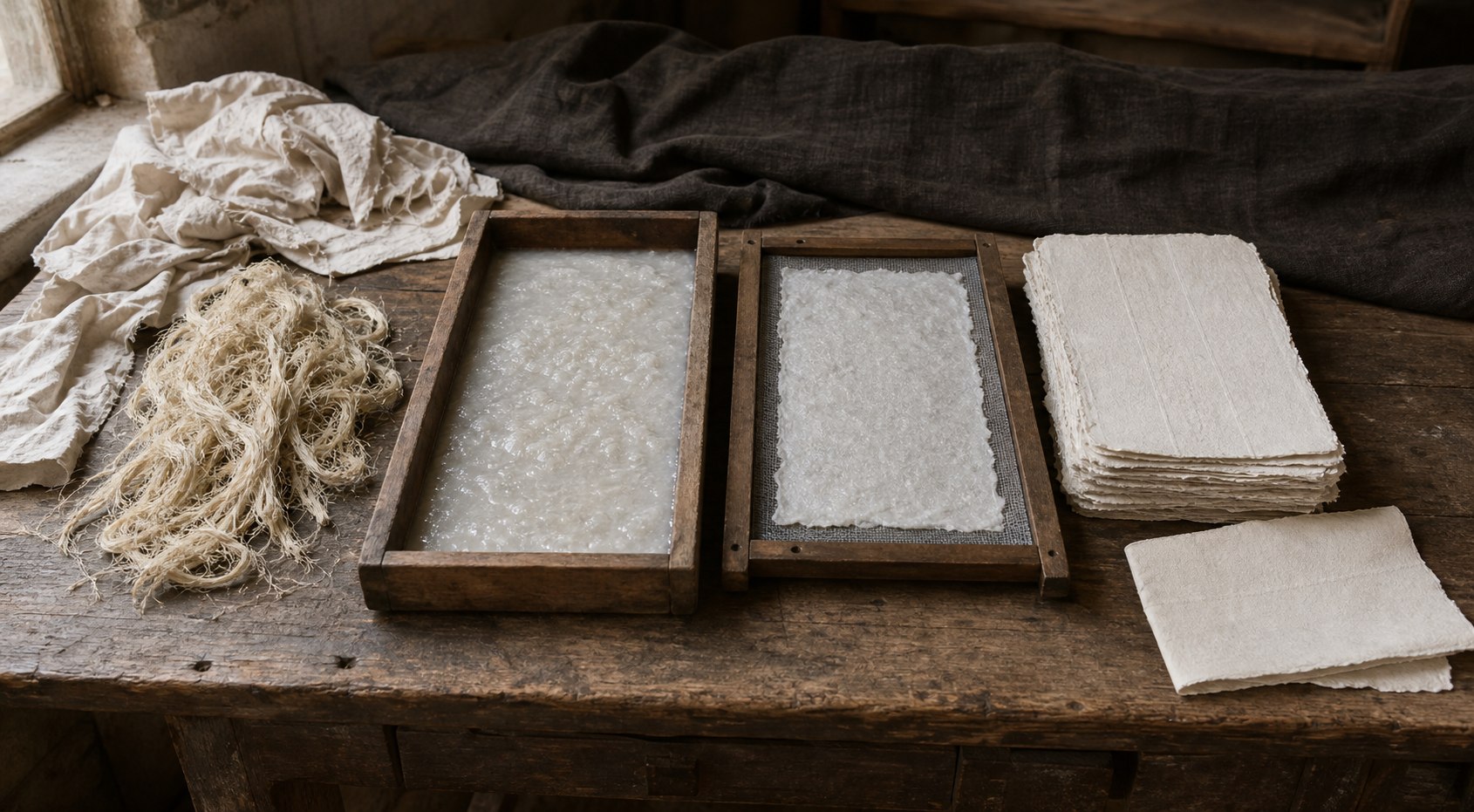
AI-generated visual reference: rags and bast → pulp → wet sheet on a mould → dry handmade sheets. It is not a historical photograph or equipment drawing.
Why it matters
Paper is cheap information storage. Parchment takes a whole animal skin for a few pages; papyrus was geographically restricted compared with rag and bast paper; paper can use many locally available fibers. Combined with movable type, it's the highest-leverage civilization accelerator in this repo. It's also a lucrative trade good — paper took roughly a thousand years to travel from China to Europe, and arriving with the recipe skips that entirely.
What paper actually is
A mat of cellulose fibers, matted together while suspended in water and then dried. The fibers bond to each other by hydrogen bonding as the water leaves — no glue is needed. Everything below is in service of: get clean cellulose fibers, separate them individually, suspend them in water, catch them on a screen in an even layer, press, dry.
Step 1: Choose your fiber
Best sources (long, strong fibers, minimal lignin):
- Old rags — linen and hemp cloth. The European standard for centuries. Already de-lignified by the original textile processing, so this is the easiest possible start. Cotton rags work too.
- Bast fibers — the inner bark of paper mulberry (kozo), mulberry, hemp, flax, ramie, jute. The Chinese and Japanese standard, and superb quality.
- Grasses and straw — rice straw, wheat straw, esparto, bamboo. Abundant but shorter fibers, weaker paper, needs harder cooking.
- Worn-out rope, fishing nets, sailcloth. Free and pure.
Avoid at first: whole wood. Wood is ~25% lignin, which is what makes groundwood paper brown and brittle. De-lignifying wood needs strong chemicals and pressure; skip it until you have sulfite or soda-process capability.
Step 2: Retting and stripping (bast fiber only)
If starting from bark, soak the cut branches or steam them, then peel off the bark. Scrape away the outer dark bark — it carries color and grit — and keep the pale inner bark. Then ret in a contained bath for days to weeks until the fibers separate easily. Judge by pulling: when fibers slip apart cleanly, it's done. Over-retting rots the cellulose itself. Retting water has high organic load and can deplete oxygen in a stream or pond; reuse or treat it in a characterized system rather than using natural water as the process drain.
Step 3: Cook in alkali
Select a documented cook for the exact fiber and desired pulp. Specify the active chemical, purity/concentration, liquid ratio, temperature, time, and dose on dry-fiber mass. Potassium carbonate-rich ash liquor, calcium hydroxide, and sodium or potassium hydroxide are not interchangeable by mass; a generic “10–20% alkali” can undercook one fiber and destroy another.
This dissolves lignin, pectin, waxes, and gums, leaving cellulose. The liquor will turn dark brown — that's the lignin coming out. Rags need the least cooking; straw and bamboo need the most.
Then wash in contained clean-water stages until rinse pH and conductivity meet the selected process endpoint; skin feel, “squeaky,” or clear color is not a caustic assay. Reuse and treat wash water rather than discharging it to a watercourse. Residual process chemicals can weaken and discolor paper.
Alkali cooks can cause severe skin and eye burns and hot-liquor scalds. Use compatible dedicated vessels, splash/eye/skin protection, controlled charging and cooling, ventilation, and a characterized spill/waste plan. Do not lean over or hand-test a hot cook.
Step 4: Beat the pulp
This is the step that determines paper quality, and it's the one most people underdo.
Beating does two things: it separates fibers from each other, and it fibrillates them — frays the fiber walls so they bond to their neighbors. Under-beaten pulp gives weak, fluffy, blotting-paper-like sheets. Well-beaten pulp gives strong, dense, translucent paper.
Methods, in order of increasing sophistication:
- Pound wet fiber on a flat stone with a wooden mallet — hours of work.
- Water-powered stamper mill: cams on a rotating shaft lift heavy wooden hammers that drop into mortars of pulp. This was the standard European technology and is entirely buildable with a waterwheel and carpentry.
- Hollander beater (1680s): pulp circulates in an oval trough past a rotating roll with blades over a fixed bedplate. Ten times faster than stampers. If you can build gears and a waterwheel, build this.
Powered stampers and beaters need fixed guards around drives and impact points, interlocked or otherwise secured access, a positive lockout before cleaning or unjamming, stable walkways, and control of wet floors and aerosol/fiber dust. Never reach into moving pulp machinery.
Test: take a pinch of pulp, drop it in a jar of water, and shake. Well-beaten pulp disperses into a cloudy, even suspension with no visible clumps or knots.
Step 5: Form the sheet
The mould and deckle. The mould is a rectangular wooden frame with a screen; the deckle is a removable open frame that sits on top to contain the pulp and define the edges.
Screen options:
- Woven cloth stretched on a frame — the simplest ("floating mould"). One sheet must dry on the mould before you can make the next, so it's slow.
- Laid screen of split bamboo or reeds sewn with silk or horsehair — flexible, removable, and lets you couch off wet sheets one after another so one mould makes hundreds of sheets a day. This is the productivity unlock.
- Woven brass wire if you can draw wire.
The pull: fill a vat with pulp suspended in water — roughly 1 part pulp to 100 parts water, thin enough that it looks like dirty water, not porridge. Stir it thoroughly right before each pull (fibers settle fast). Dip the mould in vertically, level it under the surface, lift it out horizontally, and give it a shake in two directions as the water drains. That cross-shake is what interlocks the fibers in random orientation and makes the sheet strong in both directions. Skipping it gives paper that tears easily one way.
Step 6: Couch, press, dry
- Couch: flip the mould face-down onto a damp woolen felt and lift it away, leaving the wet sheet. Build a stack (a "post") of alternating sheets and felts.
- Press: put the post in a screw or lever press and squeeze hard. This removes most of the water and is where fiber-to-fiber bonding really happens. Weak pressing = weak paper.
- Dry: peel the sheets off the felts and hang them, or press them onto a heated smooth wall or board. Drying in a stack under light weight keeps them flat.
Step 7: Sizing (only if you want to write with ink)
Unsized paper is blotting paper — ink feathers and bleeds through. To size:
- Gelatin/animal glue size: use clean collagen-rich hide scraps, connective tissue, or fish skin/bone to make a controlled thin glue, then dip, re-press, and dry. Hoof and horn themselves are mostly keratin, not useful gelatin feedstock.
- Starch size: rice or wheat starch paste, thinned. The East Asian method.
- Internal starch sizing: a validated starch addition can reduce absorbency from within the sheet.
- Formation aid: plant mucilage such as tororo-aoi is added to the vat chiefly to disperse long fibers and control drainage so thin, even sheets can be formed. Do not assume it supplies the ink resistance of gelatin or starch sizing.
Some historical gelatin sizes used alum, which can acidify a poorly formulated sheet. Do not collapse all permanence failures into that one ingredient: lignin-rich groundwood, rosin-alum sizing, metal contamination, atmospheric pollution, heat, moisture, and formulation/storage all contributed to brittle nineteenth-century paper. Important records need a tested, pH-compatible paper/size/ink system and controlled storage.
Improving whiteness
- Use whiter rags to begin with — sorting rags by color was a real trade.
- Light bleaching: historical wet sun exposure can lighten some pulp, but ultraviolet/photooxidative exposure can also weaken and yellow cellulose. Use short controlled trials and test color and strength; do not prolong it on archival sheets.
- Loading: stir a little fine white clay or chalk into the vat for opacity and smoothness.
- Avoid iron and other metal contamination, but do not diagnose every brown spot as iron. “Foxing” is multifactorial and can involve moisture, fungi, metals, paper composition, and storage. Isolate affected records for conservation assessment rather than applying a guessed chemical treatment.
Failure modes
| Symptom | Cause | Fix |
|---|---|---|
| Sheet falls apart when couched | Under-beaten pulp, or too thin | Beat longer; more pulp in vat |
| Sheet is lumpy with fiber knots | Poor beating/dispersal | Beat longer, stir vat before each pull |
| Thick at one edge | Mould not level on lift, or bad shake | Practice the horizontal lift |
| Paper is weak and tears in one direction | No cross-shake | Shake front-back and side-side |
| Ink feathers and bleeds through | Unsized | Size it |
| Paper turns brittle/yellow in a year | Residual alkali or lignin | Wash more; cook longer; avoid wood |
| Rust-colored spots or foxing | Metal, moisture, microbial growth, composition, or storage | Isolate and diagnose; correct water/material/storage controls rather than bleaching by guess |
Worker and process safety
- Sort old rags in a segregated, ventilated area. Reject chemically contaminated, mold-heavy, vermin-soiled, or suspect animal-origin material; suppress dust, provide hygiene and suitable protective equipment, and follow local infectious-material guidance.
- Use wet or locally extracted methods for fiber, clay, chalk, and dried-pulp dust. Keep food and drinking water outside dirty processing areas.
- Guard cutters, beaters, stampers, presses, gears, belts, and shafts; lock and verify zero energy before clearing a jam. Control sharp edges, lifting loads, hot alkali, steam, splashes, and wet floors.
Sources and limits
- OSHA's pulp, paper, and paperboard-mill requirements address guards, lockout, materials handling, and process hazards.
- Peer-reviewed papermaking research describes tororo-aoi as a formation and drainage aid, not a blanket substitute for ink-resistance sizing.
- Fiber cooks, wastewater treatment, archival permanence, and machine design require process-specific testing. This chapter is historical orientation, not a validated chemical schedule or machinery specification.
Era notes
Paper was invented in Han China (traditionally credited to Cai Lun, ~105 CE), spread to the Islamic world by the 8th century, and reached Europe via Spain and Italy in the 12th–13th centuries. Every physical requirement — rags, ash lye, a pot, a screen, a press — exists in the Bronze Age. There is no material barrier to making paper millennia early; it is purely a knowledge gap, which makes this one of the best things in this repo to arrive with.