Sulfur
Difficulty: moderate for low-temperature melting of verified native sulfur; specialist industrial work for vapor refining, sulfide roasting, fumigation, or acid production. Prerequisites: verified ore, controlled indirect heat, dry noncombustible equipment, eye and skin protection. Any process that deliberately creates H₂S, SO₂, SO₃, or NOₓ also needs engineered gas capture, treatment, monitoring, and an exclusion zone — outdoor airflow is not a substitute.
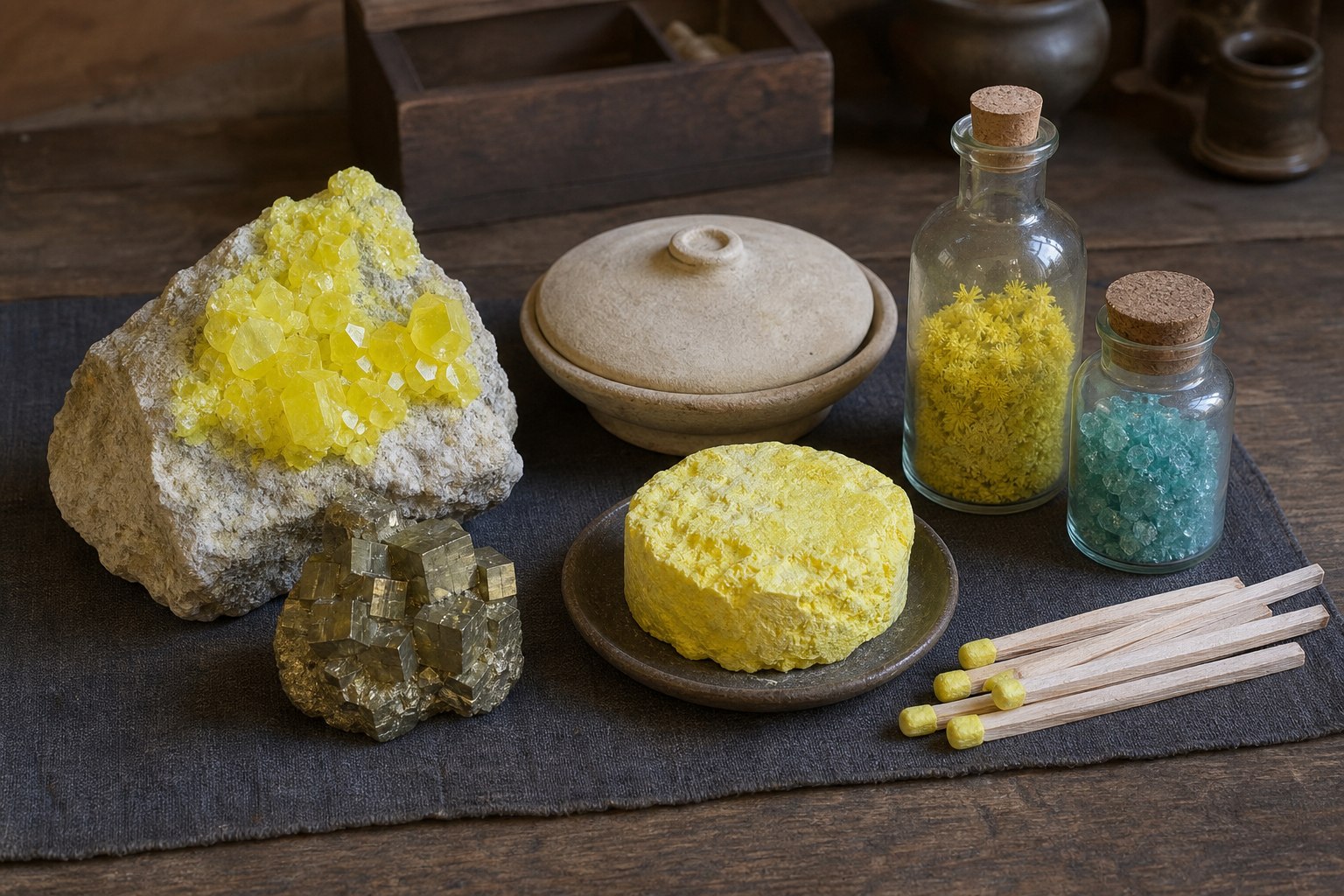
AI-generated visual reference: possible sulfur-bearing minerals → contained refined forms and simple products. Color cannot identify a mineral, and this is not a refining, ignition, gas-handling, fumigation, or acid-production guide.
Why it matters
Sulfur is a gateway chemical:
- Sulfur dioxide was an important pre-industrial antimicrobial and bleaching agent. Measured processes can sanitize wine vessels or pretreat fruit before drying, but the same gas can cause severe respiratory injury; it is not a general-purpose building fumigant.
- Sulfuric acid — the single most important industrial chemical. Everything from fertilizer to dyes to metal refining runs on it. Made from sulfur.
- Vulcanized rubber, if you ever get to rubber.
- Medicine — sulfur ointment is a genuinely effective treatment for scabies and various skin parasites, and was used for exactly that for millennia.
- Matches — sulfur-tipped splints catch flame from a coal far more reliably than bare wood.
- Cement: molten sulfur was historically used to set iron fixings into stone.
Where to find it
General prospecting technique is in mining and prospecting — including the roasting hazards, since sulfide roasting is where most of the SO₂ in this repository comes from.
Sulfur does not turn up randomly. You need one of these:
1. Volcanic deposits (the classic source, and by far the easiest) Native sulfur forms around fumaroles and volcanic vents as bright canary-yellow crusts and crystals, but color alone is not a reliable identification. Sicily (which supplied most of the world's sulfur until the 20th century), Iceland, Java, Japan, and the Andes have important deposits. Fumaroles can emit lethal H₂S and SO₂, odor can disappear through olfactory fatigue, and the ground may be hot or unstable. Collect only from a surveyed, inactive or professionally controlled site with gas monitoring and an escape plan; do not imitate unprotected historical mining.
2. Sedimentary deposits over salt domes Native sulfur occurs with gypsum and limestone in cap rock above salt domes, produced by bacteria reducing sulfate. Gulf Coast USA, Poland, Iraq. Usually underground, so harder without drilling.
3. Pyrite and other sulfide minerals (the fallback, available almost anywhere)
- Pyrite (FeS₂) — "fool's gold." Brassy metallic yellow, often in perfect cubes or radiating discs, hard (scratches glass, unlike real gold), brittle, sparks against steel. Common in shales, coal seams, and quartz veins.
- Marcasite — same chemistry, paler, crumbles readily.
- Galena, sphalerite, chalcopyrite — the ore sulfides. Industrial roasting produces SO₂ that a closed gas-handling plant can capture (see silver); an open furnace cannot do so safely.
- Gypsum — calcium sulfate. Route to sulfur exists but is genuinely hard pre-industrially; don't start here.
4. Sulfur springs Hot springs may deposit sulfur where H₂S meets air, but they are not “easy pickings.” Never use smell to judge safety: H₂S can rapidly disable the sense of smell and can be fatal. Treat the spring margin as a hazardous-gas and unstable- ground area unless it has been surveyed and continuously monitored.
Refining native sulfur
Volcanic sulfur comes mixed with rock, ash, and clay. Sulfur melts at only 115°C but boils near 445°C. That low melting point permits indirect separation; it does not make sulfur vaporization a low-risk operation.
Method A: Melting out
Heat the crude sulfur ore gently to just over 115°C in a dry, covered, noncombustible vessel, using an indirect, temperature-controlled oil or sand bath with no flame or ignition source near the sulfur. Water cannot reach sulfur's melting point at ordinary pressure. Let mineral grit settle, then decant through a preheated noncombustible ceramic or metal screen; cloth can ignite or spill molten sulfur. Never add water to hot or molten sulfur.
Keep it under ~160°C. Above that sulfur polymerizes into a dark, thick, rubbery mass that will not pour. If this happens, remove the heat, keep the vessel covered, and let it cool in an isolated fire-safe area before remelting gently. Do not continue toward the boiling point.
Method B: Sublimation / distillation (gives the purest product)
This is the historical principle behind flowers of sulfur: vapor from a hot retort condenses as fine solid sulfur in a cool chamber or as liquid sulfur in a warmer receiver.
Specialist process — not a beverage-still operation. Producing sulfur vapor requires temperatures near 445°C. Air leakage can ignite it; leaks or burning sulfur create SO₂; a blocked line or failed retort can rupture and release hot vapor. Attempt it only with a gas-tight high-temperature system, remote heating, pressure control, continuous local exhaust to a scrubber, gas monitoring, fire control, and an exclusion zone. Otherwise use low- temperature settling and decanting instead.
Method C: The calcarone (historical context only)
Stack crude ore in a large heap on a sloped stone floor, cover with spent ore and earth, and burn part of the sulfur itself as fuel. The heat melts the rest, which runs downhill and is collected in wooden molds. Wasteful — you lose roughly a third of the sulfur — but needs no external fuel at all, which is why it dominated for centuries.
Do not use this method. It produces uncontrolled quantities of SO₂ and cannot be made acceptable merely by moving downwind. The Sicilian sulfur districts suffered destroyed vegetation and severe worker illness. The method is retained here as historical context, not as a fallback procedure.
Getting sulfur from pyrite
If you have no native sulfur, pyrite is nearly ubiquitous. Two routes:
Distillation: heat pyrite strongly in a sealed retort with no air. It
decomposes, giving off sulfur vapor which you condense:
FeS₂ → FeS + S. This needs a strong red heat and a retort that survives it,
and a leak can release sulfur vapor, H₂S/SO₂, and hot solids. This is a
specialist retort process subject to the same gas-tight system, remote
operation, scrubber, monitoring, and exclusion requirements as sulfur
distillation above — not an improvised furnace job.
Weathering to copperas (the more useful route): pile crushed pyrite-rich shale on a lined, curbed pad, wet it, and leave it for months to years. Air and moisture oxidize it to iron sulfate (green vitriol / copperas), which can be leached and crystallized. Capture and treat every drainage stream: open piles produce acid mine drainage that mobilizes metals and contaminates soil, groundwater, and streams. Copperas is directly useful in iron-gall ink and some dye processes and is a raw material for the historical route below.
Sulfuric acid — the real prize
Two historical routes are summarized for context. Neither is a field procedure. Both require a chemical-plant enclosure with corrosion-resistant gas handling, continuous local exhaust and scrubbing, pressure control, remote operation, gas monitoring, emergency wash facilities, and trained operators. If those controls do not exist, do not make mineral acid.
1. Distilling vitriol (the alchemists' oil of vitriol). Heating dehydrated green vitriol strongly releases sulfur oxides, historically absorbed into water to produce acid. Retort failure, pressure, and escaping SO₂/SO₃ make this unsuitable for improvised glass or clay apparatus; the historical difficulty was safe materials and gas containment, not merely a strong fire.
2. The bell-jar / lead chamber method (much better, 18th century). Historically, sulfur and saltpeter generated sulfur and nitrogen oxides in a large chamber, and water absorbed the acid. Lead-lined chambers resisted some acid conditions but created a separate lead-exposure and contaminated-waste problem. A functioning process needs designed, continuous gas circulation and scrubbing; never open or “ventilate” a charged chamber into a workspace.
This is a genuine leverage point: sulfuric acid unlocks nitric acid (from saltpeter), hydrochloric acid (from salt), and thus most of inorganic chemistry.
Serious hazard. Concentrated sulfuric acid causes severe burns, and always add acid to water, never water to acid — the reverse boils explosively and throws acid. The gases involved (SO₂, SO₃, NO₂) are all severely damaging to lungs at low concentrations. Outdoor or upwind work is inadequate: use closed capture and treatment, suitable acid PPE, a face shield, emergency eyewash/shower, and an exclusion zone.
Practical uses to set up first
- Sulfur dioxide for vessel sanitation. This can improve wine and cider keeping quality only as a measured, validated process. Treat the vessel and surrounding area as an unoccupied fumigation zone; prevent fire spread, capture escaping gas, ventilate completely, and verify clearance with an instrument before entry or filling. Odor is not a clearance test.
- Fruit sulfuring. Use food-grade sulfur and a validated dose, exposure time, dryer airflow, and final sulfite specification. A closed box of unmeasured burning sulfur can poison workers and leave uncontrolled residue.
- Sulfur ointment. Formulations containing precipitated or otherwise pharmaceutical-grade sulfur can treat scabies and some skin conditions. Do not put mined or technically refined sulfur on skin; use a validated formulation and clinical guidance.
- Fungicide. Agricultural sulfur controls powdery mildew when its purity, particle size, application rate, temperature limits, and crop interval are controlled. Avoid inhalation and ignition; do not improvise with refinery dust.
Failure modes
| Symptom | Cause | Fix |
|---|---|---|
| Molten sulfur turns dark and won't pour | Overheated past ~160°C | Stop heating, cover, isolate, and cool; remelt later with indirect temperature control |
| Sulfur ignites during melting | Ignition source, air ingress, or overheating | Stop heat remotely, evacuate from SO₂, and use the site fire plan; do not approach an uncontrolled sulfur fire |
| Low-temperature product is grey/brown | Rock, ash, or organic contamination | Let a remelt settle and decant through a preheated noncombustible screen; do not escalate to vapor refining without the specialist controls above |
| A vapor-refining receiver yields liquid rather than powder | Receiver is above sulfur's melting point | Stop and review the engineered process; do not open or adjust a hot charged system |
| Retort cracks during pyrite distillation | Thermal shock, pressure, corrosion, or inadequate materials | Evacuate and treat as a toxic-gas release; do not retry without an engineered, pressure-controlled system |
Safety summary
Elemental sulfur is a combustible solid and its dust can irritate eyes, skin, and airways; fine dust can form an explosive mixture in air, and mined material may contain hazardous impurities. Heating adds the larger hazards of molten burns, fire, and sulfur dioxide, which injures lungs and eyes at concentrations far below those that can be judged safely by smell. Keep sulfur dry, grounded and away from ignition, minimize airborne dust, and segregate it from oxidizers. Do not deliberately burn or vaporize sulfur without closed capture, scrubbing, monitoring, and trained emergency response. “Outdoors and downwind” is not a control system.
Sources
- NIOSH Pocket Guide: sulfur dioxide
- NIOSH Pocket Guide: hydrogen sulfide
- NIOSH: Occupational Exposure to Sulfuric Acid
Era notes
Sulfur ("brimstone") has been known and traded since antiquity — Homer mentions burning it to fumigate, Pliny describes its uses, and Chinese alchemists worked with it extensively from the Han dynasty. It's one of the few pure elements available to the ancient world alongside carbon, gold, silver, copper, tin, lead, iron, and mercury. The knowledge advantage is recognizing sulfur's useful chemistry while separating measured sanitation and agricultural applications from vapor, fumigation, and acid processes that require industrial controls.