Textiles: Fiber, Thread, and Cloth
Difficulty: basic hand operations are learnable; consistent cloth, powered machinery, chemical/wet finishing, and load-bearing cordage are skilled and can be hazardous. Prerequisites: suitable identified fiber and supervised hand tools to start; clean water, waste control, guarded equipment, and process-specific expertise as the workflow scales.
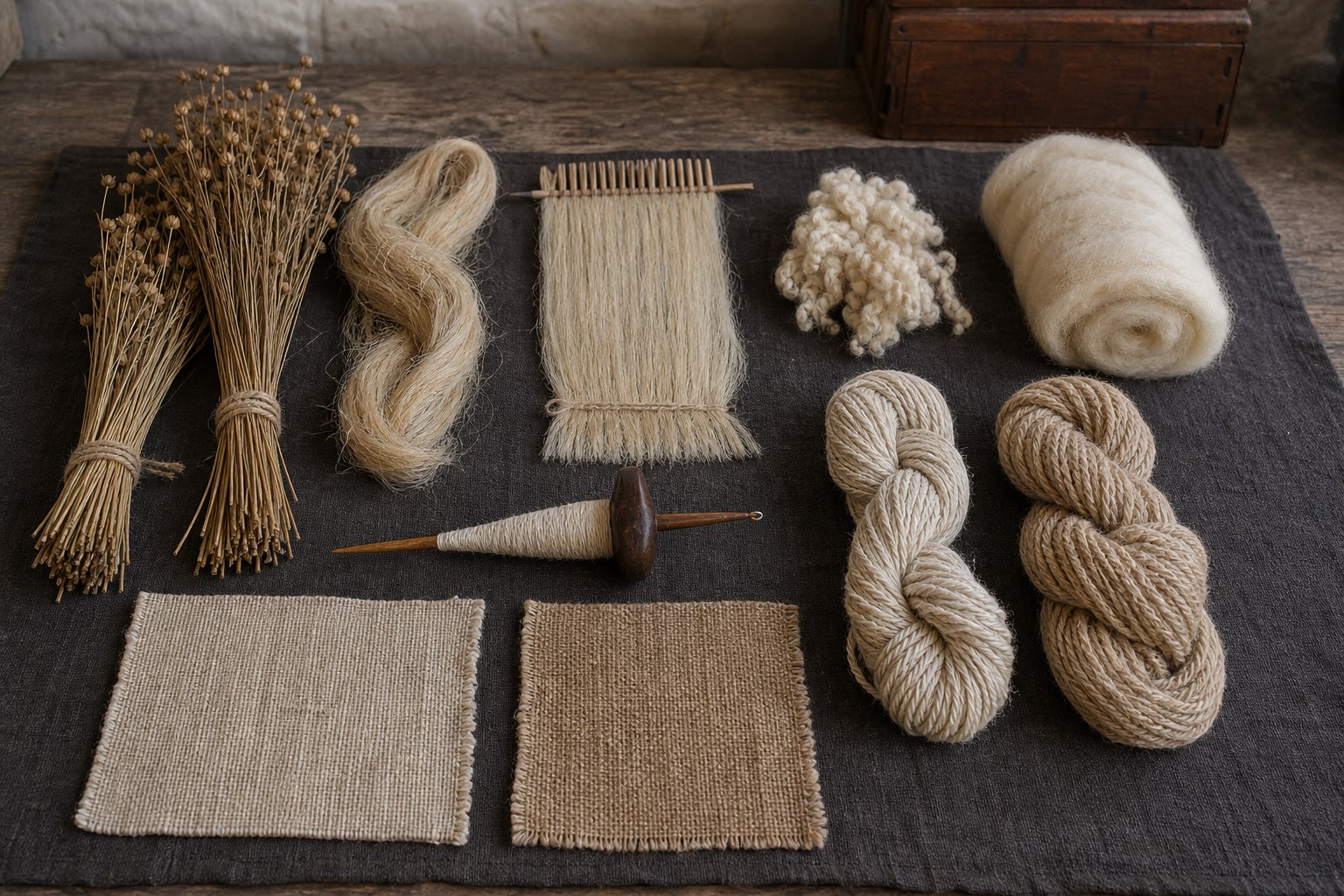
AI-generated visual reference: flax and wool → prepared fibers → spun yarn → woven cloth. It is not a historical photograph, fiber-identification standard, or specification for load-bearing cordage.
Why it matters
Cloth is the second-biggest expense in any pre-industrial household after food. A single linen shirt represented weeks of labor — spinning alone consumed more human hours than any activity except farming, which is why "spinster" became a word for an unmarried woman: it was the default paid work available to her.
This is the domain where labor-saving devices matter more than materials. The material knowledge here is modest; the machine knowledge is transformative. A suitable spinning wheel can raise output substantially, but the gain depends on fiber preparation, yarn count, operator skill, wheel design, maintenance, and whether spinning or another stage is the actual bottleneck.
Cloth also gives you: rope and cordage (which gates ships, cranes, and wells), sails, sacks, paper from worn-out rags, wicks, bandages, and filters.
The fibers
| Fiber | Source | Strength | Notes |
|---|---|---|---|
| Wool | Sheep, goat, camel, llama | Moderate | Warm when wet — the survival fiber. Takes dye beautifully. Felts |
| Flax → linen | Linum usitatissimum stems | Very high | Strong, cool, gets softer with age. Labor-intensive to process. Poor dye uptake |
| Hemp | Cannabis stems | Often high | Can make strong cordage and coarse cloth; strength and fineness depend on cultivar, retting, and preparation |
| Nettle | Suitable Urtica species and stands | Often high | Useful where the right species and climate support harvest; labor and yield vary |
| Cotton | Gossypium seed hairs | Moderate | Short-staple or poorly ginned cotton can be difficult; climate, cultivar, staple preparation, and seed removal govern spinnability |
| Silk | Bombyx mori cocoons | Extremely high | The luxury fiber; see below |
| Bast (lime/bark, jute, ramie) | Inner bark | Varies | Cordage and coarse cloth |
If you're starting from nothing: compare the fibers that the local climate, animals, crops, and existing craft can actually supply. Wool, flax, hemp, nettle, and cotton each shift labor among husbandry/cultivation, cleaning, retting, ginning, carding/combing, spinning, and finishing; no one fiber wins everywhere.
Step 1: Get the fiber out
Wool
- Shear with iron spring shears (the design hasn't changed in 2000 years) or pluck during the natural spring moult of primitive breeds.
- Skirt — throw away the filthy belly and britch wool.
- Scour — wash in warm water with a measured soap process to remove grease and dirt. Stale urine was historical but exposes workers to ammonia and biological contamination; use contained baths, ventilation, hygiene, and treated effluent if documenting it. Don't agitate hot wool or it felts. Some spinners deliberately spin "in the grease" and scour the finished yarn instead.
- Recover wool grease only as an industrial feedstock. Skimmed scour grease is not purified lanolin or a skin salve; refining and contaminant testing must remove dirt, microbes, pesticides, detergent, and process residues before a specified use.
- Card or comb. Carding (two paddles with wire teeth) makes a fluffy jumbled rolag for soft, warm, lofty woolen yarn. Combing (long-toothed combs) aligns the fibers parallel for smooth, strong, dense worsted yarn. Two different yarns from the same fleece — worth knowing which you want.
Flax, hemp, nettle (bast fibers)
The fiber is inside the stem, glued to the woody core by pectin. Getting it out is the whole job.
- Harvest by pulling up whole plants, not cutting — you want the full stem length.
- Ret — rot away the pectin. Either lay the stems in a field for 2–4 weeks and let dew and fungi do it (dew retting, easier, gives grey fiber), or use a contained water-retting tank or lined pond (often faster and paler, but odorous and high in oxygen-demanding waste). Never ret in or discharge untreated liquor to a natural stream or pond. This is the step that decides quality. Under-ret and the fiber will not separate; over-ret and cellulose strength is lost. Test representative stems and route liquor to a characterized treatment system.
- Break — crush the dried stems in a wooden brake (a hinged blade into a slotted block) to shatter the woody core.
- Scutch — beat the broken stems with a wooden blade against a board to knock the woody bits away.
- Hackle — pull the fiber through beds of iron spikes, progressively finer. Long fiber (line) comes out combed and parallel for good linen; short waste (tow) makes coarse cloth, rope, and lamp wicks.
Silk
Sericulture is a whole discipline, but the outline: rear Bombyx mori caterpillars on mulberry leaves, let them spin cocoons, then stifle the pupae with steam or sun before they emerge (a moth breaking out cuts the single continuous filament into useless short pieces). Soften the cocoons in hot water and reel several filaments together into a single thread. One cocoon yields several hundred metres of continuous filament, which is why silk needs no spinning in the usual sense.
The Byzantine Empire ran an industrial-espionage operation to steal silkworm eggs from China in the 6th century. If you have mulberry trees and can obtain eggs, this is arguably the highest-value agricultural product on this list.
Step 2: Spin
Spinning is twisting loose fibers so friction locks them together into a continuous thread. That's the whole principle.
Drop spindle
A stick with a weight (whorl) on it. Set it spinning, draft the fiber out with your hands, let the twist run into it, wind on, repeat. Costs nothing, portable, and it's how most of the cloth in human history was made. Women spun while walking, herding, and talking.
Output varies by fiber, preparation, spindle, yarn count, strength target, and spinner; measure local metres and acceptable mass per labor-hour instead of planning from one universal rate.
Spinning wheel — the upgrade worth introducing
A large driving wheel turns a small spindle whorl by a belt, so one turn of the wheel gives many turns of twist. This is simply mechanical advantage applied to twisting.
- Great wheel / walking wheel (~11th c. from India, Europe by 13th): the spinner turns the wheel by hand and drafts with the other hand, stopping to wind on. It can be much faster than a spindle for suitable fibers and yarns, but test the complete preparation-and-spinning workflow.
- Flyer-and-bobbin wheel (~15th–16th c.): a U-shaped flyer rotates around the bobbin, adding twist and winding on continuously, so there's no stopping. Add a treadle and both hands are free. Continuous wind-on can raise productivity, but no fixed multiplier transfers across products and operators.
The flyer mechanism is the clever part and it's the thing to carry back. It's just a rotating fork with hooks that drags the yarn onto a bobbin turning at a slightly different speed — the difference in speed is what winds on. Buildable with good carpentry, a lathe, and some wire.
Plying
A high-twist single can be lively and kink, while an appropriately spun single can be used directly in many woven and other textiles. Plying two or more singles in the opposite direction can balance torque and change strength, roundness, abrasion resistance, bulk, and handle. Choose singles or a defined ply construction for the intended warp, weft, knitting, sewing, or cordage use.
Step 3: Weave
Weaving interlaces a fixed set of warp threads with a crossing weft thread. The entire art of loom design is about lifting alternating warp threads quickly and consistently so you can throw the weft through the gap (the shed).
Loom types, in order of sophistication:
- Warp-weighted loom — a leaning frame with the warp hanging free, tensioned by clay or stone weights. Ancient Greek and Norse standard. Simple to build, and the weights are a common archaeological find.
- Backstrap loom — one end tied to a post, the other to a belt around the weaver's waist; tension is controlled by leaning back. Needs almost nothing, is portable, and produces superb fine work. The basis of Andean and Mesoamerican textiles.
- Horizontal treadle loom — the workhorse. Warp threads pass through heddles on frames (shafts) lifted by foot pedals, freeing both hands for the shuttle. This is the single biggest weaving productivity jump and it's entirely a carpentry problem.
- Draw loom — individual warp threads controlled separately (originally by a "drawboy" pulling cords) to weave complex figured patterns. This is the direct ancestor of the Jacquard loom and, through punched cards, of programmable computing.
Weaves worth knowing:
- Plain/tabby — over one, under one. Simplest and strongest per thread.
- Twill — over two, under one, offset each row, giving diagonal ribs. More drape, more durable, sheds water better. Denim and most wool cloth are twill.
- Satin — long floats on the surface. Lustrous, weak, luxurious.
The flying shuttle (1733) — a shuttle knocked across the loom by cords rather than passed hand-to-hand — can raise output and lets one weaver make cloth wider than their arm span. The actual gain depends on loom, fabric, warp breaks, pirn changes, skill, and upstream yarn supply. The shuttle is also a high-speed projectile: enclose its travel where practicable, guard picking mechanisms, exclude bystanders, inspect shuttle/race/catchers, and lock out the loom before adjustment. Historically, faster weaving intensified demand for spinning capacity.
Step 4: Finish the cloth
Raw off-the-loom cloth is not a finished product.
- Fulling — pound wet woolen cloth with soap, fuller's earth, or historically stale urine. Prefer a measured soap/process bath; if urine is documented, contain ammonia/pathogens and treat the waste. The fibers felt together and the cloth shrinks and thickens, improving wind and water resistance without making every cloth waterproof. Historically done by feet in a trough, then by water-powered fulling stocks (see mechanical power) — one of the first industrial uses of water power anywhere.
- Napping and shearing — raise the surface fibers with teasels, then shear them level for a smooth face.
- Bleaching — the traditional cycle: soak in ash lye, wash, then spread on grass in sunlight. Light, moisture, prior alkaline treatment, and photooxidation can lighten material; damp grass does not “release oxygen” as the bleaching agent. Prolonged ultraviolet/alkali exposure weakens fiber, so use controlled trials and stop at a tested color/strength endpoint. A “bleachfield” historically tied up land for long periods.
- Dyeing — see dyes and ink. Dye at whichever stage suits: fleece, yarn, or finished cloth.
- Water resistance — a compatible wax, oil, or refined/tested lanolin dressing on a suitable tightly woven cloth; prove strength, flammability, breathability, and weathering for the intended use.
This guide stops at cloth. Turning cloth into something a person wears — needles and thread, stitches, cutting and fitting, footwear, and cold-weather layering — is in clothing, sewing, and footwear.
Non-woven shortcuts
- Felt — wool alone, agitated with hot water and soap. The scales on wool fibers interlock permanently. No spinning and no weaving at all, and it makes hats, boot liners, blankets, and — at scale — yurts. If you need warm material fast, felt is the answer.
- Barkcloth / tapa — inner bark soaked and beaten flat. Common across the Pacific and Africa.
- Netting and looping (nålbinding) — single-needle looped fabric, older than knitting, doesn't unravel when cut.
- Knitting — needs only two sticks and produces stretchy fabric, which weaving cannot. Excellent for socks, caps, and gloves.
Rope and cordage — do this first
You can make rope before you can make cloth, and you'll need it sooner.
Take any long fiber — hemp, nettle, flax tow, bark, grass, rawhide — and use the reverse-wrap: twist one bundle away from you, then cross it over the other toward you, repeatedly. The opposing twists lock the rope together and it cannot unwind. Splice new fiber in as bundles run short, staggering the joins.
For heavier rope, lay three twisted strands together in the opposite direction in a ropewalk — a long straight shed where strands are stretched out and twisted by a rotating crank. Rope length was historically limited by the length of the building, which is why ropewalks were absurdly long narrow structures.
Do not put handmade cordage into a ship, crane, well, fall-arrest, hoist, or overhead load merely because it looks sound. Establish material and construction traceability, break-test representative samples, set a qualified design factor for the service, proof-load where appropriate, inspect before and during use, derate for knots, bends, wetting, rot, chemicals, heat, ultraviolet exposure, abrasion, shock loading, and splices, and define retirement criteria. Keep people out from under suspended loads.
Failure modes
| Symptom | Cause | Fix |
|---|---|---|
| Bast fiber won't separate from the stem | Under-retted | Ret longer; test by snapping a stem |
| Fiber is weak and breaks easily | Over-retted — rotted | Shorter ret; watch it daily |
| Yarn keeps breaking while spinning | Not enough twist, or drafting too thick | More twist; thinner draft; check fiber prep |
| Yarn is hard, wiry, and kinks | Over-twisted | Less twist; ply it to balance |
| Yarn is lumpy and uneven | Uneven drafting, poor carding | Card/comb more thoroughly; practice |
| Wool felts into a solid mat while washing | Hot water plus agitation | Wash gently, don't shock with temperature changes |
| Warp threads break constantly on the loom | Warp too weak, too dry, or tension uneven | Use plied warp; size it with starch; check tension |
| Cloth is loose and sleazy | Weft beaten in too loosely | Beat harder and consistently |
| Selvedges pull in and the cloth narrows | Weft pulled too tight | Lay the weft in at a slight angle before beating |
| Dyed cloth is blotchy | Uneven scouring — grease left in patches | Scour thoroughly before mordanting |
Worker and machine safety
- Cotton and other fiber dust can cause asthma, byssinosis, fire, and explosion. Use source capture/ventilation, housekeeping methods that do not aerosolize dust, exposure monitoring, and health surveillance where required.
- Raw wool, hair, hides, and dirty rags can carry pathogens including anthrax. Use inspected/traceable sources, segregated sorting, dust suppression, hygiene, protective clothing, and public-health/veterinary direction for suspect material.
- Guard cards, hackles, shears, fulling stocks, loom drives, belts, gears, shafts, and shuttle paths. Lock out energy before cleaning or unjamming, control noise and repetitive-strain work, and maintain clear non-slip floors.
- Contain scouring, retting, fulling, dyeing, and bleaching water and treat it for organic load, pH, salts, metals, and other process contaminants before release.
Era notes
Twisted fiber cordage goes back at least 40,000 years, and dyed flax fibers from Georgia date to ~34,000 years ago. Weaving is Neolithic. Nothing here is new to anyone you'd meet.
Your knowledge advantages are all mechanical, and they are large:
- The flyer-and-bobbin spinning wheel with treadle—often a major gain once measured against the local fiber, yarn, skill, and preparation bottleneck.
- The horizontal treadle loom where only body-tensioned looms exist.
- The flying shuttle, once spinning can keep up.
- Water power applied to fulling, then to everything else.
- Plying for balanced yarn, and combing vs carding as a deliberate choice.
Textiles are where mechanization started historically, and there's a reason: it's the industry with the most human hours to save.
Sources and limits
- OSHA summarizes cotton-dust health hazards and controls.
- OSHA's textile machinery requirements cover loom, shuttle, carding, drive, and related guarding hazards.
- Peer-reviewed work on plant-fiber retting documents its oxygen demand and wastewater burden.
- Productivity, rope strength, wastewater treatment, and product release must be measured for the exact materials, machinery, service, and jurisdiction. This chapter supplies historical orientation, not a lifting-rope or machine design.