Penicillin
Difficulty: the hardest thing in this repository, by a wide margin. Prerequisites: realistically — an authenticated production strain, a regulated microbiology and pharmaceutical-quality system, glass apparatus, precise temperature control, distillation good enough to make organic solvents, strong acids and alkalis, a microscope, and a laboratory culture with sterile technique.
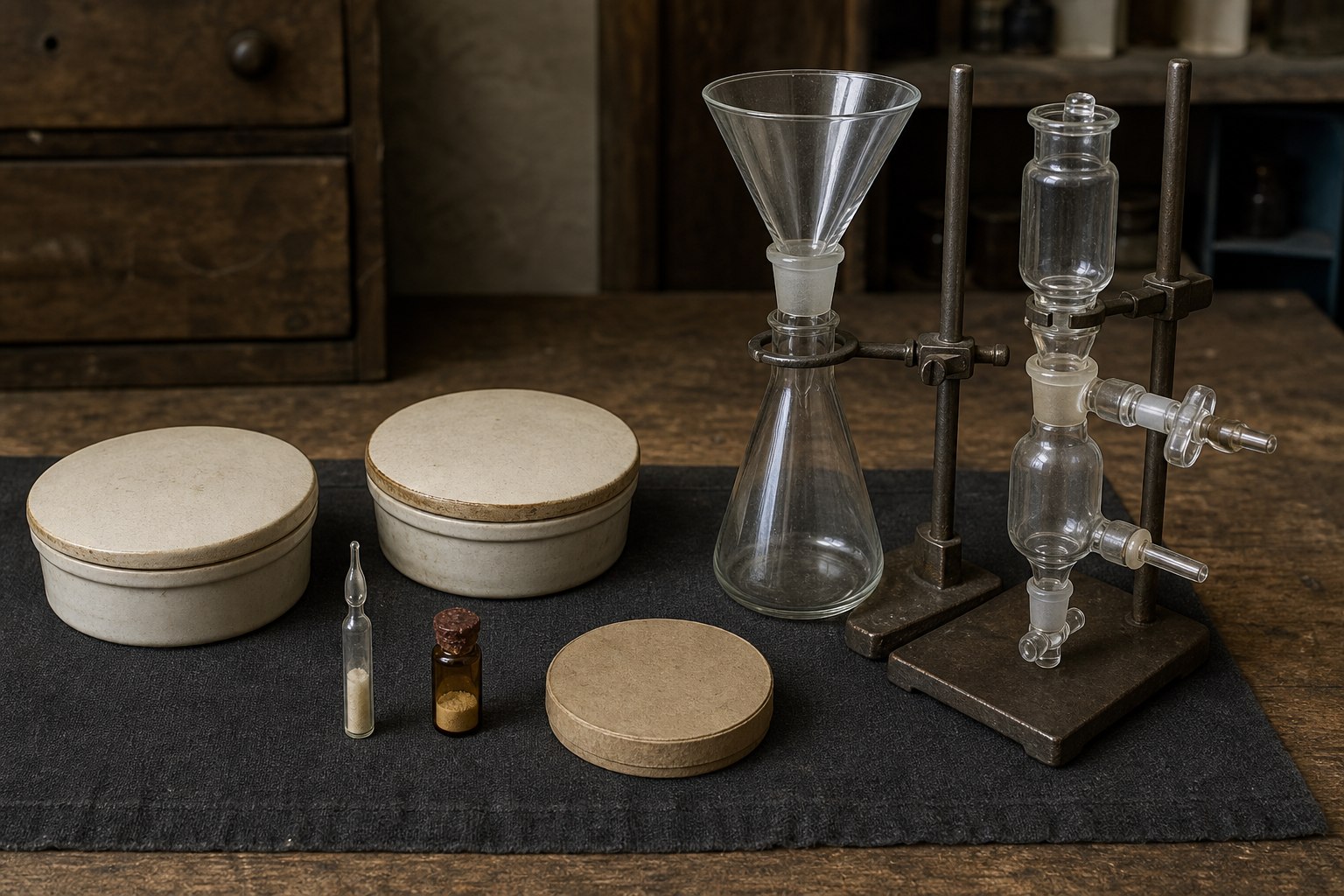
AI-generated historical orientation only. The culture and assay contents are deliberately hidden: appearance cannot identify a production strain or establish purity, potency, sterility, safety, or medical usefulness.
Read this first. This page explains why the intuitive version of this idea — grow mold, use mold — does not work and is dangerous, and what the real path looks like. It is a historical and technical discussion, not medical advice, and nothing here should be used to treat an infection in place of actual medicine. Crude mold preparations are not a treatment; see the warning section.
Why it matters
Antibiotics transformed treatment of susceptible bacterial infections, but their effect depends on diagnosis, organism, resistance, source control, supportive care, and access. Before effective antimicrobial treatment, commonplace wounds, pneumonia, childbirth infections, and surgery all carried much greater risk.
If you could make it, it would matter more than anything else on this list. This page is about being honest regarding whether you could.
The honest difficulty assessment
Fleming noticed the mold's effect in 1928. It took twelve more years, a team of world-class biochemists at Oxford, and then the industrial and financial might of the wartime United States to turn that observation into a usable drug.
Consider what that team had that you won't: pure chemical reagents, precision glassware, centrifuges, freeze dryers, refrigeration, chromatography, pH meters, electricity, X-ray crystallography, a global network to source mold strains, and several hundred trained scientists.
Even so, in 1941 the Oxford team could not make enough to treat a single patient to completion. Their first case — a policeman with a face infection — improved dramatically, then died when the supply ran out. They were recovering penicillin from his urine and re-injecting it, and still ran out.
The bottleneck was never "find the mold." It was yield, purification, potency measurement, and stability — four separate hard problems, each of which needs technology from the industrial era.
Realistic verdict: in a genuinely pre-industrial setting, producing usable penicillin is not achievable. In an early-industrial setting — say, 1850s technology with a real chemistry laboratory — it is achievable and would be an extraordinary achievement. Set your expectations by which of those you're standing in.
Why "just use the mold" doesn't work
This is the part worth understanding properly, because the folk version of this idea is appealing, widespread, and actively dangerous.
1. Concentration is far too low. Fleming's original Penicillium notatum produced roughly 2 units per millilitre of broth. A therapeutic dose is hundreds of thousands to millions of units, repeated every few hours for days. You would need to drink or inject impossible volumes of mold broth. This is not a matter of trying harder — it's three or four orders of magnitude.
2. Penicillin is chemically fragile. It's destroyed by stomach acid (so eating it does nothing for most of the original forms), by heat, by extremes of pH, and by an enzyme called penicillinase that many bacteria produce. Crude broth loses its activity within days. Getting it to the infection intact was itself a research problem.
3. You cannot know the potency. Different molds, different batches, different conditions give wildly different yields. Without a validated assay you have no idea whether a given batch contains a useful dose or none at all. Too little, too much, the wrong drug, or the wrong duration can all harm the patient and select for resistance.
4. Crude mold broth contains other things, some of them toxic. The Penicillium genus includes species producing genuinely dangerous compounds — patulin, ochratoxin, citrinin, cyclopiazonic acid. Bread mold is usually not even Penicillium, and telling species apart requires a microscope and training. Injecting unpurified fungal broth means injecting an unknown mixture of fungal metabolites and bacterial contaminants into a bloodstream.
5. The historical folk remedies were topical and mostly worked for other reasons. Poultices of moldy bread applied to wounds appear in Egyptian, Greek, Chinese, and European folk medicine, and some of them probably had mild effects. But a poultice on a wound is a completely different proposition from a systemic dose treating an infection that has spread. Historical use does not establish sterility, identity, potency, or clinical benefit.
What the real process requires
If you're in a setting where this is worth attempting, here is the actual chain. Every step was a research program.
1. Find and select the right strain
Fleming's original strain was hopeless for production. The Oxford and Peoria teams screened thousands of samples worldwide. The winner was found on a moldy cantaloupe in a Peoria market in 1943 — Penicillium chrysogenum strain NRRL 1951 — which produced far more than anything else.
Then they mutated it deliberately, with X-rays and ultraviolet light, and screened the survivors for higher yield. Successive rounds of this raised output from 2 units/ml to over 1000, and eventually to tens of thousands. Modern production strains yield perhaps 50,000× Fleming's original.
That mutation-and-selection program is the single largest factor in making penicillin practical, and it's the least intuitive one. Without it, no purification process is good enough to matter.
Some Penicillium colonies are blue-green and may show brush-like spore-bearing structures under a microscope. Those observations are useful for screening, but appearance and basic microscopy cannot authenticate a production strain, exclude a toxin producer, or establish purity. Production requires a traceable culture, validated identity testing, contamination controls, and retained reference samples.
2. Grow it at scale, with aeration
The Oxford team grew mold in flat vessels — bedpans, biscuit tins, and eventually custom ceramic flasks — because Penicillium grows on the surface of a liquid. Surface culture is desperately inefficient: enormous floor area for tiny output.
The breakthrough was submerged deep-tank fermentation: growing the mold throughout a vigorously stirred, sterile-air-sparged tank. This required:
- Sterile technique at industrial scale — the tank, the air, and the medium all sterilized, because a single bacterial contaminant outcompetes the mold and ruins a whole batch.
- Controlled aeration and agitation — the mold needs a lot of oxygen, so you need filtered sterile air blown through continuously and mechanical stirring.
- Corn steep liquor — a waste product of corn milling that turned out to boost yields dramatically. Finding it was luck and screening, not theory.
- Temperature control at around 24–26°C, and pH control throughout.
3. Extract and purify
Norman Heatley's method, and it's clever:
Laboratory-only process. Ether forms highly flammable vapor and can form explosive peroxides; amyl acetate is also flammable and its vapor is harmful. Acid/base transfers add splash and pressure hazards. This work requires trained chemists, closed or effectively captured equipment, explosion-controlled ventilation and electricals, compatible storage, monitoring, and hazardous- waste handling. A domestic still or open workshop is not adequate.
- Filter off the mold.
- Acidify the broth to about pH 2 and immediately extract into an organic solvent (ether, then later amyl acetate). Penicillin is soluble in solvent in its acid form.
- Immediately back-extract into slightly alkaline water. Penicillin returns to the water; most impurities stay in the solvent.
- Repeat the pH swing. Each cycle concentrates and purifies.
The catch: penicillin is destroyed by acid, so every step must be done in seconds, and cold. Heatley built a continuous counter-current apparatus out of glass tubing, milk churns, and doorbells precisely to make the contact time short enough. This is where the real engineering ingenuity was.
Then: freeze-drying (lyophilization) to a stable powder, or conversion to a stable salt. Both need refrigeration and vacuum.
4. Measure potency — non-negotiable
Without an assay you are administering an unknown dose of an unknown substance.
The cylinder plate assay: spread a lawn of a standard test bacterium on a nutrient plate, place small cylinders containing your sample on it, incubate, and measure the diameter of the clear zone where bacteria failed to grow. Compare against a reference standard. The zone diameter scales with the log of concentration, so it's genuinely quantitative.
This requires: a reference standard, sterile agar plates, a pure bacterial test culture, an incubator, and consistent technique. It is not optional. The "Oxford unit" was defined precisely because there was no other way to talk about dose.
5. Administer correctly
Formulation, route, drug choice, dose, interval, and duration depend on the infection, patient, susceptibility, renal function, and product. Injectable penicillin requires pharmaceutical sterility and clinical monitoring; this guide cannot supply a regimen. Use antibiotics only after a competent diagnosis and take them exactly as prescribed. Do not stop early because symptoms improve, but do not extend treatment arbitrarily either: unnecessarily long exposure also causes harm, and modern stewardship uses the shortest effective evidence-based duration. Resistance was observed almost immediately—Abraham and Chain described penicillinase in 1940—so correct selection, dose, duration, and infection control all matter.
If you cannot make it — and you probably cannot
The good news is that the interventions that prevent the infections penicillin treats are cheap, low-technology, and available immediately. Go to medicine and public health and work through it. Specifically:
- Handwashing and clean instruments prevent surgical and puerperal sepsis — the largest single class of what penicillin was used for.
- Wound irrigation and debridement — removing dirt and dead tissue prevents most wound infection. Volume of clean water matters more than any additive.
- Do not blindly close contaminated wounds. Irrigate and obtain skilled assessment; deep wounds may need debridement, drainage, tetanus prophylaxis, or carefully planned closure.
- Some medical-grade, sterilized honey dressings have clinical uses. Kitchen honey is not a sterile wound product.
- Use validated skin antiseptics at their labeled concentration and contact time. Beverage or home-distilled alcohol is not a wound antiseptic and alcohol can damage exposed tissue.
- Clean water and sewage separation prevent the enteric infections that killed more people than wound infections did.
- Prevent neonatal tetanus with maternal vaccination plus clean birth and clean, dry cord care. Use sterile cord-cutting equipment; boiling alone is not a validated way to destroy all bacterial spores.
Realistically, these prevent far more deaths than any quantity of penicillin you could produce, and they need nothing but soap, water, boiling, and understanding.
Are there easier antimicrobials?
Somewhat, in an early-industrial setting:
- Sulfonamides (Prontosil, 1932) are chemically synthesized rather than fermented, which sidesteps the entire biology problem. They come out of coal-tar dye chemistry — the same aniline chemistry as synthetic dyes. If you have a working organic chemistry laboratory, sulfa drugs are meaningfully more achievable than penicillin, and they were the first drugs to reliably cure bacterial infections. Still a serious chemistry program, and they carry real toxicity risks.
- Antiseptics — properly formulated products based on agents such as iodine, alcohol, or chlorhexidine are simpler than antibiotics, but agent, concentration, contact time, tissue compatibility, and intended use matter. Phenol and hypochlorite can cause serious burns; an industrial chemical is not automatically a safe skin or wound product.
Warnings, stated plainly
- Do not inject or drink crude mold preparations. Unknown potency, unknown contaminants, and several Penicillium relatives produce nephrotoxins and hepatotoxins. This is a route to killing the patient you're trying to save.
- Do not treat moldy bread as medicine. The mold on your bread is most likely Rhizopus or Aspergillus, not Penicillium, and some Aspergillus species produce aflatoxin — see soy sauce.
- Penicillin allergy can be fatal, but labels are often wrong. About 10% of US patients report an allergy, while fewer than 1% of the population are truly allergic when evaluated. That does not make unmonitored dosing safe: anaphylaxis requires immediate skilled treatment, and allergy assessment or challenge belongs in a controlled clinical setting.
- Wrong drug, dose, or duration promotes failure and resistance. Use a validated product exactly as prescribed for a diagnosed infection; neither stopping early nor prolonging a course by guesswork is stewardship.
- Working with concentrated fungal spore preparations carries real inhalation risks. Handle spores wet, and don't work in an enclosed space.
Failure modes
Unusually for this repository, most of these have no fix — the entry exists to tell you why the attempt failed, so you stop rather than repeat it.
| Symptom | Cause | Fix |
|---|---|---|
| Mold grows well, broth has no effect on infection | Concentration three or four orders of magnitude too low | Strain selection and yield improvement, not a bigger pot |
| Broth was active yesterday, inert today | Penicillin degrades fast in solution | Cold, neutral pH, use immediately; stabilization is a whole research problem |
| Patient improves, then relapses | Wrong diagnosis/drug, inadequate source control, resistance, dose/duration problem, or another complication | Urgent clinical reassessment and testing; do not improvise or merely extend treatment |
| An oral product appears ineffective | Wrong drug or formulation, wrong diagnosis, degradation, resistance, absorption/adherence problem, or inadequate source control | Seek urgent clinical and pharmaceutical review; never improvise an injection or change route, dose, or duration by guess |
| Extraction yields nothing usable | Acid step too slow — penicillin destroyed during extraction | Seconds, and cold, in a counter-current apparatus |
| Whole fermentation batch ruined | Bacterial contamination outcompeting the mold | Sterile medium, sterile air, sterile vessel — at every scale |
| Doses wildly inconsistent between batches | No potency assay | Cylinder plate bioassay against a reference standard. Non-negotiable |
| Patient develops hives, wheeze, swelling, collapse, or shock | Possible immediate allergy/anaphylaxis | Stop exposure and activate emergency treatment; production and administration are unacceptable without that capability |
| Treatment stops working across the community | Resistance selected and spread through inappropriate use and poor infection control | Stewardship: diagnosis, surveillance, correct drug/dose/duration, hygiene, vaccination, and isolation as indicated |
| Patient develops liver or kidney damage | Toxins from a contaminating Penicillium species | Never administer unpurified fungal broth |
Sources and limits
- The CDC explains both appropriate duration and the harms of excess treatment: use the shortest effective antibiotic duration and take antibiotics exactly as prescribed.
- The CDC distinguishes a reported allergy label from a clinically evaluated allergy: clinical features of penicillin allergy.
- This page is historical orientation, not a manufacturing specification, clinical protocol, or validation package. See the repository-wide source policy and evidence map.
Era notes
- 1928 — Fleming observes the effect and publishes; it's largely ignored for a decade, including by Fleming, who couldn't purify or stabilize it.
- 1939–40 — Florey, Chain, and Heatley at Oxford develop extraction and assay and demonstrate it works in mice.
- 1941 — first human trials. Not enough drug to complete a single treatment.
- 1941–43 — the work moves to the US; Peoria finds corn steep liquor, the cantaloupe strain, and deep-tank fermentation; strain improvement by mutation begins.
- 1944 — enough produced to treat Allied casualties after D-Day.
- 1945 — Nobel Prize; Fleming uses his lecture to warn about resistance from underdosing, which was prescient and largely ignored.
- 1945 — Dorothy Hodgkin determines the structure by X-ray crystallography, which opens the door to semi-synthetic penicillins.
The lesson worth taking from that timeline: the gap between "noticing that a mold kills bacteria" and "having a drug" was twelve years and a national industrial effort, and the observation was the easy part. Knowing that penicillin exists gets you almost none of the way there.
The genuine knowledge advantages, if you're in a position to use them: that the answer is Penicillium chrysogenum rather than P. notatum, that mutation and selection for yield is the decisive step, corn steep liquor as a medium, submerged aerated fermentation rather than surface culture, the rapid cold pH-swing extraction, the cylinder-plate assay, and the resistance-stewardship rules from day one. Those would compress a twelve-year program considerably — but they would not make it a small one.