Soap
Difficulty: moderate — the chemistry is simple, but measuring and safely handling caustic alkali are not optional. Prerequisites: basic chemicals (wood ash liquor, quicklime), fat or oil, a lye-resistant pot, eye protection, alkali-resistant gloves, and a way to measure active alkali.
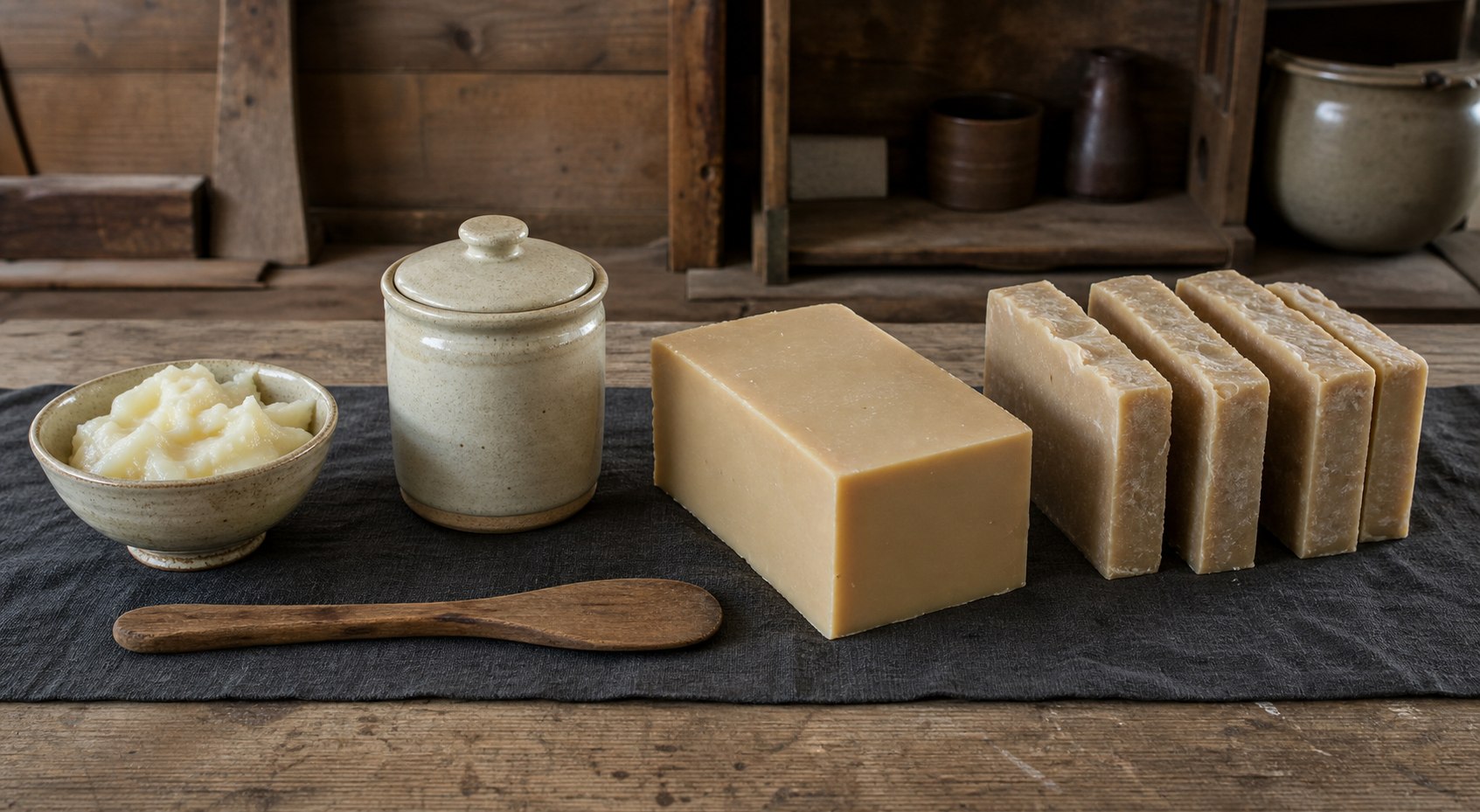
AI-generated visual reference: rendered fat and contained alkali → cut and cured soap. The alkali is deliberately shown closed; this is not a historical photograph or a safe handling demonstration.
Why it matters
Soap is the cheapest life-saving technology on this list. Handwashing with soap cuts diarrheal disease by roughly a third and respiratory infection substantially — in a world with no antibiotics, that is an enormous effect.
Ignaz Semmelweis sharply reduced maternal mortality in 1847 by requiring hand cleaning between autopsies and deliveries; his most effective historical agent was a chlorinated-lime solution. Chlorinated lime is not made by merely mixing lime and salt: manufacture requires generating chlorine and absorbing it into lime, a corrosive and toxic-gas process outside this guide. Do not improvise chlorine products for skin. Soap and clean water are the right everyday method; clinical hand antisepsis needs a validated product, concentration, contact time, and protocol. See medicine and public health.
Soap is also useful for cleaning wool before spinning and dyeing, degreasing metal before soldering, and emulsifying oils; dry, well-formulated soap stores and trades well.
The reaction is straightforward once the alkali is known. The knowledge that routine handwashing interrupts disease transmission is the larger public-health advantage.
What's happening
Fat is triglyceride — three fatty acid chains attached to glycerol. Strong alkali cuts them off, giving fatty acid salts (soap) and glycerol (glycerine, a useful by-product). This is saponification.
A soap molecule has a greasy tail and a water-loving head, so it bridges oil and water and lets grease wash away. That's the entire mechanism.
Step 1: Make the lye
From basic chemicals, in brief:
- Burn hardwood or potassium-rich bracken to fine white ash. Coastal plants and seaweed instead give sodium-rich, highly variable ash.
- Pack the ash in a barrel or basket over straw, with a drain hole.
- Pour water through slowly. The runoff is ash liquor — mostly potassium carbonate and other soluble salts.
- Run it through the same or fresh ash repeatedly to strengthen it.
Measure the liquor. A floating egg or potato is only a rough density test: it responds to every dissolved ash salt and does not reveal the KOH concentration. Use a hydrometer or measured density to reproduce a leaching batch, then use a standardized two-endpoint acid titration that distinguishes hydroxide from carbonate before calculating a soap recipe. Never taste the liquor or test it on skin.
Strengthen it to caustic (important). Carbonate lye makes mediocre soap. Boil the lye with slaked lime and the carbonate converts to hydroxide:
K₂CO₃ + Ca(OH)₂ → 2 KOH + CaCO₃↓
Chalk drops out; let it settle fully and decant the clear liquid. This causticized liquor is hydroxide-rich, but its strength remains unknown until measured.
Caustic lye blinds. It does not sting immediately enough to warn you, and damage continues after contact. Work outdoors and keep your face away.
If lye touches skin or eyes, flood it with clean water immediately and keep flooding for a full twenty minutes. Do not reach for vinegar or any other acid: neutralizing alkali on living tissue releases heat and adds a thermal burn to the chemical one, and the seconds spent fetching it are seconds the lye keeps eating into you. Water, immediately, and a lot of it.
Never use aluminum or tin vessels — lye attacks them. Use only a sound vessel whose material and glaze are verified compatible with hot concentrated alkali; traditional iron and suitable stoneware can serve.
Step 2: Get fat or oil
| Source | Notes |
|---|---|
| Tallow (beef/sheep suet) | The classic hard-soap fat. Hard, white, long-lasting bar |
| Lard (pork) | Softer, milder, lathers well |
| Olive oil | Makes Castile soap — very mild, hard, slow to lather. Excellent |
| Coconut / palm-kernel oil | Huge lather, very cleansing (drying if used alone) |
| Fish oil | Works but smells appalling. Last resort |
| Wood ash + any waste fat | The peasant standard — kitchen grease, bones, trimmings |
Render it first. Chop the raw fat, simmer it with a little water until the fat melts out and the connective tissue browns, then strain through cloth. Let it cool and lift the clean fat cake off the water. Repeat once for clean, odorless fat. Rendering properly is what separates good soap from soap that goes rancid in a month.
Step 3: Cook the soap
Historical soap boilers learned by repeating the same ash, fat, and batch size. That experience did not make an unknown alkali concentration safe for a new operator. Measure known-purity hydroxide by mass, or analyze crude ash liquor with a standardized two-endpoint acid titration.
- Put fat in a large iron or stoneware pot and warm it.
- Add the calculated amount of lye gradually, stirring constantly.
- Simmer gently for the recipe's specified time. Do not boil hard — hot soap can foam over and throw caustic liquid.
- Watch for trace. The mixture thickens from watery to the consistency of thin porridge, and a drizzle from the spoon sits on the surface for a moment before sinking. That's saponification well underway.
- Continue the cook according to the measured formulation. Trace shows that an emulsion and reaction are underway; it does not prove completion or the absence of free alkali. Never put soap batter on the tongue or bare skin. Check finished, cooled soap with a recognized free-alkali titration; pH paper can screen a gross error but cannot by itself certify the soap.
The critical balance: too much lye gives soap that can burn skin; too much fat gives greasy soap with poor cleaning and shorter shelf life. A deliberate lye discount (“superfatting”) reduces the risk of free alkali but cannot correct an unknown lye strength or inaccurate saponification value.
Proportions, so you aren't working blind
These figures are approximate; use an oil-specific value when one is available. They apply to pure, dry potassium hydroxide, not causticized wood-ash liquor:
| Fat | Approx. KOH needed |
|---|---|
| Tallow (beef/sheep) | ~19% |
| Lard (pork) | ~19% |
| Olive oil | ~19% |
| Coconut / palm kernel | ~26% |
For pure, dry sodium hydroxide (giving harder soap) use roughly 70% of those figures — about 13–14% for tallow, lard, or olive oil. Correct the calculation for the stated purity of the reagent.
Then apply a deliberate lye discount appropriate to the recipe, commonly about 5% for a known oil and known-purity alkali. That leaves some unreacted fat and makes a milder soap. It reduces risk; it does not guarantee safety when the inputs or measurements are uncertain.
If the ash liquor's strength is unknown, do not apply this percentage table. Use a standardized two-endpoint acid titration, calculate its hydroxide and carbonate content, and run a small test batch. If you cannot measure the alkali and test the finished product, reserve the experiment for non-skin cleaning and do not distribute it as hand or body soap. Record every mass and result; see mathematics and record-keeping.
Step 4: Salt out and finish
You now have soap dissolved in a mess of lye, glycerol, and water.
- Salt out: stir in common salt or saturated brine. Soap is insoluble in brine and rises as a solid curd, while the glycerol, excess lye, and impurities stay in the water below.
- Skim off the curd and drain it.
- Wash it: re-boil the curd with fresh water and salt out again. Two or three cycles can remove much of the soluble alkali and contamination. It does not replace a free-alkali check on the finished soap.
- Press it into a wooden mould lined with cloth, let it set for a day, and cut into bars.
- Cure the bars on racks with air circulation for 4–6 weeks. Water evaporates and the bar hardens while a properly formulated batch finishes reacting. Cure time does not neutralize a materially lye-heavy batch; test, reprocess, or reject that soap rather than waiting longer.
The first salting-out liquor is glycerol-rich, not purified glycerine. It also contains salt, free alkali, water, degraded organics, and other ash impurities. Simple boiling concentrates those contaminants. Do not put it on skin or use it as antifreeze; recovery of usable glycerine needs neutralization, salt removal, and controlled purification or distillation.
The two kinds of soap
- Potash lye (wood ash) → soft soap. A jelly, sold by weight in tubs. This is what most historical soap actually was. Perfectly good for laundry and washing.
- Soda lye (plant ash from coastal plants, or natron) → hard soap. Bars. Higher value, easier to store and trade. This is why Mediterranean soap (Aleppo, Marseille, Castile) is hard and northern European soap was soft: it follows the local ash.
Salting out potash soap can precipitate and firm some of the soap, and some ion exchange may occur, but it does not guarantee complete conversion to a sodium soap. For a predictable hard bar, start with measured sodium hydroxide or a characterized sodium-rich alkali and use a tested formulation.
Recipes worth making
Castile / Aleppo soap — olive oil and soda lye, cured for months (Aleppo soap traditionally cures 6–9 months, going from green to golden). Laurel berry oil is a traditional Aleppo ingredient; introduce any fragrance or specialty oil only at a tested skin-safe proportion.
Everyday tallow soap — rendered tallow plus measured causticized wood-ash liquor gives a potassium-rich soft soap; salting can separate and firm it. Use measured sodium hydroxide when a consistently hard bar is required.
Scented soap — add fragrant oil or resin at the end after the cook, off the heat. Lavender, rosemary, pine resin, citrus peel oil. Scent is what turns a utility product into a luxury one, and the margin on luxury soap is where the money is.
Fuller's soap for cloth — coarse soft soap plus fuller's earth (a fine absorbent clay). Used for degreasing and thickening woolen cloth.
Alternatives if you have no fat to spare
Fat is food. In a subsistence economy, spending it on soap is a real cost. The alternatives below rely on saponins — plant compounds that foam and lift dirt without any fat at all. Extraction, limits, and the caution that saponin liquor is toxic to fish are in extracts and by-products.
- Soapwort (Saponaria officinalis) — boil the root and leaves; the saponins lather gently. Excellent for washing delicate textiles.
- Soap nuts (Sapindus) — the shells contain saponins; used across South Asia for laundry.
- Yucca root, horse chestnut, ivy leaves — all saponin sources.
- Plain alkali liquor or urine — historically used for laundry and fulling, but both are variable and can burn skin or damage fibers. If used at all, keep them out of handwashing, control concentration, settle and decant ash liquor, use gloves, and rinse textiles completely.
Failure modes
| Symptom | Cause | Fix |
|---|---|---|
| Mixture never thickens (won't trace) | Alkali, temperature, mixing, or formulation error | Stop adding material; cool safely, review measured inputs, and correct only from a new calculation |
| Separates into oil and liquid layers | Formulation, temperature, or mixing error | Stop and recalculate before reprocessing; never add a guessed amount of stronger lye |
| Soap burns or stings skin | Possible excess free alkali or unmixed lye pocket | Quarantine it; do not solve this by longer cure. Confirm by free-alkali test, then reprocess with a calculated amount of fat or discard |
| Soap is greasy and won't lather | Too much fat or too little active alkali | Recalculate from measured inputs before adding anything; re-cook only with a calculated correction |
| Soap goes rancid, smells bad | Fat not properly rendered, or contains meat residue | Render carefully, strain, wash the fat |
| Soap is soft and dissolves fast | Potassium soap, excess water, or incomplete cure | Use a measured sodium-hydroxide formula for hard bars; dry a correctly formulated batch |
| Won't lather in this water | Hard water — calcium binds the soap into scum | Prefer rainwater or properly softened water; if using lime-soda treatment, settle and decant before washing |
| Soap has white crumbly patches | Surface carbonate or possibly an unmixed lye pocket | Quarantine and test; reprocess or discard if free alkali is present |
Safety
The principal hazard is caustic lye: it causes deep chemical burns and permanent eye damage, and it may not hurt soon enough to give useful warning. Hot fat, caustic boil-over, steam, fire, splashing during salting-out, and irritating or sensitizing fragrance oils are additional hazards. Wear splash goggles, alkali-resistant gloves, long sleeves, and closed footwear; use a stable, ventilated workspace and keep a large supply of rinse water within reach. Add solid lye slowly to water rather than pouring water onto concentrated lye, never lean over the pot, and keep children away from every lye vessel.
Sources
Era notes
Soap-like substances are attested in Babylon around 2800 BCE and in a Sumerian tablet around 2200 BCE; the Romans knew of it but mostly used oil and a strigil instead. Hard soap making was industrialized in the Islamic world by the 9th century (Aleppo, Nablus, Fez) and reached Europe from there.
Your knowledge advantage is emphatically not the recipe — it's germ theory. Explaining that invisible living things cause disease, that they transfer from hand to mouth and from one patient to the next, and that soap physically removes them, is worth more than every material in this repo combined. Pair it with boiling drinking water and separating latrines from wells, and you've done more for a pre-modern community than any technology you could hand them.