Glass
Difficulty: hard — this is the real test of your furnace skills. Prerequisites: fire and heat, basic chemicals (lime + soda/potash).
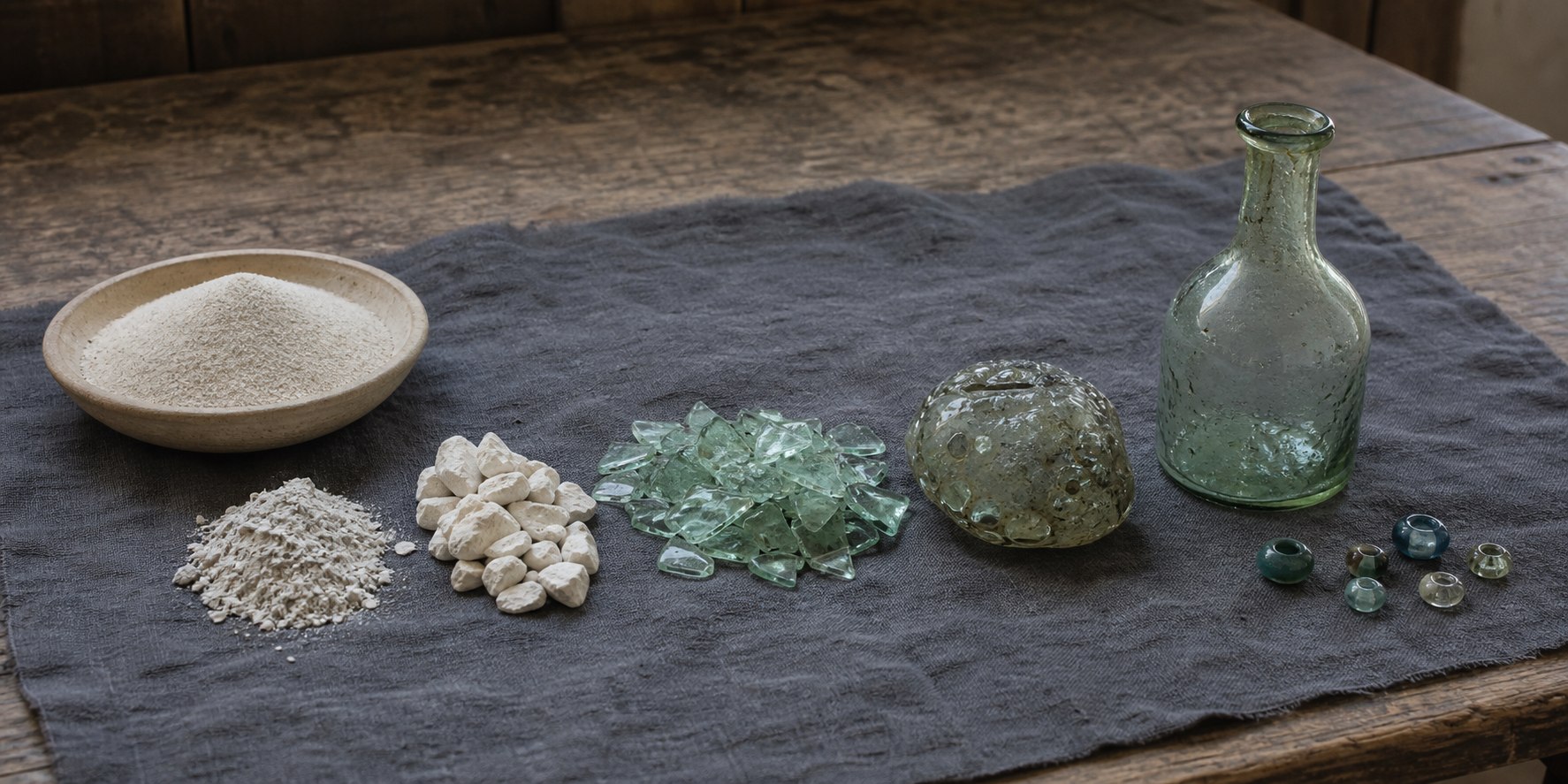
AI-generated visual reference: batch materials → cullet and rough glass → bottle and beads. It is not a historical photograph, material-identification standard, or process endpoint.
Why it matters
Glass is windows, bottles, and lenses. Lenses are the highest-leverage object a time traveler can make: spectacles, magnifiers, microscopes, telescopes. Glass is also an enormously valuable trade good in any era before it was industrialized.
The key insight
You are not melting sand. Pure silica melts at 1710°C, which you cannot reach with charcoal and bellows in any practical way. Instead you add a flux that drops the melting point to around 1000–1200°C, and a stabilizer that stops the result from dissolving in water.
An approximate final glass composition by oxide mass is:
| Component | Proportion | Source |
|---|---|---|
| Silica (sand) | ~70% | Quartz sand, crushed quartzite, crushed flint |
| Flux (soda ash or potash) | ~20% | Plant ash / natron — see basic chemicals |
| Stabilizer (calcium oxide) | ~10% | Calculated from quicklime, shells, limestone, or suitable ash |
These are not raw-batch masses. Carbonates lose carbon dioxide on firing, shell and limestone are not mass-equivalent to quicklime, plant ash is a variable mixture, and impurities change the result. Calculate a batch from assayed or tested feedstocks and verify it in small melts. Too little stabilizer can make a glass chemically vulnerable, but durability depends on the whole composition; wood ash can itself supply calcium.
Working temperatures for this batch, which the rest of this guide and the temperature ladder both refer back to:
| Stage | Temperature |
|---|---|
| Fritting (sintering, gas driven off) | ~800°C |
| Batch begins to melt | ~1000–1100°C |
| Working melt, and fining out the bubbles | 1200–1300°C |
| Conditioning to working stiffness | ~1000–1100°C |
| Annealing finished pieces | Composition- and thickness-specific; often near 500°C for common soda-lime glass |
The number to design your furnace around is 1300°C sustained for hours, not the 1100°C at which the batch first goes liquid. A furnace that just barely melts the batch will never fine it clear, and you'll get bubbly glass forever.
Lead (flint) glass — make this once you can make ordinary glass
Lead-containing optical glass uses substantial lead oxide; historical formulations vary. Producing and handling litharge can expose workers and the site to lead dust and fume (see silver). It belongs in a controlled industrial process with exposure monitoring, local exhaust, hygiene, contained waste, and composition testing—not an open workshop recipe.
Why bother:
- Many lead formulations melt and soften at lower temperatures than soda-lime glass, although the actual range follows composition.
- It is dense, soft, and brilliant — this is lead crystal, and it cuts and polishes beautifully. A high-value trade good.
- It has much higher optical dispersion, and that is the whole point for optics: pairing a convex crown-glass lens with a concave flint-glass one cancels the color fringing that ruins simple telescopes. Without flint glass there is no achromatic doublet.
Lead glass is comparatively soft and useful for some optical work. Do not use it for food, drink, toys, or other exposure-prone products; lead can leach, and making, cutting, or polishing it creates contaminated dust and waste.
Finding and preparing the sand
What you want: white or pale, sharp-grained sand. Test candidates by sight — the whiter the better. Iron is your enemy; it turns glass green-brown.
Good sources: inland dune sand, sandstone quarries, riverbeds with quartz gravel, and beach sand from quartz-rich (not shell-rich, not volcanic) coasts. Crushed flint or quartz pebbles were used historically for fine glass, but composition still needs testing. Do not quench red-hot stone: trapped water, steam, and flying fragments can cause severe injury.
Silica-dust gate. Crushing, sieving, mixing, grinding, and polishing quartz can release respirable crystalline silica, which causes irreversible lung disease and cancer. Enclose dusty work, use wet methods and effective local exhaust, prohibit dry sweeping and compressed-air cleanup, isolate bystanders, and use an appropriate respiratory-protection program when engineering controls cannot keep exposure controlled. If these controls are unavailable, do not dry crush or grind silica. See NIOSH safe work practices for silica.
Purification, in order of value:
- Wash repeatedly. Slurry the sand in water, swirl, and pour off the cloudy water carrying clay and organics. Repeat until the water runs clear.
- Sieve. Discard oversize grains and fines. Uniform grain size melts evenly.
- Reduce free iron-bearing grains. Pick out visibly dark or red grains and remove free magnetic particles with a magnet in a contained process. This cannot remove iron within the quartz grains and does not certify optical purity.
- Calcine. Roast the washed sand red-hot to burn off remaining organics.
Building the furnace
You need a chamber that holds 1100–1300°C for many hours — the long soak is harder than the peak temperature.
- Build a shaft or beehive furnace of heavily grogged clay, walls 15+ cm thick, with an internal chamber big enough for your crucible plus fuel space.
- Insulate the outside with packed earth or a second clay shell.
- Two tuyères and two bellows, worked alternately, at the base.
- Crucible: a thick pot of clay with 30–40% grog, pre-fired slowly to drive out all water. It must survive hours at temperature holding a corrosive melt. Alkali attacks clay, so expect crucibles to be consumables.
The two-stage process (do it this way, not in one shot)
Historical glassmakers did this in two firings for a reason: it works.
Stage 1 — Fritting (~800°C, several hours)
Mix the batch, spread it in a shallow pan or on the furnace floor, and hold it at a dull red heat. It will not melt; it will sinter into a crumbly cake called frit. This drives off CO₂ from the carbonates, burns out organics, and lets the alkali start reacting with the silica.
Frit is much easier to melt than raw batch, and fritting prevents the violent foaming that ruins a one-stage melt. Crush the frit before the next stage.
Stage 2 — Melting (~1100–1300°C, 6–24 hours)
Load crushed frit into the crucible and bring the furnace up. You will pass through stages:
- Sintering — the charge slumps into a solid mass.
- Melting — it becomes a bubbling, viscous liquid.
- Fining — the critical, slow part. Bubbles must rise out. Hold the melt hotter than melting temperature for hours until it goes clear and still. Rushing this is the #1 cause of ugly, bubble-filled glass.
- Conditioning — let the temperature drop somewhat until the glass is honey-thick and workable.
Cullet trick: add 20–30% crushed glass from previous batches to any new melt. It melts first and dramatically speeds up the whole process. Never throw away broken glass.
Color control
Iron contamination gives green/brown glass. Two fixes, both historical:
- Decolorizing: add a small amount of manganese dioxide (pyrolusite — a soft black mineral, "glassmaker's soap"). It oxidizes iron to a pale yellow and adds a complementary purple, canceling to near-colorless. Use sparingly; too much gives purple glass. Note that manganese-decolorized glass slowly turns purple over decades of sunlight — that's the tell for old glass.
- Just accept it and sell green glass, which is perfectly good for bottles.
Deliberate colors, for trade value:
| Additive | Color |
|---|---|
| Copper oxide (oxidizing melt) | Turquoise / blue-green |
| Copper (reducing melt) | Red — hard to control |
| Cobalt ore, tiny amounts | Deep blue — extremely potent, use pinches |
| Iron + reducing conditions | Green to near-black |
| Antimony or tin oxide | Opaque white |
| Gold chloride, minute amounts | Ruby red (cranberry glass) |
Working the glass
- Blowing: an iron blowpipe about 1.2 m long. Gather glass on the hot end by rotating it in the melt, blow a bubble, shape by rolling on a flat stone (marver), reheat constantly. Requires an assistant and a lot of practice — budget weeks of failure.
- Casting: use a compatible, fully dried and preheated mold designed for hot glass. Moisture can flash to steam and eject molten material. Roman window glass was cast and stretched, not blown.
- Core forming (pre-blowpipe technique): dip a clay-and-dung core on a rod into the melt, build up a vessel around it, then scrape out the core.
- Grinding lenses: cast a rough blank, then grind it against a concave metal or stone dish with wet sand, progressing to finer abrasive (emery, then pumice, then rouge — iron oxide from calcined iron sulfate). This is slow and entirely doable by hand. A pair of spectacles is achievable; a telescope objective needs real care about surface figure.
Annealing — do not skip this
Glass that cools unevenly can retain severe internal stress and fail later. Anneal at a range established for the measured composition, then cool on a schedule validated for the thickest section and shape; a universal 500°C/time recipe is unsafe. Historically a second chamber could use the main furnace's waste heat, but process control still needs trial pieces and strain inspection.
Failure modes
| Symptom | Cause | Fix |
|---|---|---|
| Batch never melts | Not enough flux, or furnace too cold | More soda/potash; more air, better insulation |
| Glass full of bubbles (seeds) | Fining time too short | Hold hotter, longer |
| Glass is cloudy/stony | Undissolved silica, sand too coarse | Grind finer, longer melt |
| Surface goes cloudy or sticky in storage | Not enough lime — it's water glass | Increase lime to ~10% |
| Strong green/brown color | Iron in sand or clay | Better sand, magnet, add manganese |
| Pieces crack days later | No annealing | Build an annealing chamber |
| Crucible fails mid-melt | Wrong clay, insufficient grog, thermal shock | More grog, preheat slowly |
Era notes
- Faience and glass beads: possible from the Bronze Age with simple furnaces.
- Cast/core-formed vessels: Egypt and Mesopotamia, 2nd millennium BCE.
- Blown glass: Roman-era invention (~1st c. BCE), and the blowpipe is the single most valuable thing you could introduce early.
- Clear, flat, large window glass: genuinely hard until late medieval crown and cylinder methods. Set expectations accordingly.