Wine
Difficulty: moderate. Fermentation is accessible; a stable, safe, repeatable product requires sanitation, measurement, and gas control. Prerequisites: sound fruit, food-compatible equipment, an established wine yeast culture, food-preservation controls, and basic pH, temperature, sugar/density, and ventilation measurement.
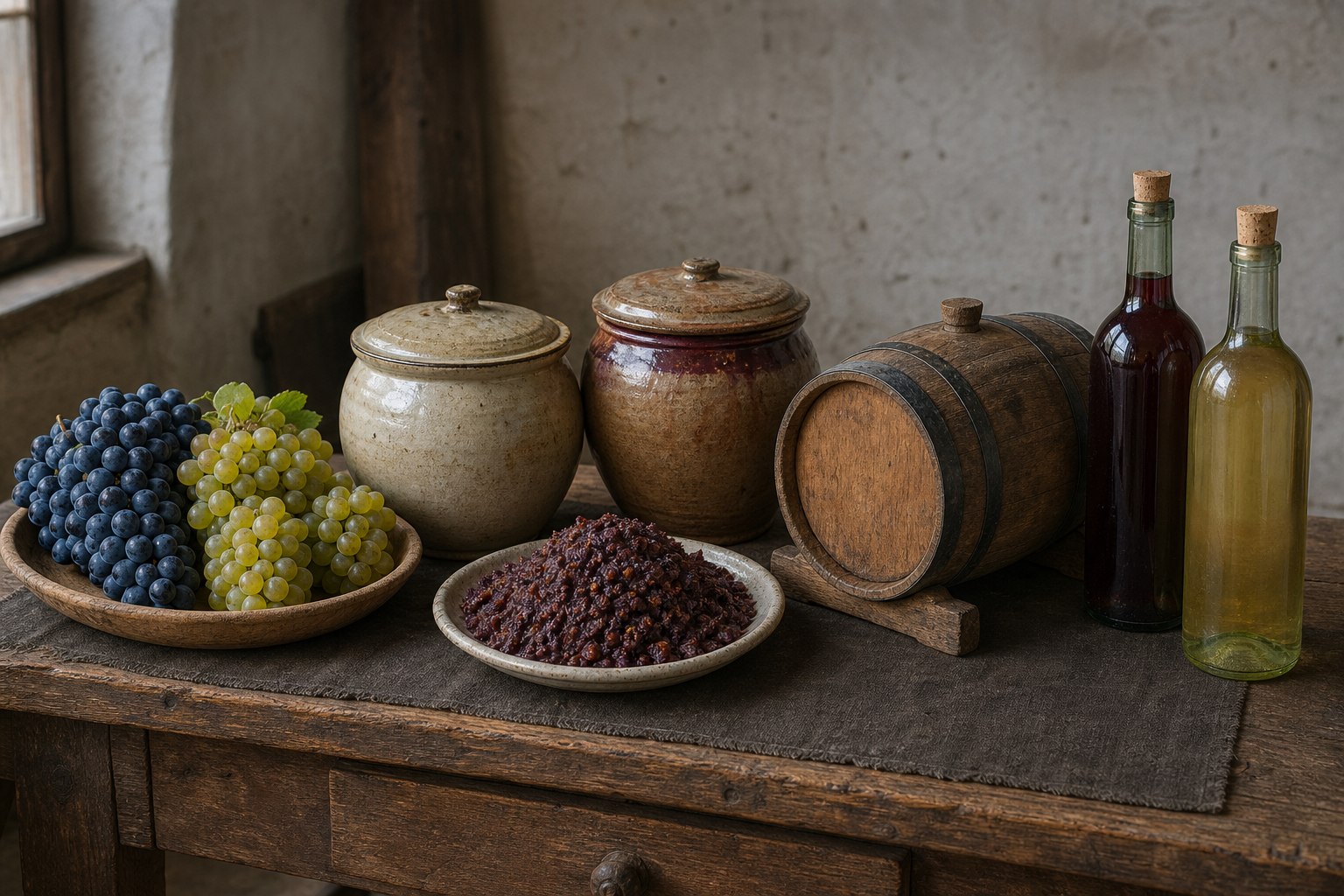
AI-generated visual reference: sound grapes → closed must vessels and pressed pomace → cask and bottled wine. It is not a historical photograph, sanitation standard, stability test, or proof that a fermentation is safe or complete.
Why it matters
Wine preserves some fruit energy, is a solvent for medicines, the feedstock for vinegar and distilled spirits, and a high-value trade good. It is not treated water: alcohol does not make contaminated water potable, and wine can itself be contaminated or spoiled.
What's actually happening
Yeast converts sugars principally to ethanol and CO₂, while many organisms and reactions affect acidity, flavor, stability, and safety. The production goals are:
- Get sugary juice.
- Make sure the right microbes win.
- Manage oxygen according to the selected fermentation and maturation stage.
- Wait.
Grape surfaces carry mixed yeasts, bacteria, molds, and vineyard residues. Spontaneous fermentation is historically authentic but less predictable; an authenticated, healthy starter culture and measured process give better control.
Step 1: Fruit
Grapes often combine useful sugar, acidity, skin/seed phenolics, and fermentable juice, but no variety or ripeness guarantees a safe/stable balance. Sample representative fruit and measure sugar/density, pH, and titratable acidity; inspect for rot, damage, and residues. Choose harvest and any validated adjustment from those results rather than assuming every ripe grape has enough protective acidity.
No grapes? Anything sugary ferments:
- Honey + water (mead) — the oldest alcoholic drink, roughly 1 part honey to 3 parts water by volume. Honey lacks nutrients for yeast, so mead ferments slowly; use a measured enological nutrient or a validated food-compatible fruit addition rather than unknown pollen or unwashed material.
- Apples (cider), pears (perry), berries, dates, figs, plums.
- Palm sap, agave, birch sap.
- Low-sugar fruits can be topped up with honey or boiled-down juice. Aim for a starting sugar range supported by the chosen culture and product. Roughly 20% fermentable sugar might yield about 11% alcohol only under stated assumptions; that alcohol level does not establish stability. pH/acidity, residual sugar, sanitation, oxygen, temperature, sulfite where used, filtration, and packaging remain interacting controls.
Step 2: Crush
Crush fruit on cleanable, sanitized, food-compatible surfaces without grinding seeds excessively. Foot treading is historically authentic but not a sanitation control: exclude anyone with cuts, sores, infection, or chemical residue, clean and inspect feet and trough under a validated process, and protect workers from sharp debris and falls. A sanitized crusher is more repeatable.
Red vs white: all grape juice is pale. Red wine gets its color and tannin from fermenting with the skins; white wine is pressed immediately and fermented as clear juice.
Step 3: Ferment
Put the crushed fruit (the must) in a vessel filled about 3/4 full — it will foam vigorously.
Vessel options: food-compatible ceramic jars, wooden vats (see coopering), or suitable stone equipment. A buried Georgian qvevri can buffer temperature, but only a sound, food-compatible, inspectable and cleanable lining/vessel belongs in production. Its opening, burial, access, drainage, and gas space also need fall, collapse, carbon-dioxide, and confined-space controls; nobody enters a vessel without a formal entry and independent rescue system.
Avoid iron and copper, and absolutely avoid lead — including lead-glazed pottery, which is the trap here, because wine is acidic and will leach it steadily. See the glaze warning in pottery and ceramics and the poisoning notes in silver. Boiling acidic must in lead-bearing vessels can produce severe contamination and poisoning. Claims that Roman sapa caused a particular population-wide “mass poisoning” remain debated, so treat the vessel chemistry as the established hazard without presenting that historical diagnosis as fact.
Distil the results and you have brandy; let them go to air and you have vinegar.
Starting: inoculate sound, measured must with an established wine culture using a documented process. Foam and fizz indicate gas production, not purity or completion. Do not rescue a stalled batch by adding unknown unwashed fruit; find and correct temperature, acidity, nutrient, culture, or contamination problems.
During active fermentation:
- With red must, skins float up and form a cap. Push it down (punch the cap) two or three times a day. A dry cap exposed to air grows mold and vinegar bacteria — this is the single most common way to lose a batch.
- Hold the measured temperature in the range specified for the culture, fruit, vessel, and wine style. A generic 20–28°C range or a 35°C failure threshold is not transferable across yeasts and products.
- Confirm completion with stable density/residual-sugar measurements over time; lack of bubbles or a dry taste is not proof that fermentation has finished.
Step 4: Press and keep air out
Press the solids (a bag and weights, a lever press, a screw press) and combine with the free-run juice.
During active fermentation, use a vessel and airlock that discharge CO₂ safely: never seal a fermenting vessel and do not enter or lean into a poorly ventilated fermentation space. After verified completion, manage oxygen exposure because it promotes oxidation and acetic-acid bacteria.
- Move the wine to a compatible vessel sized to minimize headspace without overfilling. Until stability is verified, use a rated vent/airlock rather than a pressure-tight seal.
- Close it with a clean, food-compatible closure. A guessed clay seal or oil layer is not equivalent to a sanitary, pressure-safe closure.
- Top up regularly as the level drops.
Step 5: Rack, age, clarify
- Racking: use a sanitary, oxygen-controlled transfer when analysis and the selected process call for separation from the lees. Timing and repetition depend on wine style and microbial/chemical condition; every transfer also creates contamination and oxygen risk.
- Aging: use a cleanable, food-compatible vessel and measured storage conditions. Wood, ceramic, stone, linings, and closures are not chemically neutral or automatically suitable; each changes extraction, oxygen, cleaning, leakage, and contamination risk.
- Fining: diagnose the haze, then use a food-grade enological fining agent at a validated trial dose and rack/filter as specified. Egg and milk products introduce major allergens and possible microbes; use sanitary material, control residual allergen, and meet applicable disclosure/labeling rules.
- Don't discard the cask crust. Potassium bitartrate crystallizes on the vessel walls and under the lees as a hard deposit (argol). Scraped off and recrystallized it becomes cream of tartar — a leavening acid, a dye mordant, and a metal-cleaning agent. See extracts and by-products.
Stabilization and sulfites
Sulfur dioxide can be an effective antioxidant and antimicrobial control, but its active fraction depends strongly on pH and the required dose must be measured. Use food-grade enological material, calibrated pH/free-SO₂ measurement, and a validated formulation. Do not burn a sulfur wick in a vessel: it gives an uncontrolled dose and can expose workers entering or leaning over the vessel to toxic sulfur dioxide. See sulfur for the gas hazard.
Worth knowing how late this actually is: the Romans burned sulfur as a general fumigant but there is no evidence they treated wine vessels with it. The first clear record is a 1487 decree in the Holy Roman Empire permitting sulfured wood chips to be burned in barrels, with Cologne prosecutions from 1465 suggesting slightly earlier unlicensed use. So in any classical or early medieval setting this is a genuine thousand-year jump, not a rediscovery.
Other historical stabilizers:
- Higher alcohol — fortification can inhibit some organisms but does not sterilize wine or replace validated stabilization and contaminant testing.
- Resin — pine resin flavored wine and lined some historical vessels. Treat it as a characterized food-contact coating or flavor, not a validated antimicrobial stabilization step.
- Seawater / salt / herbs — historically used flavorings, not validated safety controls; unknown seawater can add pathogens and chemical contaminants.
- Cold — cool storage slows reactions and growth but does not solve every spoilage or safety problem.
Failure modes
| Symptom | Cause | Fix |
|---|---|---|
| Never starts fermenting | Temperature, pH, sugar, culture viability, nutrient, inhibitor, or contamination problem | Quarantine and diagnose measurements; if sound, use an authenticated active culture under its documented process—never unknown unwashed fruit |
| Stops halfway, still sweet | Temperature/pH/sugar stress, weak culture, deficient nutrient, inhibitor, or contamination | Diagnose first; if recoverable, use a measured enological nutrient or authenticated active culture; discard when contamination or safety is uncertain |
| Turns sour, smells like vinegar | Oxygen exposure, dried cap, headspace, or acetic contamination | During active fermentation use a rated vent/airlock and maintain the cap; after verified completion minimize headspace with a sanitary closure—never pressure-seal active wine |
| Film or suspected mold on the surface | Oxidative yeast, mold, or another contamination | Isolate the lot; do not skim and assume it safe. Obtain competent assessment and discard when identity or safety is uncertain; correct sanitation, oxygen, pH, and sulfite controls next time |
| Rotten-egg odor is noticed | Hydrogen sulfide or another sulfur compound, often associated with process stress | Ventilate and avoid deliberate close sniffing; quarantine the lot and use measured process/laboratory assessment rather than uncontrolled splashing |
| Slimy, viscous, “ropey” product | Microbial or polysaccharide instability | Quarantine without tasting and obtain competent analysis; discard if identity or safety is uncertain, then correct fruit, pH, sanitation, sulfite, and packaging controls |
| Thin, watery, or low-alcohol result | Fruit composition, dilution, incomplete fermentation, measurement, or process mismatch | Diagnose recorded sugar, acidity, density, culture, and fermentation data; do not add honey to an active or suspect lot by guess |
| Cloudy and won't clear | Pectin/protein, yeast, microbes, or another instability | Diagnose before racking/filtering or a bench-trial food-grade fining treatment; control allergens where egg/milk is used |
The most important non-obvious point
Cleanliness and sanitation are foundational. Remove soil with a material-compatible cleaning process, then apply a validated sanitizer or heat schedule at its specified concentration, contact time, and temperature. A boiling-water rinse alone does not sanitize every geometry or porous material, and it can scald workers or crack vessels. Inspect, rinse/dry as required, verify the process, and repair or retire any vessel that cannot be verified clean. Do not burn a vessel in an occupied area.
Era notes
Wine residues are attested from ~6000 BCE in Georgia and Iran; this is one of the oldest technologies humanity has. You are unlikely to introduce wine to anyone. Potential improvements are measured temperature, oxygen, pH and sulfite control; sanitary transfers; microbial understanding; records; and release testing. Their value depends on compatible materials, trained workers, local practice, regulation, storage, and transport.
Sources and limits
- Oregon State University Extension explains why wine microbial stability depends on measured pH and free sulfur dioxide and why oxygen, pH, and SO₂ must be managed together when handling damaged fruit.
- The FDA's ethyl-carbamate prevention manual shows why spontaneous fermentation and fortification require process monitoring and analysis rather than sensory assurance alone.
- OSHA's permit-required confined-space standard frames entry into tanks and buried vessels; odor, a candle, or an open top is not atmospheric testing or a rescue plan.
- FDA summarizes controls and labeling responsibilities for major food allergens, including milk and egg fining materials.
- This is a conceptual guide, not a validated recipe or legal release standard. Local food, alcohol, workplace, and labeling rules still apply.