Dyes, Pigments, and Ink
Difficulty: easy to moderate. Mostly botany and patience. Prerequisites: basic chemicals (lye, lime, vinegar), a pot, paper if you want somewhere to write.
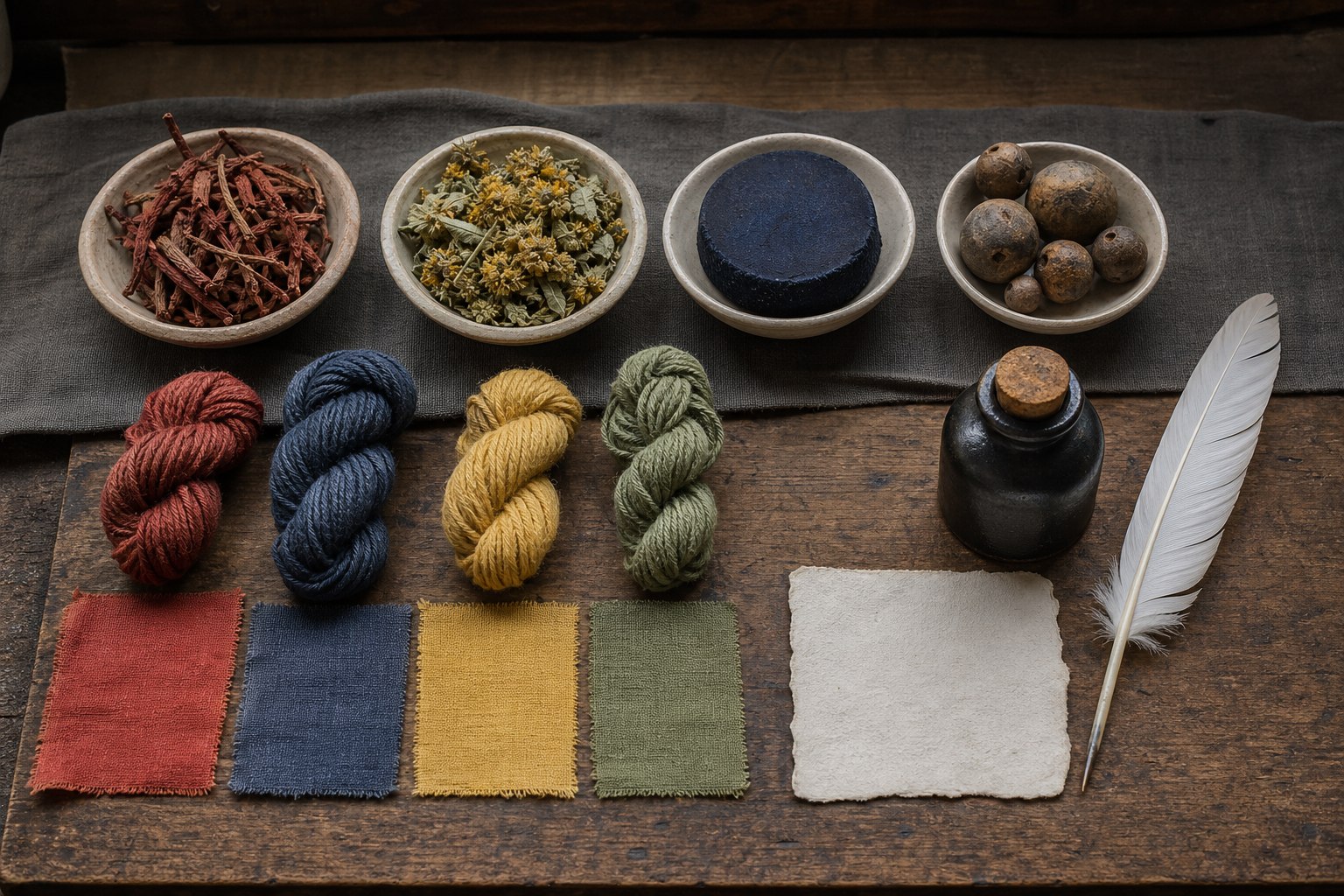
AI-generated visual reference: dry dye and ink materials → dyed skeins and swatches → contained writing ink. It is not a historical photograph, dye recipe, colorfastness test, or chemical-handling demonstration.
Why it matters
Color was expensive. Tyrian purple cost more than its weight in silver; indigo and cochineal drove global trade routes and colonial wars. Dyeing is one of the fastest routes from "knows things" to "has money" in a pre-industrial economy.
Ink matters for a different reason: paper with nothing to write on it is just a commodity. Ink plus paper plus movable type is how knowledge stops depending on any single person surviving.
Part 1: Dyes for textiles
The thing that separates success from failure: mordants
Many natural dyes need a fiber-specific pretreatment or mordant to improve washfastness. Metal-salt mordants can coordinate with fiber and colorant, while tannin pretreatments help some cellulose fibers. Alkali and acid generally act as pH modifiers instead; calling every treatment a mordant hides important chemical and waste-handling differences.
The same dye with different mordants gives completely different colors. This is the central trick of natural dyeing and it multiplies your palette severalfold.
| Treatment | Source | Effect |
|---|---|---|
| Alum (aluminum salt) | Authenticated alum or a characterized alunite-processing route | Often gives bright shades; arbitrary clay or plant leachate is not verified alum |
| Iron salt | Authenticated iron sulfate or a separately characterized iron-acetate process | Darkens many colors; excess iron can damage fiber |
| Copper or tin salt | Authenticated material used in a validated recipe | Can alter hue, but adds toxic metal exposure and effluent |
| Tannin pretreatment | Oak galls, bark, sumac, tea | Helps prepare cotton and linen for some mordant systems |
| Lime / ash alkali | Characterized alkali; see basic chemicals | A pH modifier that can shift color; not a metal-salt mordant |
Method: choose a documented recipe for the exact fiber, dye, mordant salt and hydrate, desired shade, and aftercare. Record every addition on dry-fiber weight; a generic “10–20% alum” is not transferable across salts and fibers. Wool and silk generally accept many systems more readily. Cotton and linen often need a tannin pretreatment and a different sequence. Prove the recipe on a small, washed and light-exposed sample before processing valuable cloth.
Metal mordants can harm workers and water systems. Use identified chemicals, splash/skin/eye controls, dedicated labeled vessels, and a characterized treatment or hazardous-waste route for all metal-bearing baths and rinses. Never use dye vessels for food or discharge liquor to soil, drains, wells, or surface water by dilution.
Reds
- Madder (Rubia tinctorum) root — the great red of the ancient world. Grow it three years, dig the roots, dry, grind. Dye below 70°C — boiling turns madder brown, and this is the single most common madder mistake. Alum gives red, iron gives purple-brown, lime shifts it toward orange-red.
- Cochineal — scale insects on prickly pear cactus (Americas). Ferociously strong; a small amount of insects gives brilliant crimson. Tin mordant gives scarlet, alum crimson, iron purple.
- Kermes — scale insects on kermes oak, the Mediterranean equivalent, used before cochineal reached Europe.
- Brazilwood / sappanwood — heartwood shavings, extracted with water. Bright but fades in light. Cheap and cheerful.
Blues — indigo, the difficult and valuable one
Indigo-bearing plants supplied one of the principal durable pre-industrial textile blues, using chemistry unlike ordinary mordant-dye systems.
Indigo pigment is insoluble in water — you cannot simply boil cloth in it. It must be chemically reduced to a soluble yellow-green form ("indigo white"), absorbed into the fiber, and then re-oxidized in air back to insoluble blue, trapped inside the fiber. This is why indigo is so colorfast: the pigment is physically locked in place, and it needs no mordant at all.
Sources: Indigofera tinctoria (tropical, richest), woad (Isatis tinctoria, temperate Europe, much weaker but the same chemistry), and Japanese indigo (Persicaria tinctoria).
Extraction: steep fresh leaves in water for a day or two until it ferments and turns yellow-green. Then aerate violently — beat, splash, and whisk the liquid. It turns deep blue as indigo precipitates. Let it settle, pour off the water, and dry the blue sludge into cakes. Those cakes keep and trade for years.
The vat (the hard part): you need reducing, alkaline conditions.
There is no safe universal “10-litre vat” formula: ash liquor, lime, fermentation systems, hydrosulfite, and other reducing chemistries need different amounts, pH ranges, ventilation, and waste controls. Select one documented vat process for the available indigo and reagents, then scale every component proportionally. The table below is a planning list, not a recipe:
| Component | Amount | Notes |
|---|---|---|
| Water | 10 L | Soft water if you have it; hard water wastes alkali |
| Indigo cake, ground fine | 50–100 g | Start at 50 g for medium blues. Grind it to a powder or it will never disperse |
| Alkali | Formula-specific, measured addition | Use one documented vat chemistry: ash liquor, lime, and other alkalis are not interchangeable by mass. Measure pH with calibrated strips or an electrode; never judge causticity by touch |
| Reducer/culture system | Formula-specific | Use the named material, culture, dose, temperature, and aging schedule from the chosen process; ingredients are not interchangeable |
- Follow the selected order of addition, temperature, pH, time, and reducer endpoint; log measured pH and temperature rather than judging causticity by touch.
- Confirm reducing conditions using the process's specified measurement or a small controlled dye trial. Yellow-green liquor and a coppery surface film can be useful observations, but appearance alone does not establish safe pH or a healthy culture.
- Correct a tired vat from its measurements and documented maintenance table. Do not add alkali or reducer blindly.
- Dip cloth gently to limit oxidation and splashing.
- Lift the cloth out. It may come out yellow-green and turn blue in front of you over about 30 seconds as oxygen hits it. This never stops being astonishing, and it's excellent theatre for convincing skeptical customers.
- Repeat dips for deeper shades when the process remains within its measured control range.
A maintained fermentation vat can last for months, but discard or treat it under the selected process if contamination, chemistry, or waste handling cannot be verified.
Yellows (easy and abundant)
Weld (Reseda luteola — the best and most lightfast), onion skins, dyer's broom, turmeric (bright but fades badly), saffron (absurdly expensive), goldenrod, birch leaves, pomegranate rind, marigold. All simmer directly with an alum-mordanted fiber.
Greens, purples, blacks
- Green: dye yellow first, then overdye with indigo (or vice versa). There is no good single-source green — this surprises people, but chlorophyll is a terrible dye.
- Purple: indigo over madder or cochineal; or logwood with an alum mordant.
- Black: iron mordant plus heavy tannin (oak galls, alder bark, walnut hulls). Repeat cycles build depth. Warning: iron-tannin black slowly rots the fiber it's on, which is why old black textiles are often the first to disintegrate. Use the mildest iron that gets you there.
- Tyrian purple: from the hypobranchial gland of Murex sea snails. Thousands of snails per gram, an appalling stench during production, and chemically an indigo relative (dibromoindigo). Its historical precursor development involves enzymatic, light, and oxidation steps and is not simply the indigo-vat process. It was a specialized coastal industry, not a substitute ingredient for the vat above.
Part 2: Pigments for paint
Pigments differ from dyes: they're insoluble solids suspended in a binder rather than dissolved and bonded to fiber.
| Pigment | Source | Notes |
|---|---|---|
| Ochres — yellow, red, brown | Characterized iron-rich earth pigment | Often durable; source, contaminants, particle size, binder, and storage govern performance. Heating changes some yellow iron oxides but also creates dust/fume controls |
| Carbon black | Soot collected from an oil lamp or resinous wood flame | Chemically and light stable; actual durability depends on particle dispersion, binder, substrate, and storage |
| Bone black / ivory black | Charred bone, ground | Warmer, denser black |
| Chalk / lime white | Ground limestone | Cheap white, weak covering power |
| Green earth | Celadonite/glauconite clays | Soft grey-green, very stable |
| Verdigris | Copper sheets suspended over vinegar fumes for weeks | Brilliant blue-green. Corrosive and reacts with other pigments |
| Ultramarine | Lapis-lazuli-derived pigment made through a specialized separation process | Historically valuable, with quality dependent on mineral source and processing |
| Egyptian blue | Historical copper-calcium silicate pigment | Requires identified raw materials and a controlled high-temperature process; see glass for furnace hazards |
| Vermilion | Historical mercury-sulfide pigment | Brilliant scarlet but mercury-bearing; do not mine, grind, synthesize, or use it as a workshop recipe |
| White lead | Historical basic lead-carbonate pigment | Strong historical white but cumulatively poisonous; do not synthesize or use it |
Real hazards here. Lead and mercury pigments are not appropriate small-workshop recipes. Do not synthesize, heat, grind, or deliberately use them; isolate inherited material for qualified hazardous-material management. Use chalk, gypsum, or lime for white and ochre or a cinnabar-free lake for red. Even nominally lower-toxicity dry pigments and lampblack need wet handling or local extraction, sealed cleanup, eye/skin controls, and exposure assessment: “natural” dust is not harmless.
Binders turn pigment into paint: egg yolk (tempera — durable, fast-drying), linseed or walnut oil (oil paint — slow, blendable, luminous; use a characterized non-lead drier and compatible controlled formulation if faster curing is needed), animal glue (distemper), gum arabic (watercolor), lime putty (fresco — pigment applied into wet lime plaster becomes part of the wall as it carbonates, which is why frescoes last millennia).
Part 3: Ink
Iron gall ink — the workhorse of Western writing for 1400 years
This is the ink of nearly every European manuscript, Bach's scores, and the US Constitution. Four ingredients:
- Oak galls — the hard round growths on oak twigs caused by gall wasps. Rich in tannic acid. Crush and steep in water or wine for several days. (Substitutes: sumac, pomegranate rind, tea, any strong tannin source.)
- Iron sulfate (copperas/green vitriol) — use authenticated material of known composition. Weathering sulfide minerals can produce it, but also produces acidic, metal-contaminated drainage; see sulfur. Rust soaked in vinegar produces mainly iron acetates and is not an interchangeable route to iron sulfate.
- Gum arabic — acacia gum, or any plant gum, to thicken the ink and keep the pigment suspended.
- Water or wine.
Combine the gall extract and the iron solution and it turns black almost instantly — the tannin and iron form an insoluble black complex. Add gum, strain, and bottle.
Why it's good: it soaks into and bonds with the fiber, so it can't be scraped off cleanly — hence its use for legal documents.
Why it's dangerous to your archive: excess acid and iron can catalyze paper degradation. Use a tested formulation, compatible substrate, controlled storage, and conservator guidance for important records; adding chalk or lime by guess can change the ink and does not certify it as archival.
Carbon ink (India/Chinese ink) — the archival choice
Older and simpler. A well-formulated carbon ink can be very durable on a compatible substrate, but no ink is guaranteed never to fade, flake, smear, or damage its support under every formulation and storage condition.
- Collect lampblack — burn oil (sesame, tung) or resinous pine in a lamp under a cool ceramic dome, and scrape off the soot. The finer and more evenly collected, the better the ink.
- Mix with a binder: animal glue or gum arabic, roughly 1 part soot to 1 part glue by weight.
- Knead extensively — traditional Chinese ink was pounded tens of thousands of times. This disperses the carbon and is what separates good ink from gritty ink.
- Press into moulded sticks and dry slowly for months.
- Grind the stick on a wet inkstone to make ink as needed.
Downside: it sits on the surface rather than bonding, so it can be washed or scraped off. Fine for books, poor for contracts.
Printing ink
Neither of the above works for movable type — water-based ink beads off metal. You need an oil-based ink: lampblack ground into boiled linseed oil (a characterized printing varnish), often with resin added. Do not heat an open pot of drying oil; use the controlled process and fire guidance in oils and fats. This was Gutenberg's actual innovation as much as the type was — he borrowed oil-paint technology from painters. Without it, movable type doesn't work.
Failure modes
| Symptom | Cause | Fix |
|---|---|---|
| Color washes straight out | No mordant, or wrong fiber | Mordant first; use wool/silk to learn |
| Madder comes out brown, not red | Boiled it | Keep below 70°C |
| Indigo vat won't dye, stays blue | Reduction, pH, temperature, oxygen, or culture problem | Measure against the chosen documented vat process; do not add alkali or reducer blindly |
| Indigo dyes patchy | Cloth not evenly wetted, or air in the vat | Wet cloth first; dip gently, no splashing |
| Cotton dyes pale while wool dyes strongly | Cellulose needs different treatment | Tannin first, then mordant, repeat |
| Colors fade in sunlight | Fugitive dye (turmeric, brazilwood, most berries) | Use madder, indigo, weld — the proven lightfast ones |
| Black textile rots apart | Incompatible iron/tannin formulation, acidity, or storage | Stop using that recipe; select a tested formulation and substrate, then control washing and storage rather than adding chalk by guess |
| Ink damages the paper | Excess acid/reactive iron, incompatible paper, or poor storage | Use a tested ink/substrate system and conservation-grade storage; do not correct an important batch by adding chalk or lime by guess |
| Ink is gritty and skips | Carbon not dispersed | Grind and knead far longer |
| Printing ink beads off the type | Incompatible vehicle, type surface, or ink rheology | Use a characterized printing varnish and tested formulation; do not heat drying oil in an open vessel |
Era notes
Indigo and madder are attested from at least 2000 BCE; Egyptian blue from ~2500 BCE; iron gall ink from the Roman era. The dyer's craft was well developed everywhere.
Your knowledge advantages: understanding why mordants work so you can predict new combinations instead of relying on inherited recipes, knowing indigo's reduction–oxidation mechanism so you can diagnose a dead vat instead of blaming luck, the acidity problem in iron gall ink, and oil-based ink as the prerequisite for printing.
Sources and limits
- OSHA's lead safety overview explains why lead pigment production, use, cleanup, and take-home dust need occupational controls.
- NIOSH's engineering-controls library supports wet or locally extracted pigment preparation rather than open dry grinding.
- Vat chemistry, mordant recipes, colorfastness, and metal-bearing wastewater treatment must be validated for the exact reagents, fiber, scale, and local discharge rules. This chapter is historical orientation, not a release or archival-quality specification.