Silver
Difficulty: hard — needs good furnace control and careful handling of lead. Prerequisites: fire and heat (charcoal, bellows, 1000°C+), bone ash or wood ash, clay crucibles.
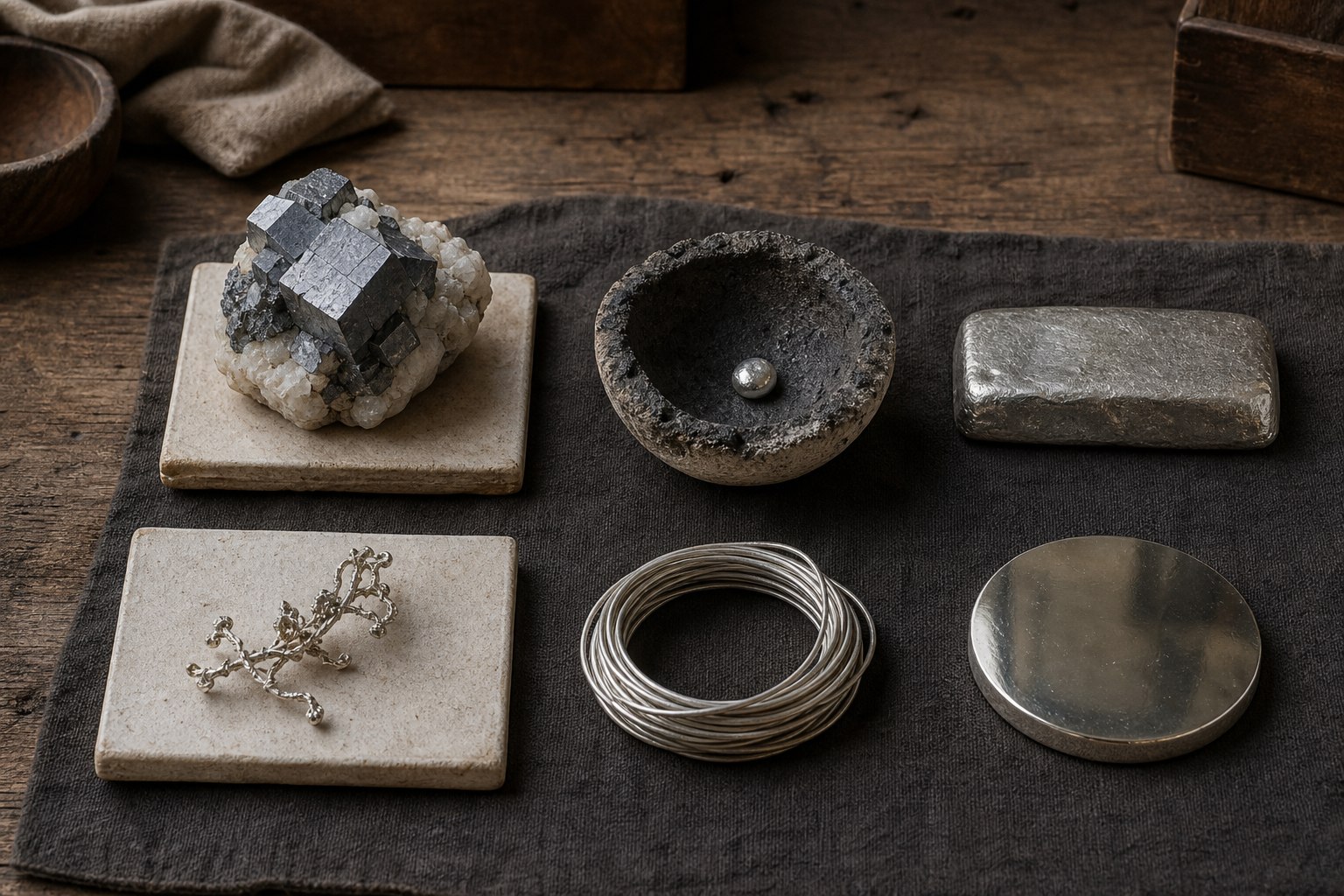
AI-generated visual reference: possible silver-bearing mineral specimens → a cupel bead → finished silver forms. It is not a historical photograph, ore assay, exposure-control example, or safe cupellation demonstration.
Why it matters
Silver is money. It's also the best material for mirrors, has real antimicrobial uses, and is the foundation of photography if you ever get that far. Silver melts at 962°C — well within reach of charcoal and bellows — so the challenge is not melting it but separating it from the ore.
Read the safety section before the process section. Silver extraction is lead metallurgy, and lead poisoning is cumulative, irreversible, and historically killed or crippled large numbers of the people who did this work.
Where silver comes from
General prospecting and the actual business of getting rock out of the ground — gossans, gravity concentration, shafts, drainage, ventilation, and fire assay — are in mining and prospecting. Read its safety section too; silver mining is lead mining.
Native silver exists but is uncommon. Much pre-industrial silver came from argentiferous lead ores, including galena, but silver occurs in several mineral systems and most galena is not economic silver ore. Identification and a quantitative assay—not the presence of lead ore—determine value.
Possible galena (PbS): dense, metallic lead-grey material with cubic cleavage and a grey streak is suggestive, not definitive. Similar-looking ores may carry other toxic metals; verify identity and composition before crushing or heating.
Where to look: hydrothermal veins in limestone or in the contact zones around granite, often alongside quartz, calcite, fluorite, sphalerite (zinc, resin-brown), and pyrite. Historic districts — the Laurion mines of Attica that funded the Athenian navy, the Harz, the Mendips, Rio Tinto, Potosí — were all galena or related sulfide systems.
Also worth knowing: cerussite (white/grey lead carbonate) and anglesite (lead sulfate) occur in the weathered upper zones of the same deposits and are easier to smelt because they need no roasting.
Overview of the process
galena ore
   ↓  crush + sort
concentrate
   ↓  roast (burn off sulfur)
lead oxide
   ↓  smelt with charcoal (reduction)
argentiferous lead ("work lead")
   ↓  cupellation (oxidize the lead away)
silver
Step 1: Crush and concentrate
Crush the ore with hammers and grind it, then concentrate by gravity — galena is enormously denser (7.4) than the quartz and calcite around it (2.6). Wash the crushed ore in a sloped trough with flowing water (a buddle), or agitate it in a shallow pan and let the heavy black galena settle first while you pour off the light gangue. This is straightforward panning, and it's the same skill as gold panning.
Hand-sort visible clean galena crystals out first — free concentrate.
Step 2: Roast off the sulfur
Lead-sulfide metallurgy may use roasting, roast-reaction, or other routes selected for the ore and plant. The open-hearth method below is historical context, not an acceptable operating instruction: lead and SO₂ emissions require enclosed handling, effective local capture and treatment, exposure and gas monitoring, an exclusion zone, and contained waste.
2 PbS + 3 O₂ → 2 PbO + 2 SO₂
Outdoors and wind direction do not control SO₂ or lead emissions. If engineered capture, treatment, monitoring, hygiene, and medical surveillance are not available, do not roast or cupel lead ore.
Never use smell as a process monitor or exposure alarm. Instrumented process and air measurements plus chemical analysis are required.
Alternative: the traditional "roast-reaction" method skips full conversion —
roast partially, then seal the hearth so unroasted sulfide reacts with the oxide
to give lead metal directly: PbS + 2 PbO → 3 Pb + SO₂. Faster, but harder to
control.
Step 3: Smelt to lead
Mix the roasted ore with charcoal and a flux (limestone, or iron-rich rock if you still have sulfur present) and smelt in a shaft furnace at 1000–1200°C with bellows. Carbon monoxide from the charcoal reduces the oxide:
PbO + CO → Pb + CO₂
Molten lead (mp 327°C) runs to the bottom of the furnace and collects in a hearth; slag floats and is tapped or raked off. Cast the lead into blocks.
This lead now contains all of the silver from the ore — typically a fraction of a percent, but silver is worth ~100× lead so it dominates the value.
Optional intermediate step (Pattinson's process, for low-grade lead): melt the work lead and let it cool slowly while stirring. Nearly pure lead crystallizes out first; skim the crystals off. The remaining liquid is enriched in silver. Repeat several times to concentrate silver ~10-fold before cupellation, saving enormous fuel. Historically 19th-century, but there is no reason it couldn't be done much earlier — this is a genuine knowledge advantage.
Step 4: Cupellation — the actual separation
This is the elegant part, and it's been done essentially unchanged since ~3000 BCE.
The principle: at high temperature with air blowing across it, molten lead oxidizes to litharge (PbO), which is molten and is absorbed into a porous bone-ash hearth. Silver and gold are noble — they do not oxidize — so they stay behind as a shrinking bead.
Make the cupel/hearth:
- Calcine bones white in a fire, grind them to fine powder — this is bone ash, the traditional and best material because it's porous and does not react with litharge.
- Alternative: fine hardwood ash, packed and dampened; used in antiquity.
- Pack the ash damp into a shallow dish shape, either a small cupel for assays or a large hearth for production, and dry it completely.
Run it:
- Melt the work lead in the cupel at 950–1100°C.
- Direct a blast of air across the surface with bellows. This is essential — cupellation is an oxidation, and without moving air nothing happens.
- The surface will bloom with a shimmering, iridescent film of litharge that soaks into the ash or is blown off the edge. Keep skimming/blowing.
- The molten pool shrinks steadily over hours as lead leaves.
- The "brightening" or fulguration: at the very end, when the last lead is gone, the dull, scummed surface suddenly flashes brilliantly clean and mirror-bright. That flash is the endpoint. Stop.
- Let the silver bead cool, then lift it out and wash it.
Yields are good — cupellation recovers most of the silver — and the litharge- soaked hearth can be re-smelted with charcoal to recover the lead for reuse. Don't throw it away; that's most of your lead.
Step 5: Refining further (optional)
Cupelled silver still contains gold and traces of copper.
- Parting with salt (cementation): pack thin silver sheets in a mixture of brick dust and common salt, seal in a pot, and hold at a red heat below silver's melting point for a day. Chlorine liberated from the salt attacks the silver, forming silver chloride absorbed into the cement, while gold is untouched. Recover the gold; recover silver from the cement by smelting with lead and re-cupelling. This is how gold and silver were parted before nitric acid.
- Parting with nitric acid: if you have sulfur and saltpeter you can make nitric acid, which dissolves silver and leaves gold. Much faster, and the medieval alchemists' method.
Assaying — know your ore before you build a smelter
Take a precisely weighed small sample of ore, mix with lead (or litharge) and a flux, fuse it in a small crucible, then cupel the resulting lead button in a small cupel and weigh the silver bead. The ratio tells you the ore grade and whether the deposit is worth mining at all. Do this first. Fire assay is one of the oldest quantitative analytical techniques in existence and it will save you from wasting a season on barren rock.
Safety — take this seriously
- Lead fume and lead dust are the dominant hazards. Roasting and cupellation can produce fine airborne lead oxide. Use enclosure and source-capture local exhaust with treated discharge, measured exposure control, decontamination, medical surveillance, and a clean/dirty boundary. Outdoor work alone is not adequate, and the operation must never share air, soil, clothing, or tools with a dwelling or food area.
- Lead poisoning is cumulative and can cause anemia, abdominal illness, kidney and nerve injury, reproductive harm, and lasting developmental or cognitive damage. Removing exposure and medical treatment can reduce blood lead and some effects, but prevention is essential and some injury is irreversible.
- Do not eat, drink, or store food anywhere near the smelting area. Wash before eating. Change and wash clothes — you carry lead dust home on them.
- Keep children and pregnant women entirely away from the operation.
- Never use lead for cooking vessels, water pipes, food storage, or sweetening (Roman sapa, wine sweetened with lead-boiled grape must, was a genuine mass poisoning).
- SO₂ from roasting can acutely injure lungs. Capture and treat it, monitor the air, and evacuate on a release; wind direction is not a safety system.
Failure modes
| Symptom | Cause | Fix |
|---|---|---|
| Ore won't reduce, furnace clogs with sulfurous matte | Under-roasted | Roast longer, more air, stir more |
| Lead fuses into a lump during roasting | Roast too hot | Lower fire; keep below melting |
| Cupellation never finishes | No air blast, or too cool | Bellows across the surface; raise temp |
| Silver bead is grey, brittle, or scummy | Copper or bismuth present | Re-cupel with fresh lead added |
| Silver bead is tiny/absent | Ore was low grade, or silver lost to slag | Assay first; check slag for entrained metal |
| Cupel cracks and lead soaks through | Ash too coarse or not dry | Finer bone ash, pack firmly, dry fully |
Era notes
Cupellation is attested from the 4th–3rd millennium BCE in Anatolia and Mesopotamia — this is genuinely ancient technology, and any Bronze Age society with lead ore can be shown it. Your knowledge advantages are: systematic fire assaying before committing to a deposit, gravity concentration to raise feed grade, Pattinson crystallization to cut fuel use, and above all understanding that lead is a slow poison, which nobody in antiquity did.