Sugar
Difficulty: moderate — the chemistry is easy, the labor is enormous. Prerequisites: lime, fire, large pans, a press or mill.
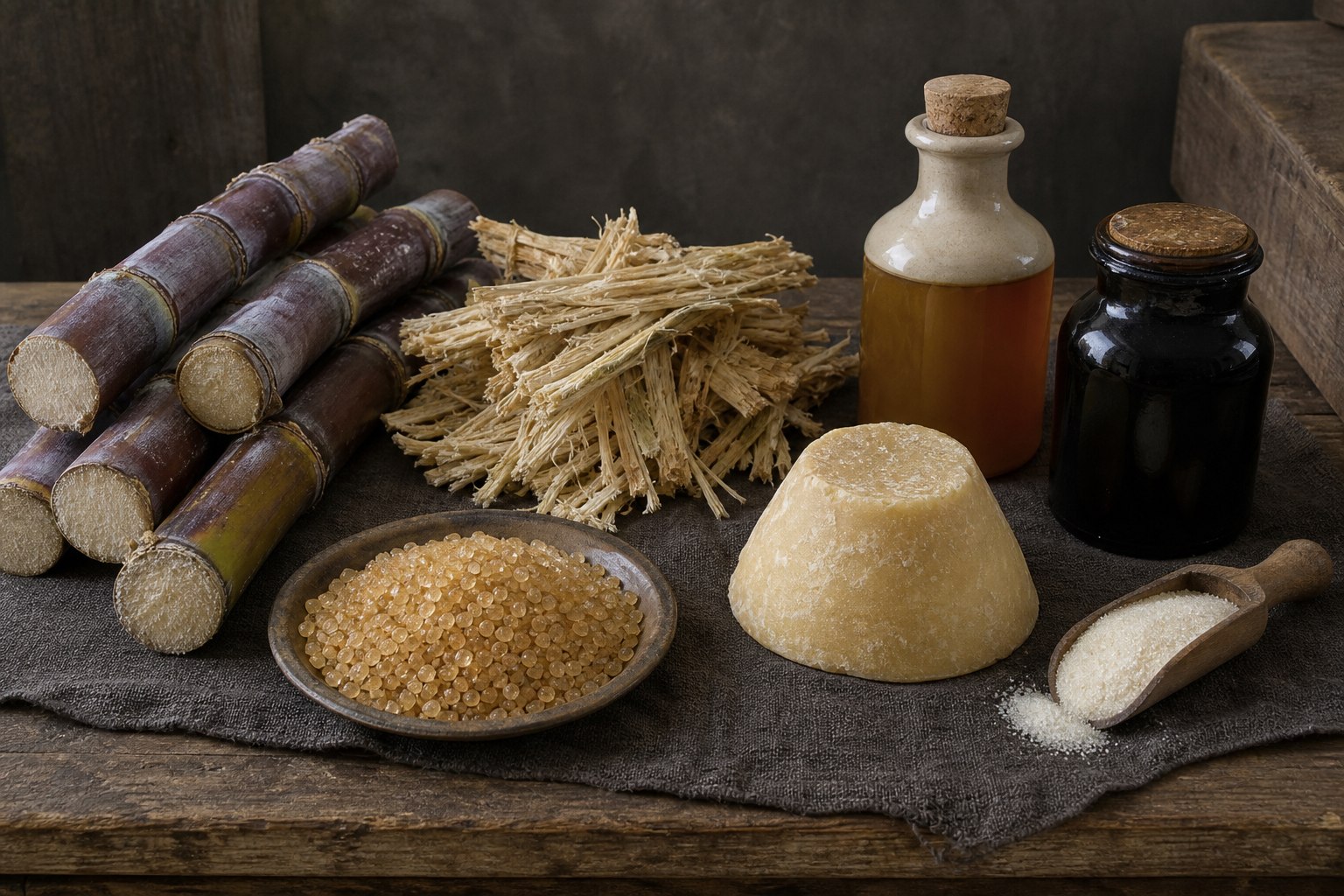
AI-generated visual reference: sugarcane → bagasse, contained syrup, and molasses → raw crystals, a sugar loaf, and refined crystals. It is not a historical photograph, food-safety standard, or crystallization endpoint.
Why it matters
Refined sugar was a luxury medicine-grade commodity in Europe for centuries. It's also a preservative (jam, candied fruit), the feedstock for wine and spirits, and pure stored calories. Crystalline sugar keeps indefinitely, unlike honey's competitors.
Where sugar comes from
| Source | Sugar content | Notes |
|---|---|---|
| Sugarcane | 12–17% of stalk weight | Best by far. Needs tropical/subtropical climate, lots of water |
| Sugar beet | 15–20% | Temperate climate. Needs selective breeding — wild beets are ~4% |
| Sweet sorghum | 10–15% | Hardy, drought-tolerant, temperate — but syrups mostly, crystallizes poorly |
| Maple sap | 2–3% | Cold-climate; 40 litres of sap per litre of syrup |
| Date/palm sap | 10–15% | Tap the flower stalk; the traditional Asian jaggery source |
| Honey | ~80% sugar already | Not crystallizable to white sugar, but zero processing |
If you land in the tropics, grow cane. If you land in temperate Europe, your realistic near-term options are honey and palm/maple, and your long-term project is selectively breeding fodder beets for sugar content — that's exactly what happened historically (Marggraf identified beet sugar in 1747; Achard bred it into a crop by 1801), and it took decades of selection.
The process, in outline
cane
 ↓ crush/press
raw juice (dirty, green, acidic)
 ↓ heat + lime  → clarification
clear juice
 ↓ evaporate in stages
thick syrup
 ↓ cool + seed
massecuite (crystals in molasses)
 ↓ drain/spin
raw sugar + molasses
 ↓ wash / re-dissolve / re-crystallize
refined sugar
Step 1: Extract the juice
Cut cane and process it within a day or two — cut cane starts inverting its sucrose into glucose and fructose, which will not crystallize. Freshness is a real yield issue.
Pressing:
- Simplest: pound the cane in a mortar and squeeze the pulp in a cloth. Very low yield.
- Three-roller vertical mill — three wooden or iron rollers geared together, turned by animals, water, or wind. Cane is fed through twice. This design (16th century) is the workhorse and is buildable with good carpentry and simple gearing.
- Milling twice with water added (imbibition) between passes extracts far more sugar. Free efficiency gain.
Expect to get 50–70% of the available sugar with a good mill. The fibrous residue (bagasse) is dried and burned as the fuel for the evaporation pans — the operation is nearly fuel self-sufficient, which is the key economic insight.
Guard every roller nip, gear, belt, shaft, and power take-off; use a feed table and tool that keep hands out of the intake, provide a reachable emergency stop, and lock out all energy before clearing cane or cleaning. Do not wear loose clothing around the mill.
Step 2: Clarify with lime — the critical step
Raw cane juice is grey-green, cloudy with soil, wax, protein, and plant gums, and slightly acidic. Left alone, it makes dark, sticky, non-crystallizing goo.
Heat the juice under the selected clarification process.
Use identified food-grade calcium hydroxide of known purity and a validated dose for the measured juice composition. Calibrate a suitable pH instrument, record juice pH and titratable acidity where the process requires it, add diluted milk of lime in measured increments with mixing, and stop at the process-specific target. Home-burned or construction lime can introduce metals, grit, excess magnesium, or other contaminants and is not food-grade.
Flocculation—the cloudy juice becoming clearer while scum separates—is a useful process observation, not a food-safety or pH endpoint. Lime demand varies with cane, soil, harvest, storage, and process. Too much lime can darken the juice, damage flavor, and impair crystallization; too little may leave clarification poor. Prove the schedule on representative small lots.
Heat to boiling. A thick scum of coagulated protein, wax, and calcium phosphate rises. Skim it all off. Continue until no more scum forms.
Let it settle, then decant or filter the clear amber juice off the mud.
This is defecation (the historical term), and it is the difference between grey sludge and clean crystals. If you take one thing from this guide: lime, heat, skim.
Optional further whitening:
- Filter through charcoal — bone char (calcined bone) is the best decolorizer and was the industry standard; wood charcoal works less well. This is what makes sugar truly white.
- Clay claying: cover a cone of raw sugar with wet clay; water percolating down washes molasses off the crystals. The traditional method, invented in the Islamic world, and it needs no charcoal at all.
Char, clay, filter cloth, and every other food-contact aid must be made from a traceable food-compatible source and checked for lead, arsenic, pathogens, cleaning residues, and other relevant contaminants. Unknown ash, bone, or clay can make a whiter-looking but unsafe product.
Step 3: Evaporate in stages
Historically a battery of pans ("the Jamaica train") in decreasing size over one long fire, hottest at the small end. Juice is ladled from pan to pan as it thickens.
Why staged rather than one big pot: sugar caramelizes and inverts if held hot too long, especially once concentrated. Staging keeps the concentrated syrup in contact with high heat only briefly. Boil hard and fast at the start, gently at the end.
Use a calibrated thermometer suited to hot syrup and the validated process endpoint. Historical stage names remain useful, but never touch or draw hot syrup between fingers: it adheres to skin and causes deep burns. If a thermometer is unavailable, move a small sample with a long-handled spoon or tongs into cold water and assess it only after it has cooled:
- Thread: a cooled sample draws a thread. Not ready.
- Pearl / smooth: forms a soft ball when dropped in cold water (~112–115°C). This is roughly your crystallization point for raw sugar.
- Soft/hard crack: brittle threads in cold water (~140–155°C). Too far for sugar; this is candy territory.
Skim continuously. Adding a tiny amount of fat or oil controls foaming — a real trick, since a boil-over loses the batch and burns people.
Use stable guarded platforms, long-handled tools, heat/splash protection, a controlled transfer path, and pans with overflow and emergency shutdown provisions. Keep workers out of steam and splash zones. All pans, pipes, ladles, glazes, joints, and storage vessels must be food-compatible; acidic juice and concentration can extract lead or other metals from unsuitable equipment.
Step 4: Crystallize
- Take the syrup off the heat at the "pearl" stage — supersaturated but not burnt.
- Seed it: stir in a small amount of powdered sugar from a previous batch, or simply stir vigorously as it cools. Seeding is what gives you many small crystals instead of one unpredictable mass.
- Cool slowly and stir. Slow cooling with agitation grows large, clean crystals; fast cooling gives a fine, sticky mass. You now have massecuite — crystals suspended in molasses.
- Separate the crystals from the molasses. Options:
- Drain in a cone mold with a hole at the bottom (the classic sugarloaf). Molasses drips out over days to weeks. Slow but needs nothing.
- Drain in a cloth bag under gentle pressure.
- A purpose-designed centrifuge if you have controlled rotary power. Its bowl, cover/interlock, anchoring, balance, overspeed protection, braking, and lockout must be engineered; an improvised high-speed basket can fragment lethally.
Step 5: Refine
Raw sugar is brown because a film of molasses coats each crystal. To refine:
- Wash the crystals with a small amount of saturated sugar syrup or cold water (not much — you'll dissolve your product).
- Or fully re-dissolve, re-clarify with lime and charcoal, and re-crystallize. Each cycle is whiter. Two or three cycles gives genuinely white sugar.
Don't discard the molasses. It can be food or fermentation feedstock after food-safety release. Livestock use is not automatic: composition, minerals, contaminants, spoilage, species, life stage, and ration inclusion need feed or veterinary review. Molasses was a major co-product of the colonial sugar trade.
Failure modes
| Symptom | Cause | Fix |
|---|---|---|
| Syrup never crystallizes, stays sticky | Sucrose inverted to glucose/fructose | It cannot be converted back by neutralizing; salvage only through a validated syrup/fermentation use and correct freshness, pH, and heat next batch |
| Dark, burnt, bitter product | Caramelized — held hot too long | Staged pans, hard fast boil early, gentle at end |
| Grey, muddy sugar | Raw material, clarification, filtration, contamination, or process control failed | Quarantine the lot and diagnose measurements/materials; repeat only with food-grade aids and a validated clarification/filtration schedule |
| Dark or alkaline-tasting product | Lime dose, pH control, heating, contamination, or degradation may be wrong | Do not neutralize or release by taste; quarantine and analyze the lot, then correct the measured process next batch |
| Fine sticky mass instead of crystals | Cooled too fast, no seed | Seed with sugar dust; cool slowly with stirring |
| Batch boils over | Fill, heat rate, geometry, solids, foam control, or operator response failed | Stop heat remotely and exclude the splash zone; redesign fill/heat/overflow controls and use only a validated food-compatible antifoam when specified |
| Terrible yield | Poor extraction | Mill twice with water between passes |
Era notes
Sugarcane was domesticated in New Guinea, crystallized sugar first made in India around the 4th–5th century CE (śarkarā — the root of "sugar," "sucre," and "Zucker"), and the refining technology spread west with the Islamic world. It reached Europe as a spice-priced medicine. Everything needed — a press, lime, pans, fire — exists in the Bronze Age; again, the barrier is knowledge, chiefly the whole agricultural, milling, clarification, evaporation, crystallization, fuel, labor, and quality-control system rather than one secret step.
One honest caveat: sugar production is historically inseparable from plantation slavery, because the labor demand at harvest is brutal and unrelenting — cane must be cut, milled, and boiled within days. If you're building this, build the mill and the mechanical power first. Water-powered milling and staged evaporation cut the labor requirement enormously, and that's a place where arriving with modern engineering knowledge actually matters.
Sources and limits
- OSHA's machine-guarding overview covers nip points, rotating parts, and power-transmission hazards relevant to cane mills and centrifuges.
- OSHA's lead safety overview explains why lead in vessels, glazes, joints, dust, and take-home contamination requires strict exclusion and control.
- Food-grade processing aids, food-contact materials, clarification targets, release testing, worker protection, and animal-feed use require a validated process and applicable local food/feed rules. The quantities and stages here are historical orientation, not a commercial release specification.