Food Preservation
Difficulty: easy. The highest survival return of anything in this repo. Prerequisites: salt, pottery, fire.
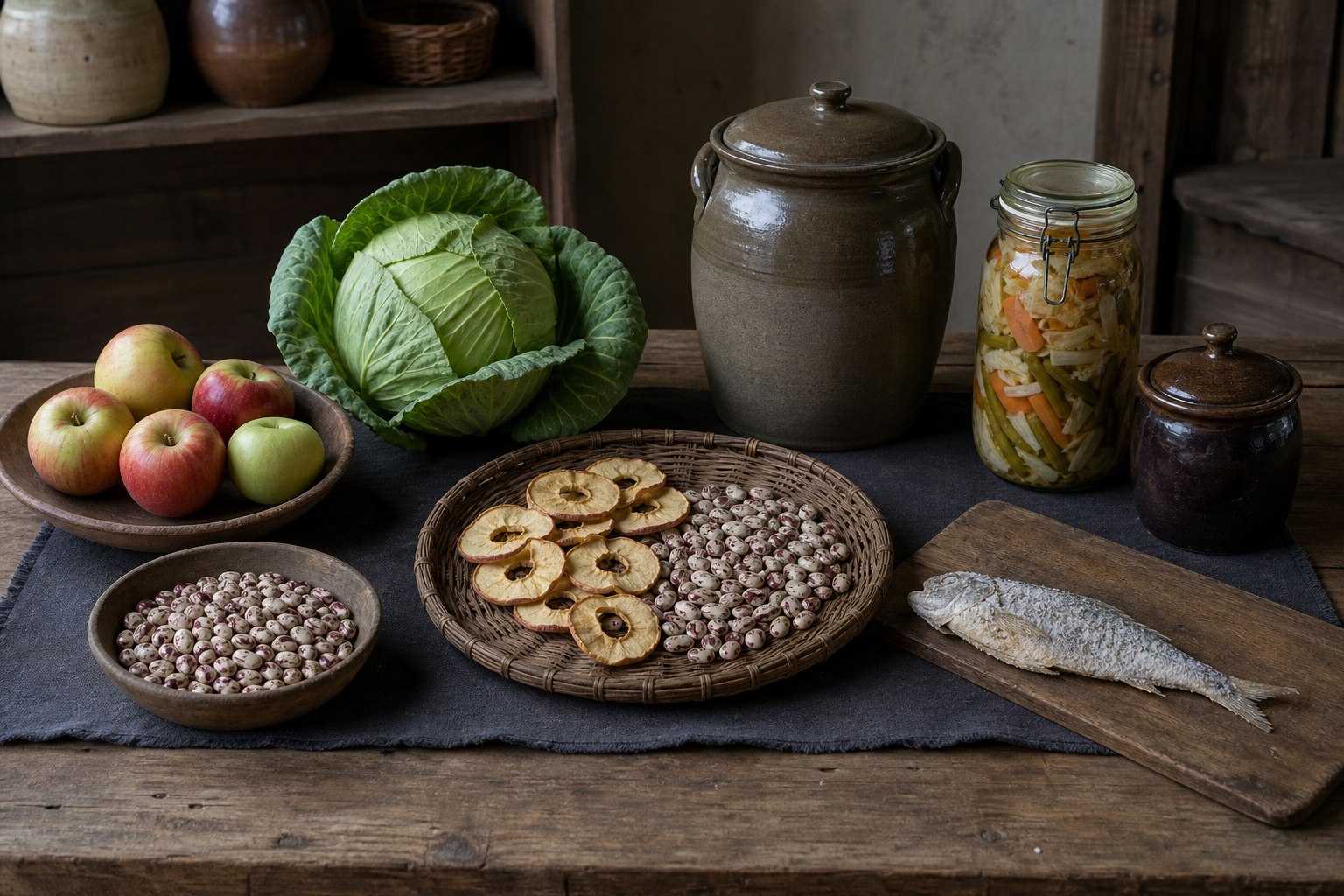
AI-generated visual reference: fresh foods → dried, salted, fermented, pickled, and sugared examples. It is not a historical photograph, validated recipe, spoilage test, or proof that any product is safe or shelf-stable.
Why it matters
Pre-industrial famine was rarely about a year with no food. It was about food arriving all at once — harvest, slaughter season, a fish run — and then rotting. Preservation converts a glut into a year's supply, and it's the difference between surviving winter comfortably and the "hungry gap" of late spring that killed people annually across Europe.
It also enables everything else: armies, ships, cities, and trade all run on food that keeps.
The five mechanisms
Everything below is one of these. Understanding which one you're using tells you what will go wrong.
- Remove water — microbes need free water. Drying, salting, sugaring.
- Make it acidic — most pathogens can't grow below about pH 4.6. Fermenting, pickling in vinegar.
- Make it cold — slows everything. Cellars, ice, snow.
- Control oxygen deliberately — excluding it slows many spoilage organisms but favors dangerous anaerobes unless acidity, water activity, temperature, or a validated heat process provides the real barrier.
- Kill what's in it and keep new arrivals out — heat plus a seal. Canning.
Most good methods stack two or three. Salted, smoked, and dried fish uses three.
Drying — the oldest and cheapest
Water activity below roughly 0.6 stops microbial growth entirely.
- Sun drying — thin slices on racks in full sun with airflow, brought in at night so dew doesn't rewet them. Works well in hot dry climates; poor in humid ones, where food spoils before it dries.
- Air drying — hanging in a well-ventilated, shaded, dry place. Alpine and Nordic staple. Wind matters more than heat.
- Fire/smoke drying — over a low smoky fire. Works in any climate and adds antimicrobial preservation (below).
- Freeze drying — the Andean chuño method: leave potatoes out to freeze overnight, tread out the water by day, repeat for several days. The result stores for years. Genuinely brilliant, and completely free where nights freeze and days are sunny.
Key rules: slice thin and uniform, keep airflow constant, and dry fast enough that spoilage doesn't get ahead of you. Case hardening — a dry sealed skin over a wet interior — rots from the inside; dry cooler and slower to avoid it. Store finished dried food sealed against moisture and insects.
Salting
Salt draws water out osmotically and directly inhibits microbes. See salt for making it.
- Dry salting / dry curing — traditional products use controlled salt application, time, temperature, humidity, thickness, and drying targets. “Percentage salt added” is not the same as final salt concentration or water activity inside the food.
- Brining / wet curing — submerge in strong brine (a brine that floats an egg is the traditional benchmark, roughly 20%). Faster and more even; the meat stays softer.
- Equilibrium curing — a modern method that calculates salt against the entire meat-plus-water system. It still needs an accurate scale, refrigeration, hygienic handling, a validated formula for the exact product, and enough time for a cut of known thickness; it is not a room-temperature safety shortcut.
Desalting before eating: heavily salted food is soaked in several changes of fresh water. Plan for this — salt fish that can't be desalted is inedible.
Nitrate and nitrite in cures. They are controlled hurdles in many traditional cured meats, alongside salt, acidity, drying, temperature, and sometimes heat. Safe limits are product- and process-specific and are measured in parts per million of the meat block—not as “a pinch” or a fraction of the salt. Do not put homemade saltpeter, unknown-purity nitrate, or hand-measured nitrite into food. Use only standardized food-grade premixed cure, an accurate scale, and a validated formula from a competent food-safety authority. Without those, choose a different preservation method.
Slaughter season, and therefore how much of this you need to do at once, is set by winter fodder — see animal husbandry.
Smoking
Smoke deposits phenols, formaldehyde, and acids that are genuinely antimicrobial and antioxidant, and it dries the surface at the same time.
- Cold smoking (below ~30°C) adds flavor and some surface drying but does not cook the food. Salting first does not by itself validate a shelf-stable product; a tested cure/dry process and controlled temperature are required.
- Hot smoking cooks only when the coldest point reaches a validated safe time-temperature combination. Smoking does not automatically grant weeks of storage.
Use hardwoods — oak, beech, alder, fruitwoods. Avoid resinous softwoods (pine, spruce); they deposit soot and bitter resins. Never use painted, treated, or unknown wood.
Heavily smoked diets correlate with elevated stomach cancer rates historically, from polycyclic aromatic hydrocarbons. It's a real trade-off but a favorable one against starving — just don't make everything you eat heavily smoked.
Lacto-fermentation — the best method nobody expects
This is the highest-value technique on this page. It requires no fuel, no special equipment, and no rare ingredient, and it increases the nutritional value of the food.
How it works: vegetables can carry lactic-acid bacteria on their surfaces. With the right salt basis, temperature, oxygen control, sound produce, and time, acid production can suppress important hazards. A target below pH 4.6 addresses C. botulinum growth; it does not mean “nothing dangerous exists,” and pH must be measured with a suitable method when safety depends on it. Yeasts and molds can still grow, and some pathogens can survive without multiplying.
Method — this is genuinely all of it:
- Chop or shred the vegetable.
- Add salt: either 2% by weight and let the vegetable's own juice form the brine (cabbage → sauerkraut), or submerge in a 3–5% brine (cucumbers, whole vegetables).
- Keep everything under the liquid. Weight it down with a stone or a water-filled bag. Anything above the surface molds.
- Follow a validated vegetable-specific salt basis and temperature range, keep the vessel clean, and verify acidification rather than relying only on bubbles.
- Move the finished ferment to genuinely cold storage. Discard batches with fuzzy mold, putrid odor, unexpected slime, or failed acidification; do not taste them to decide.
What you get: sauerkraut, kimchi, pickles, preserved lemons, olives (which need this or lye treatment to be edible at all), and fermented fish and grain pastes. Also yoghurt, cheese, and sourdough bread by the same principle.
The scurvy connection. Fermented cabbage retains and even concentrates vitamin C, and unlike fresh vegetables it survives a sea voyage. James Cook carried sauerkraut and lost no one to scurvy on a three-year voyage at a time when scurvy routinely killed more sailors than combat. Knowing why — that fresh plant food contains something essential that heat and time destroy — is enormously valuable knowledge to arrive with, even without knowing the molecule.
Sugar and honey preserving
High sugar concentration binds water just as salt does.
- Honey is resistant to many forms of spoilage in its undiluted state — low water activity, acidic, and it generates trace hydrogen peroxide. Properly stored honey keeps for years without spoiling. (The popular claim that honey from Egyptian tombs was still edible is folklore with no published analysis behind it — where tomb honey has actually been examined it is a degraded, tarry residue. The chemistry is real; the anecdote isn't.) Adding moist food dilutes honey at its surface, so submerging meat or fruit is not a validated preservation process.
- Jam and preserves — boil fruit with roughly its own weight of sugar until it sets. Needs the fruit's pectin and acid; add sour apples or citrus if the fruit is low in both.
- Candying — repeatedly soak fruit in progressively stronger syrup until the sugar replaces the water entirely.
- Fruit leather — purée and dry in sheets. No sugar needed at all.
Fat sealing and confit
Read the botulism warning below before using this section. Fat sealing creates exactly the anaerobic, low-acid conditions Clostridium botulinum wants. It is a traditional method that works, but it works because of the salt, the cold, and the short storage life — not because the fat is a barrier. Fat excludes air, and excluding air is the danger, not the protection.
- Confit — salt-cure the meat first (this step is not optional and is the actual preservative), rinse it, cook it slowly submerged in its own fat, then pack it under fat only as part of a validated process. Keep it at a verified refrigeration temperature of 4°C or below; an ordinary root cellar, described below as 4–10°C, does not qualify. Without reliable refrigeration and a validated cure, do not store fat-sealed meat for months.
- Pemmican — dried lean meat pounded to powder and mixed with rendered fat. It can be durable when the meat is thoroughly dried, moisture is excluded, and the product stays cool, but rancidity, residual moisture, and contamination still limit it. A ratio alone does not establish shelf life.
- Potted meat — cooked meat packed into a pot under clarified butter. Same rules as confit: cure it, keep it cold, eat it soon.
Cold storage
- Root cellar — dig into a hillside or below the frost line. Earth holds 4–10°C year-round with high humidity. Roots, apples, cabbages, and beer all keep for months. This costs only labor and is the highest-value hole you will ever dig.
- Clamping — pile root vegetables on straw, cover with more straw and then earth. A field-expedient cellar.
- Ice houses — cut ice from ponds in winter, pack it in a deep insulated pit with straw or sawdust, and it lasts through summer. The Persian yakhchāl did this in a desert using thick insulated domes, deep pits, and evaporative cooling from wind catchers. If ice can be stored in central Iran, it can be stored anywhere with a cold night.
- Evaporative cooling — a wet cloth over a porous pot in moving dry air drops the contents several degrees below ambient. Free refrigeration in dry climates.
Canning — worth knowing, worth respecting
Nicolas Appert worked this out in 1809, decades before anyone knew why it worked. Modern shelf-stable canning is a validated combination of food acidity and composition, container size, fill method, headspace, closure, temperature, pressure, processing time, cooling, and altitude. “Heat thoroughly and seal hot” is not a process schedule.
If purpose-made jars and lids plus a tested recipe and processing schedule are not available, do not shelf-can food. Cork, wax, leather, and an improvised ground-glass stopper do not provide a modern validated closure. Use drying, salting, or a controlled fermentation instead.
The botulism warning, and please take this one seriously. Clostridium botulinum grows in exactly the conditions canning creates: sealed, wet, oxygen-free, and not acidic. It produces the most potent toxin known, it is odorless and tasteless, and it does not make the food look or smell spoiled. Boiling water (100°C) does not kill the spores.
High-acid foods still require a tested boiling-water process for the exact recipe, jar, altitude, and pack. Tomatoes vary and must not be assumed to be below pH 4.6. Low-acid foods (meat, beans, seafood, and most vegetables) require a tested pressure-canning schedule, commonly at 116–121°C depending on pressure and altitude; merely reaching a temperature once is not enough. Building or operating an improvised pressure vessel is itself an explosion hazard. Preserve those foods by another validated method if proper canning equipment and schedules are unavailable.
The same warning applies to oil-packed vegetables, garlic-in-oil, fat-sealed confit and potted meats, and any other sealed anaerobic storage of low-acid food. A validated fermentation can control hazards through measured acidification, salt, temperature, and time; a validated cure or drying process can control them through salt concentration, water activity, temperature, and time. Neither the word “fermented” nor “salted” proves a batch safe, and simply sealing it is not safe at all. Traditional fat-sealed preparations require a validated cure and storage regime; the seal alone only excludes air and pests.
The practical test: ask what is stopping bacterial growth in this food. If the answer is "the lid," you have made a botulism incubator.
Preserving food is not the same as cooking it. Turning stored staples into daily meals — cooking methods, fuel economy, food safety without refrigeration, and the deficiency diseases that come from a monotonous staple — is in cooking and nutrition. And when the stores run out, see hunting, fishing, and wild food.
Grain and legume storage
The unglamorous foundation of every settled society.
- Dry it hard — below ~14% moisture. Grain stored damp heats, molds, and sprouts.
- Seal against pests — sealed pottery jars, lined pits, or raised granaries on staddle stones with overhanging caps that rats cannot climb past.
- Underground pits have been used successfully, but seal quality, grain moisture, drainage, and retrieval practice determine the result. A sealed pit can contain oxygen-deficient, CO₂-rich air: never put a head or body inside, ventilate from outside, and use a retrieval method that avoids entry.
- Watch for ergot — a purple-black fungal body replacing grain kernels, especially on rye in wet years. It causes convulsions, hallucinations, and gangrene, and it's implicated in several historical mass poisonings and possibly some witchcraft accusations. Sort visibly infected grain out, and don't eat rye from a wet harvest without checking. Sorting or flotation can reduce visible sclerotia but cannot certify a contaminated lot safe; reject suspect grain rather than using a crude screen as proof.
- Aflatoxin on damp-stored nuts, maize, and peanuts is a liver carcinogen. Dry storage prevents it. See also the mold warnings in soy sauce.
Failure modes
| Symptom | Cause | Fix |
|---|---|---|
| Dried food molds in storage | Not dried enough, packaged warm, or exposed to moisture | Verify a validated endpoint (ideally water activity), cool before packaging, and use a clean moisture-resistant package in cool, dry storage; “sealed with airflow” is a contradiction |
| Dried meat rots from the inside | Case hardening — sealed skin, wet core | Slice thinner, dry cooler and slower |
| Ferment grows fuzzy mold | Exposure, contamination, or failed process | Discard without tasting; correct submersion, sanitation, salt basis, and temperature next time |
| Ferment is slimy or smells putrid | Failed acidification, contamination, or wrong salt/temperature | Discard without tasting; use a validated recipe and verify acidification next time |
| Ferment is too sour to eat | Fermented too long/warm | Move to cold storage sooner |
| Pickles go soft and mushy | Too warm, or pectin-degrading enzymes | Cooler ferment; add tannin (oak/grape/horseradish leaf) |
| Salt-cured meat spoils in the middle | The cure, temperature, time, or drying process was not validated | Discard; do not inject surface contamination inward; use a tested product-specific process |
| Cured meat is inedibly salty | Over-salted | Soak in changes of water; use equilibrium curing next time |
| Jam won't set | Low pectin or low acid | Add sour apple, citrus, or unripe fruit |
| Sealed jar bulges or hisses | Active fermentation or gas-producing spoilage | Discard it. Do not taste-test a suspect seal |
Sources and limits
For shelf canning, use the National Center for Home Food Preservation guidance on safe process schedules and purpose-made jars and lids. USDA explains the pH 4.6 botulism threshold and why low-acid food requires pressure processing in its botulism guidance. USDA curing limits are process-specific and measured against the meat block; see the FSIS fermented, salt-cured, and dried products guideline. These modern references explain the safety boundary; they do not turn an improvised historical setup into a validated process.
Era notes
Every technique here except canning is prehistoric. Salting, drying, smoking, and fermenting are all older than agriculture.
Your knowledge advantages:
- Understanding the mechanisms — so you can combine them deliberately and diagnose failures, instead of following inherited recipes that work for reasons nobody knows.
- The botulism rule — acid or heat, never just a seal. This is knowledge that will directly save lives, because the failure mode is invisible.
- Fresh and fermented food prevents scurvy — worth more than any cargo on a long voyage.
- Equilibrium curing — measured salt beats guessed salt.
- Ice houses and root cellars — pure earth-moving, no technology, massive effect.
- Ergot and aflatoxin — knowing that specific molds on specific stored crops cause specific diseases turns a mysterious recurring plague into a solvable storage problem.