Saltpeter (Potassium Nitrate)
Difficulty: easy chemistry, but it takes 1–2 years of waiting. Prerequisites: basic chemicals (wood ash lye), manure, a roof, patience.
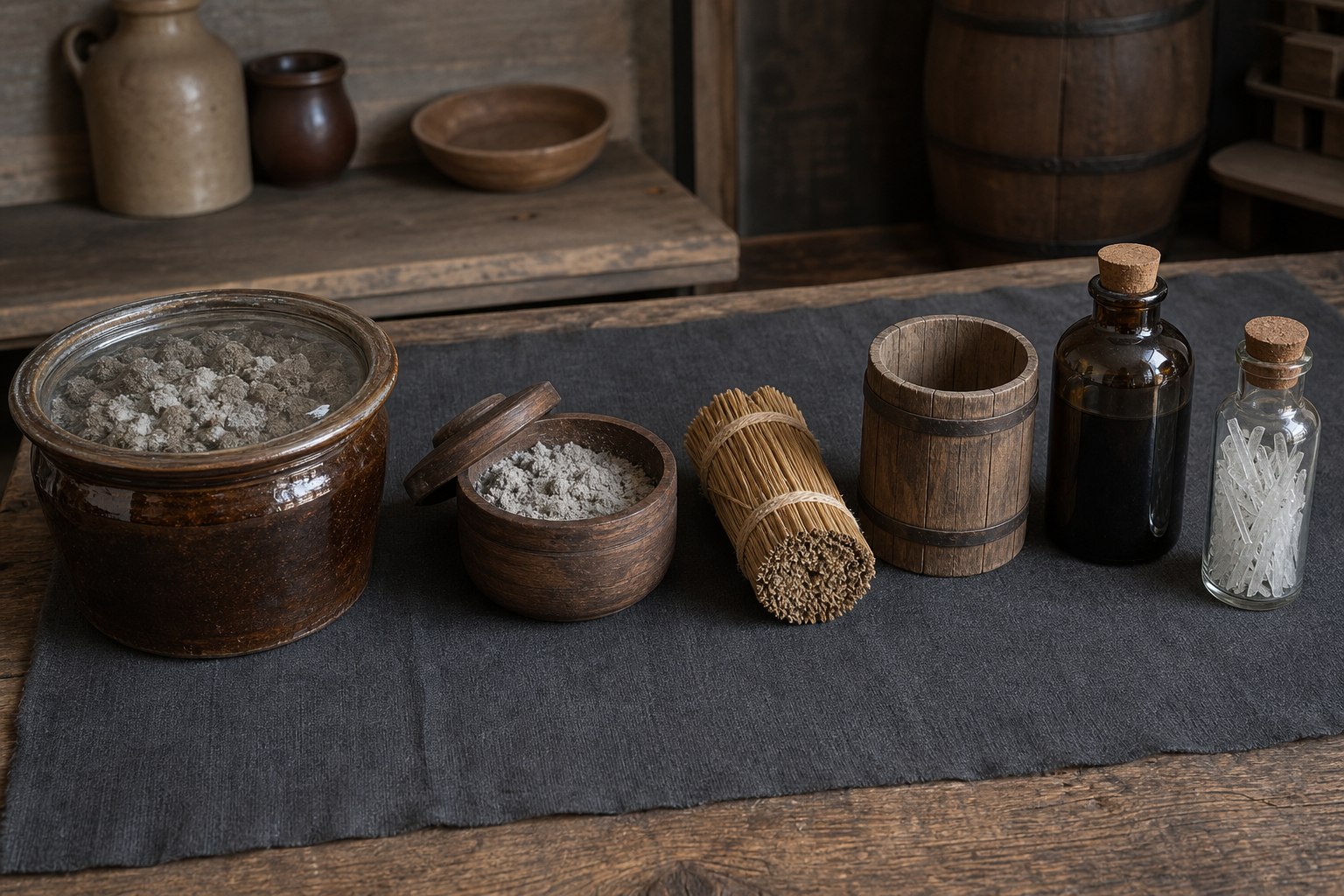
AI-generated visual reference: crude bed material and ash → dry leaching and filter components → sealed liquor and crystals. It is not a chemical-identity or purity test and does not depict food use, ignition testing, or explosives.
Scope note
Saltpeter is best known as the oxidizer in black powder. This guide does not cover making black powder — the milling and granulating steps are where people lose hands and eyes, and it isn't what this repo is for. What's below is a historical overview of nitrate production and non-food uses. Homemade product has unknown identity and purity and must not be used as a curing salt.
Why it matters
- Nitric acid. Distil saltpeter with sulfuric acid (see sulfur) and you get aqua fortis. Nitric acid dissolves silver but not gold, so it's the assayer's and refiner's essential reagent (see silver). Mixed with hydrochloric acid it becomes aqua regia, which dissolves gold. Nitric acid is also the gateway to a huge swathe of organic chemistry, dyes, and fertilizers.
- Fertilizer. Nitrogen limits many crops, but the response depends on crop, soil, water, other nutrients, and dose. Concentrated nitrate can burn plants and pollute water.
- Meat curing history. Food-grade nitrate or nitrite is one controlled hurdle in some validated cures, alongside salt, acidity, water activity, temperature, and heat. Safe limits are product-specific and measured in parts per million of meat—not by pinches of crude saltpeter.
- Fluxes and metallurgy. Saltpeter is a powerful oxidizer used to refine metals and to make glass and enamels.
The chemistry, in one paragraph
Decomposers release ammonium from protein, urine, and manure; nitrifying microorganisms then oxidize ammonium to nitrite and nitrate under suitable aerobic conditions. (Nitrogen fixation is a different process.) Nitrate is very soluble, so rain can leach it away. A historical niter bed concentrates nitrogen sources under managed moisture, air, and alkalinity, then deliberately leaches a mixed salt solution for further separation.
Route 1: Scraping natural deposits
The oldest source, and free if you have it.
Look for a white, fluffy, frost-like efflorescence on:
- The walls and floors of stables, byres, and sheepfolds
- The undersides of overhangs in caves used by bats or livestock
- Old cellars, latrine walls, and the earth under long-established dovecotes
- Dry-climate soils in India and Persia, where it forms naturally on the ground (this is why India was the world's saltpeter supplier for centuries)
Scrape it up and treat it as crude nitrate. Historically, "saltpetermen" had royal warrants to dig up other people's stable floors, which was as unpopular as it sounds.
Do not identify an unknown deposit by tasting it. Efflorescences can contain caustic, toxic, or biologically contaminated material. A small remote ignition test can show that a sample contains an oxidizer, but it does not establish that the compound is potassium nitrate or that it is pure; laboratory-style separation and multiple checks are still required.
Route 2: Niter beds (the reliable method)
This is deliberate manufacture. It's slow but it works anywhere.
Build the bed
Choose a spot that is sheltered from rain (a shed or a thatched roof over it) but open to air on the sides. The bacteria are aerobic; a sealed pit goes anaerobic and rots instead.
Build a heap roughly a metre deep on a floor of clay or stone that won't let liquid drain away.
Layer the following. Rough proportions by volume — a bed built by pure guesswork is a two-year mistake, so get these approximately right:
Component Share Purpose Manure ~50% The nitrogen source. Any herbivore dung; horse and sheep are traditional Straw, leaves, twigs, brush ~25% Keeps the heap open so air reaches the bacteria Soil or loam ~15% Body, moisture retention, and mineral surface for bacteria to colonize Wood ash or lime ~10% Keeps it alkaline, and supplies the potassium Material from an old bed a few shovelfuls Inoculant — carries the right bacteria Plus urine, poured on generously and repeatedly rather than layered in. It's the richest single input, and it was historically collected from households, breweries, and barracks by the barrel. Keep wetting the bed with it across the whole two years, not just at the start.
The ash or lime is the step people miss. Nitrifying bacteria need alkaline conditions; an acidic heap just rots and gives you nothing. The ash does double duty, because its potassium is what makes the product potassium nitrate rather than damp, useless calcium nitrate. If the heap ever smells sour or putrid rather than earthy, add more ash and turn it.
Keep it damp, never wet — like a wrung-out sponge. Water it with urine or dilute manure water when it dries.
Turn it every few weeks to admit air throughout.
Wait
One to two years. There is no shortcut; you are waiting on bacterial metabolism. Run several beds on a rotation, one maturing while another is building, so you get an annual harvest rather than a single windfall.
You'll know it's ready when white crystals appear on the surface of the heap and a sample flares on hot coals.
Extraction and refining
This is the same dissolve-filter-evaporate loop used throughout this repo.
Leach. Pack the matured bed material into a barrel with a straw filter and a drain hole. Pour water through slowly. Recirculate the liquor through fresh material several times to get a strong solution.
Convert calcium nitrate where present. Raw liquor is a variable mixture of nitrate, chloride, carbonate, calcium, magnesium, sodium, potassium, and biological contamination; do not assume one composition. Adding a controlled potassium-carbonate solution can precipitate calcium as chalk while leaving potassium nitrate in solution:
Ca(NO₃)₂ + K₂CO₃ → 2 KNO₃ + CaCO₃↓This conversion step is essential, and it's the difference between a damp useless sludge and a proper crystalline product.
Filter off the chalk and other insolubles through cloth.
Boil down. As the liquor concentrates, common salt (which is much less soluble in hot water relative to nitrate) crystallizes out first — skim it off and discard it while hot. This is the key separation and it exploits the opposite solubility behavior of the two salts.
Cool to crystallize. Potassium nitrate's solubility drops steeply as the solution cools, so it crystallizes out in long needles while the remaining salt stays dissolved. Harvest the crystals.
Recrystallize once or twice more for purity — dissolve in minimum hot water, filter, cool, harvest. Each pass is dramatically cleaner.
Dry the crystals gently. Store somewhere dry; it takes up moisture from humid air.
Yield expectation: modest. A large bed might give tens of kilograms after two years. This was always a laborious, low-yield industry, which is exactly why saltpeter was strategically valuable and why India's natural deposits mattered so much.
Uses worth setting up
Nitric acid
Historically, nitrate and concentrated sulfuric acid were heated in acid-resistant apparatus and nitric acid was condensed:
KNO₃ + H₂SO₄ → KHSO₄ + HNO₃↑
Specialist process—not a field recipe. Nitric acid causes deep burns, and nitrogen-oxide exposure can cause delayed life-threatening lung injury. “Outdoors and upwind” is not adequate process control. This requires compatible closed apparatus, engineered fume capture/scrubbing, remote handling, eye/face and chemical protection, emergency washing, and controlled waste. If those controls are unavailable, do not attempt it.
Meat curing
This page intentionally gives no food dose. Crude nitrate made from manure, soil, ash, and mixed salts is not food grade, and historical “small proportions” cannot be translated into a safe formula. Excess nitrate or nitrite can poison; too little can leave a hazardous process uncontrolled. Use only standardized food-grade premixed cure, an accurate scale, and a validated product-specific formula from a competent food-safety authority. Otherwise do not use nitrate or nitrite in food; see food preservation.
Fertilizer
Keep nitrate and niter-bed leachate out of wells and surface water. Nutrient need and safe application depend on crop, soil, area, growth stage, moisture, and the product's actual analysis. Use a small measured comparison plot and local agronomic knowledge; an unspecified “dilute” application can scorch crops or lose nitrate to water.
Legume–rhizobia symbioses can add biologically fixed nitrogen to a farming system, but the net benefit depends on compatible bacteria, soil pH and fertility, crop removal, and whether residues are retained. It is neither instant nor a permanent free increase. See agriculture and crop rotation for the full nutrient balance.
Failure modes
| Symptom | Cause | Fix |
|---|---|---|
| Bed rots and stinks, no crystals | Went anaerobic, or too acidic | Turn it for air; add ash or lime |
| Bed produces nothing after 2 years | Too dry, or rain leached it | Keep damp; roof it properly |
| Product is a damp sludge that won't crystallize | Calcium nitrate, not converted | Treat the liquor with wood ash lye |
| Crystals are cubic rather than needle-like | Common salt may dominate | Do not taste; repeat controlled fractional crystallization and identity checks |
| Crystals go damp in storage | Impure, or humid store | Recrystallize; store sealed and dry |
| Low yield from a good bed | Weak leaching | Recirculate liquor through fresh material |
Sources and limits
This guide describes historical chemistry, not analytical confirmation of a food- or reagent-grade product. For cured food, USDA's ready-to-eat fermented, salt-cured, and dried products guideline shows why nitrite/nitrate limits depend on the exact formulation and process. For nitrogen-oxide and nitric-acid hazards, see the NIOSH nitric acid IDLH documentation. Neither reference validates crude niter-bed material for ingestion.
Era notes
Saltpeter's deliberate production appears in Chinese alchemical texts by around the 9th century and in Arabic and European sources from the 13th. India's natural deposits made it a strategic export commodity for centuries, and the Chilean nitrate trade drove a war in the 1880s. Artificial nitrogen fixation (Haber–Bosch, 1909) ended the whole business and is arguably the most important invention of the 20th century — roughly half the nitrogen in your body today passed through that process.
Your realistic knowledge advantages here: keeping niter beds alkaline and aerobic on purpose rather than by folklore, the ash-lye conversion to potassium nitrate, exploiting the opposite solubility curves of salt and nitrate to separate them cleanly, and — worth more than all of it — legume rotation for nitrogen.